
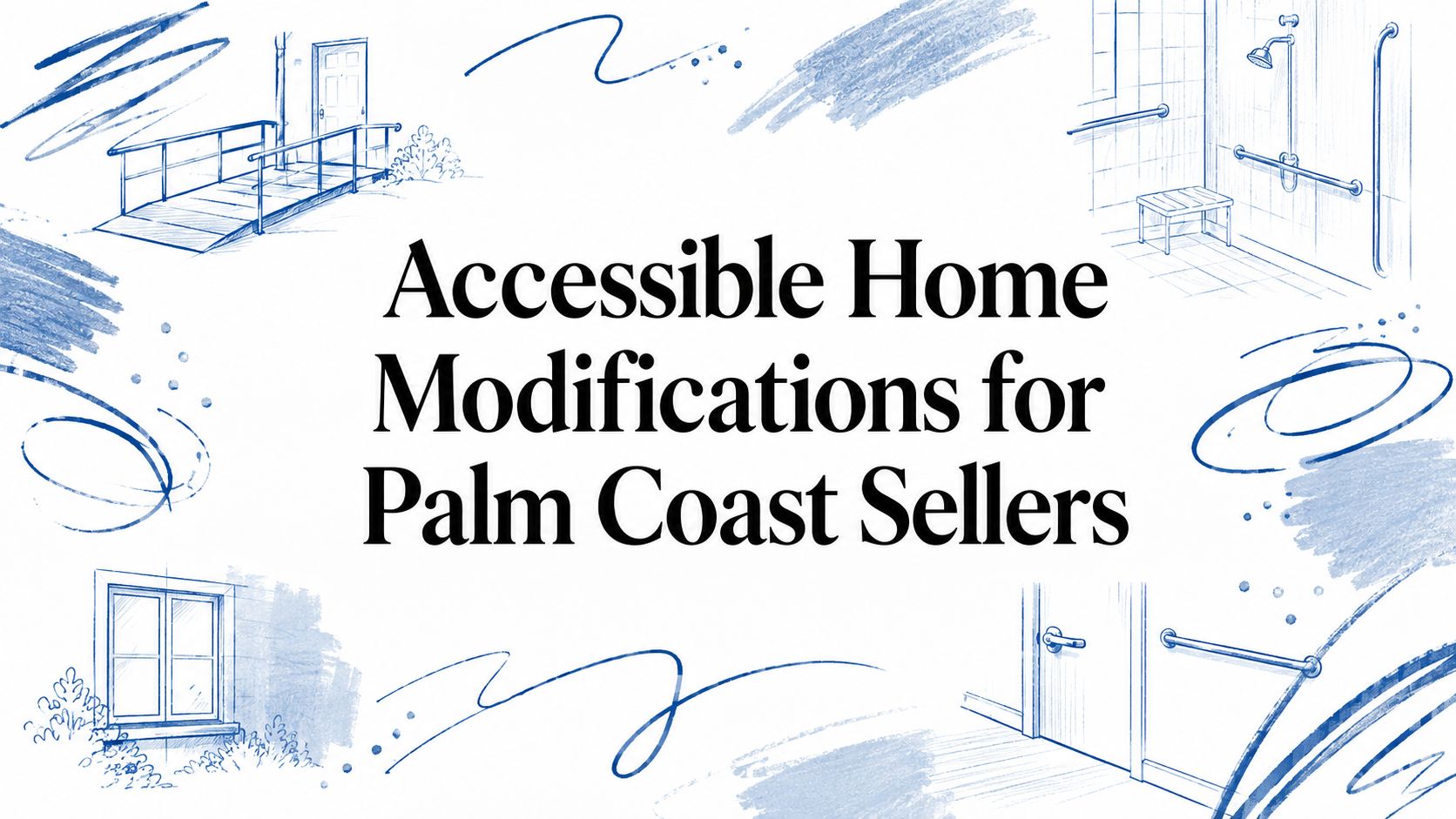
If you're getting ready to sell in Palm Coast or St. Augustine and wondering whether your home feels “easy enough” for today's buyers, that's a smart question to ask now. A house can show beautifully and still lose traction if the entry is awkward, the bathroom feels tight, or the layout makes everyday movement harder than it should be.
That comes up often with Palm Coast real estate, St. Augustine real estate, and older homes across Flagler County real estate. Buyers looking for long-term livability, 55+ convenience, or multigenerational flexibility often notice accessibility features right away, and so do buyers who are trying to avoid a future project. In Northeast Florida, accessible home modifications are no longer just about aging in place, they're part of a serious resale strategy.
Why Accessibility Matters for Today's Home Sellers
A homeowner can spend months on paint, landscaping, and staging, then hear the same feedback from showings, the entry feels tight, the bathroom is hard to use, or the house needs work before it fits their lifestyle. That's the moment accessibility stops being an abstract idea and becomes a pricing conversation.
The demand is broad enough to matter in nearly every local listing meeting. Harvard Joint Center for Housing Studies estimates that about 26 million U.S. households have some need for home accessibility features, and the 2019 American Housing Survey found 6.8 million households, about 5% of U.S. households, reported difficulty navigating or using their homes, with 4.2 million citing difficulty entering the home (Harvard Joint Center for Housing Studies). That's a big reason step-free entry, first-floor bathrooms, ramps, and grab bars keep showing up in conversations about Palm Coast home values and buyer demand.
What that means in a listing
In practical terms, buyers don't usually ask for “accessibility” as a category. They ask whether the home works for them now and later. That includes retired couples moving closer to family, absentee owners preparing a property for the market, and buyers relocating into St. Augustine housing market neighborhoods who want fewer barriers and less immediate renovation.
Practical rule: If a buyer has to picture a construction project before they can picture moving in, your pricing power slips.
That's why accessibility belongs in pre-listing planning. In Selling a home in Palm Coast, the smartest sellers focus first on the features that remove friction at the front door and in the bathroom, because those are the spaces buyers evaluate fastest.
The Most Impactful Accessible Home Modifications
The upgrades that matter most are the ones that solve the first points of resistance. If a buyer can't enter comfortably, move through the home easily, or use the bathroom without visualizing a remodel, the rest of the house has a harder time carrying the sale.

The clearest technical benchmark for circulation is a continuous accessible route. Canadian renovation guidance recommends a travel path at least 915 mm (36 in.) wide and entry doors with 915 mm clear width when fully open, while the newer Canadian Accessible-Ready Housing standard raises the benchmark to 1200 mm minimum interior width (Canadian guidance). Wider paths matter because they reduce the pinch points that make a renovated home still feel difficult to use.
The features buyers notice first
A zero-step entry is the strongest first impression because it removes the most obvious barrier. A ramp can help, but the geometry matters, and a 1:12 slope is the common benchmark, meaning 1 inch of rise needs 12 inches of ramp length (builder guidance). If the entrance feels awkward, the rest of the accessibility work loses value.
Bathrooms come next. A systematic review found that people with disabilities living in accessible home environments had better health, well-being, and ADL/IADL outcomes than people in conventional or inaccessible homes, and common modifications included grab bars, bathtub-to-shower changes, and updates at entrances, patios, doors, and stairways (NCBI review). In resale terms, that means a well-designed bathroom can help the home feel move-in ready instead of medically adapted.
Kitchen changes help most when they support function without making the home look specialized. Lowered counters, easier-reach storage, and clear floor space are useful, but they rarely beat entry and bathroom improvements for buyer impact.
Prioritized Modification Checklist for Resale Value
A seller with 30 days before listing should think differently than a homeowner with a six-month window. The first goal is to remove obvious objections. The second is to make the home feel broadly usable without overspending on niche features.

A seller's ranking order
- Zero-step entry. This is the upgrade most buyers understand immediately. If the front entrance still has a threshold or awkward transition, start here.
- Wider doorways. Door swings and tight halls are a common friction point. Once the circulation path is solved, the house feels more usable.
- Accessible bathroom. Grab bars, a safer shower setup, and non-slip flooring help the house show as thoughtful, not dated.
- Kitchen accessibility. This matters, but it's usually secondary to entry and bath changes for resale.
- Lighting and switches. Better reach and control help, especially in older homes and twilight showings.
- Flooring and hardware. Smooth, slip-resistant floors and lever handles are smart finishing touches.
For homeowners in Flagler Estates homes or older coastal properties, the right order depends on condition. A small threshold removal may deliver more buyer confidence than a half-finished bathroom project. A full doorway widening can be worth it if the house already has strong bones and you're listing in a market segment where buyers expect updates.
Practical rule: Spend first on anything a buyer would have to fix before move-in, not on features that only help after they've settled in.
The 2006 U.S. analysis of adults ages 52 and older showed that two-thirds had at least one assistive home feature, about one-third had added at least one, and 40% had used at least one in the previous 30 days (ASPE). That's a useful reminder that these upgrades aren't exotic, they're normal enough that buyers increasingly recognize them.
Comparing Quick Wins Against Larger Investments
Not every seller needs a remodel. Some homes just need a few visible changes that signal care, safety, and function. Others need structural work because the layout itself is the problem.
Here's the practical comparison most owners in Palm Coast and St. Augustine need before they decide where to spend.
| Modification | Estimated Cost | Timeline | Buyer Impact |
|---|---|---|---|
| Lever-style door handles | Low | Very fast | Easy cosmetic upgrade, small but noticeable |
| Grab bars in bath or shower | Low | Very fast | Strong safety signal, especially in 55+ showings |
| Threshold removal | Low to moderate | Fast | Helps with entry feel and daily movement |
| Ramps | Moderate | Fast to moderate | High value when the entrance is the main barrier |
| Bathroom remodel | Moderate to high | Longer | Big impact if the bath is the weak link |
| Doorway widening | Moderate to high | Longer | Helpful for flow and long-term usability |
For a seller on a short timeline, the quick wins are usually the right call. Lever handles, grab bars, and threshold work are the kind of improvements buyers notice without triggering a major construction mindset. They also keep the home from feeling overly specialized.
Larger investments make sense when the home is otherwise strong and the issue is clearly structural. A bathroom remodel can pay off in showing quality, but only if the execution is clean and the design still feels mainstream. A ramp or doorway widening is worth considering when the layout would otherwise turn away a significant share of buyers.
The deeper trade-off is this. Quick wins improve presentation. Larger investments improve function. In a neighborhood where buyers are comparing several homes in the same price band, the best choice is often the one that reduces objections without creating a project of its own.
Navigating Permits and Finding Local Contractors
Structural accessibility work needs to be handled carefully, because unpermitted changes can create more trouble than they solve. That matters in both Flagler County and St. Johns County, especially if the work affects doors, ramps, bathrooms, or any load-bearing changes.
What to verify before listing
- Permit history: Ask for copies of permits and final inspections for any significant modification.
- Code compliance: Confirm the work was completed to local standards, not just to the contractor's preference.
- Accessibility fit: Make sure the modification helps the next owner, not just the current one.
- Documentation: Keep invoices, scope details, and photos together for the buyer file.
The U.S. Administration for Community Living notes that home modifications can range from simple changes like replacing cabinet doorknobs with pull handles to larger construction such as ramps and widened doorways, and it lists wider doorways, clearer wheelchair pathways, lowered countertop heights, grab bars, and reachable switches and outlets as part of the accessibility toolkit (ACL). That's a good reminder that the right contractor should understand both the practical use of the feature and the code side of the job.
A strong local contractor won't just say a project is possible. They'll explain what the modification does to the flow of the home, whether the finish looks consistent with the rest of the property, and whether the work will stand up during inspection. If they can't speak clearly about those points, keep looking.
Staging and Marketing Accessible Features to Buyers
Once the work is done, presentation matters. Buyers in Palm Coast and St. Augustine don't want a home that feels clinical. They want one that feels open, thoughtful, and ready for real life.

The best listing photos show movement and ease. Leave paths clear, open doors where the wider opening is a selling point, and let natural light do some of the work. If the bathroom has a clean walk-in shower or the entry has a smooth transition, photograph it like a feature, not a utility upgrade.
The message in the listing should be simple and specific. Phrases like step-free entry, accessible bathroom, wide interior circulation, and main-level living help buyers understand the value immediately. Those terms are especially useful for 55+ buyers, relocating families, and people scanning Palm Coast real estate market trends for homes that won't require fast renovations.
The safest approach is to describe the benefits without overpromising. Accessibility features should read as part of a well-cared-for home, not as a medical installation. That balance helps the property appeal to a wider pool, including buyers who want flexibility now and resale confidence later.
Your Next Steps for a Stronger Listing
If you're planning to sell, start with the parts of the home that create friction at the front door, in the hallway, and in the bathroom. Those are the places where accessible home modifications tend to help resale most. Then decide whether you need quick cosmetic wins, a targeted bathroom update, or a more structural change before you list.
Keep the work grounded in buyer perception, not in trying to solve every possible need. A thoughtful, well-finished set of improvements usually performs better than a long list of mismatched upgrades. In Palm Coast real estate and St. Augustine real estate, the homes that show as easy to live in often feel easier to sell too.
Marilynn Wolfe, LLC helps homeowners in Palm Coast, St. Augustine, and Flagler County think through pre-listing improvements with a clear eye on market value and buyer appeal. If you'd like help deciding which accessible upgrades make sense before selling, visit Marilynn Wolfe, LLC or reach out for a personalized conversation about your home and your goals.