


A seller credit at closing is a negotiated contribution toward the buyer's eligible closing costs, while a price reduction lowers the contract price itself. Depending on the loan program, seller credits are commonly capped between 3% and 9% of the purchase price.
A buyer in Palm Coast or St. Augustine may be financially comfortable enough to qualify for a mortgage but still hesitate because cash-to-close expenses are substantial. A seller credit can address that obstacle without immediately changing the advertised price. The right choice depends on the buyer's financing, the home's appraisal position, your desired net proceeds, and the current balance between buyers and sellers.
For homeowners selling in Palm Coast, Flagler County, St. Augustine, or nearby communities, this distinction matters. A credit may keep a promising offer together, but it isn't automatically better than a price reduction. The strategy has to fit the transaction.
What Is a Seller Credit at Closing
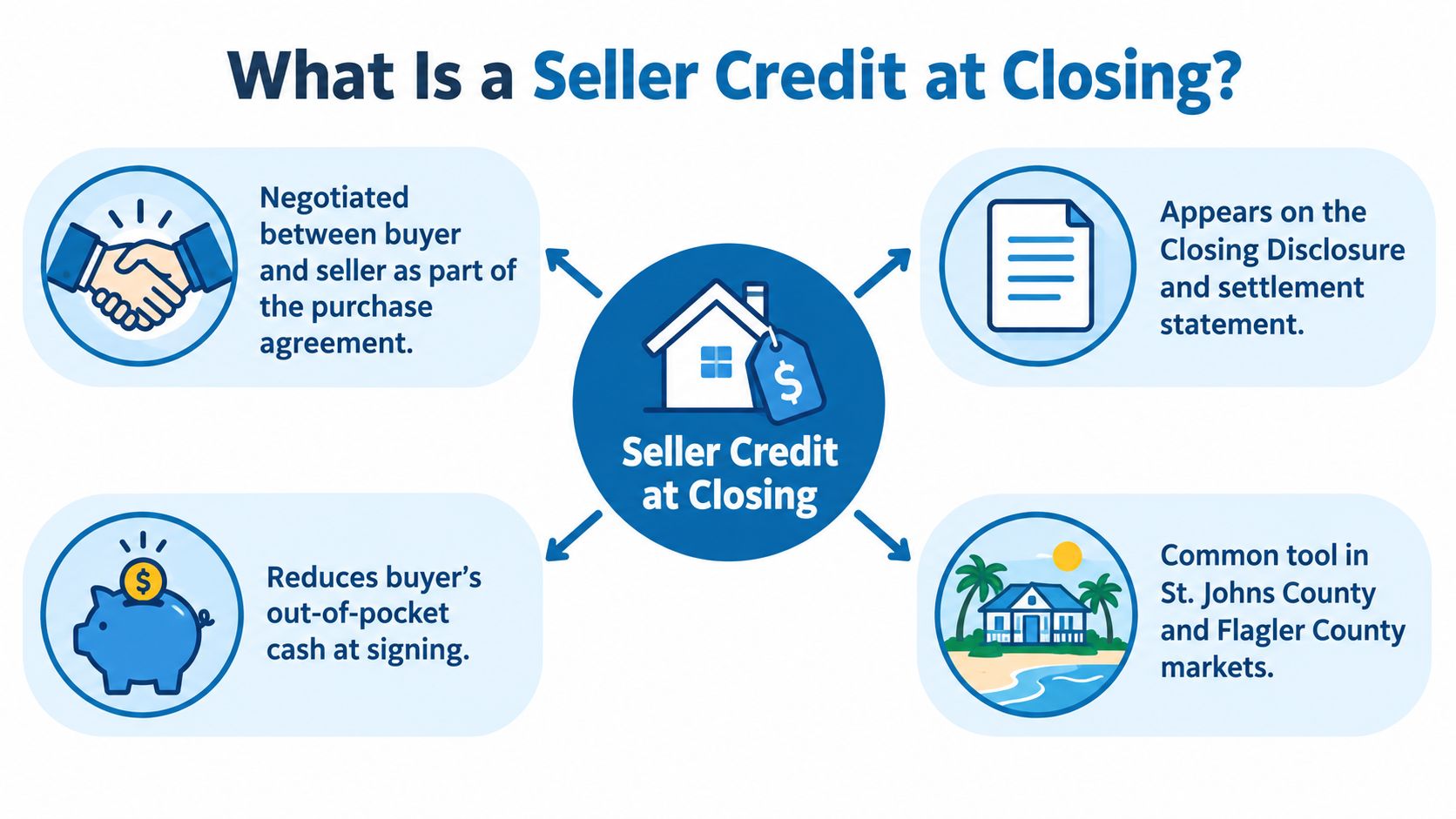
Suppose a buyer likes your Palm Coast home but asks for help with lender fees, prepaid expenses, or discount points. Instead of reducing the price, you might agree to provide a seller credit at closing, sometimes called a seller concession or seller contribution. The agreed amount appears in the purchase contract and is applied to the buyer's eligible costs at settlement.
The seller doesn't hand the buyer cash. The credit is documented through the closing process, reduces the buyer's cash due at signing, and is charged against the seller's proceeds. The contract price remains unchanged, which is the central difference between a credit and a price cut. A seller credit functions as a closing-cost mechanism rather than a direct price substitute.
What the credit can accomplish
For a buyer relocating to St. Augustine, purchasing new construction, or preserving savings for moving and immediate repairs, upfront cash may matter more than a modest change in the mortgage balance. A credit can potentially cover approved closing charges, prepaid expenses, and discount points, subject to the buyer's lender and loan rules.
For the seller, the benefit is flexibility. You can respond to a buyer's cash constraint while keeping the headline price intact. That can be useful when your pricing reflects recent Palm Coast home values and you don't want to make a broad price adjustment based on one buyer's financing needs.
The credit still has boundaries:
- It can't be used for the buyer's down payment under conventional, FHA, or VA financing.
- It can't exceed actual eligible costs. Any unused amount generally doesn't become cash back to the buyer.
- It must be approved by the lender and documented in the contract and closing disclosures.
- It may affect underwriting calculations, even when the contract price doesn't change.
Practical rule: Never agree to a credit before the buyer's lender confirms the permitted amount and the buyer's estimated eligible costs.
In Flagler Estates, Palm Coast, or St. Johns County, the same concept applies, but buyer expectations can vary by property type, condition, and competition. A credit is a negotiation tool, not a universal solution.
How Loan Types Limit Seller Credits
The buyer's loan program controls how much credit the seller can provide. Sellers don't need to become mortgage underwriters, but they do need to understand the limits before accepting a request.
Conventional financing
For conventional primary-residence and second-home purchases, seller-paid costs are commonly limited by the buyer's down payment. The conventional structure generally allows 3% when the buyer puts down less than 10%, 6% with 10% to less than 25% down, and 9% with 25% or more down, according to Fannie Mae's interested-party contribution guidance.
Investment properties are usually treated more restrictively, with seller concessions commonly limited to 2% of the purchase price, as summarized by Opendoor's seller-credit guidance. The buyer's occupancy and loan structure matter, so a seller shouldn't assume that the same credit works for a primary residence and a rental purchase.
Fannie Mae also requires the concession to be deducted from the contract sales price when calculating loan-to-value and combined loan-to-value. That means an oversized credit can affect underwriting eligibility even if the advertised purchase price remains unchanged.
FHA and USDA financing
FHA financing generally allows up to 6% of the purchase price or appraised value, whichever is lower, for permitted seller concessions. The credit may cover eligible closing costs, prepaid expenses, discount points, and certain financing charges, as explained by the National Association of REALTORS®.
USDA loans often allow seller contributions of up to 6%, but the buyer's lender must confirm the applicable rules and eligible charges before the offer is finalized.
VA financing
VA transactions require especially careful wording. Sellers can pay ordinary allowable closing costs without applying those costs to the same concession cap. Separate seller concessions are generally limited to 4% of the home's reasonable value, according to the U.S. Department of Veterans Affairs.
That distinction matters in Palm Coast and St. Augustine because “seller pays closing costs” and “seller concession” aren't always interchangeable terms in a VA transaction. The lender should identify which charges fall into each category.
The practical lesson is simple: determine the loan type, down payment, occupancy, appraised value, and actual closing costs before negotiating the amount. A credit that looks generous on paper may be unusable or may create an underwriting problem.
Seller Credit vs Price Reduction in Florida Sales
Sellers often compare a credit with a price reduction as though they produce the same result. They don't. A credit helps with upfront costs, while a price reduction changes the purchase price and usually affects the buyer's financing math more directly.
| Factor | Seller Credit | Price Reduction |
|---|---|---|
| Contract price | Stays the same | Decreases |
| Buyer cash to close | Can decrease for eligible costs | Usually changes less at the closing table unless the loan amount also changes |
| Monthly payment perception | May help if applied to discount points or a rate buydown | Directly lowers the financed amount and may reduce the payment |
| Appraisal | The contract price remains higher, so the appraisal must support that price | The lower price may be easier for the appraisal to support |
| Seller proceeds | Reduced by the credit amount and other settlement costs | Reduced by the price reduction |
| Best fit | Buyer is cash constrained or wants financing assistance | Comps are weak, the home is overpriced, or the buyer wants lasting payment relief |
A seller credit can be stronger when the buyer has enough funds for the down payment but needs help with closing costs or discount points. It may also help a seller compete with other Palm Coast listings without immediately resetting the home's headline price.
A price reduction can be better when the buyer's concern is the monthly payment, the appraisal is close to the contract price, or comparable sales don't support the current number. It also gives future buyers a clearer signal that the home's market price has changed.
The seller's net sheet should include both options. If a buyer proposes a higher price with a credit, the appraisal becomes a central risk. If the appraised value doesn't support the contract price, the parties may have to renegotiate, and the buyer may need additional cash.
A credit solves a cash-to-close problem. A price reduction solves a price problem. Don't use one as a substitute for the other without identifying the buyer's actual concern.
For a Palm Coast home, St. Augustine property, or Flagler Estates listing, I'd evaluate the offer as a complete package. Price, financing, appraisal strength, inspection terms, closing timeline, and the buyer's demonstrated ability to close all matter.
How a Seller Credit Appears on the Closing Statement
The credit starts in the purchase agreement. The contract should identify the amount and purpose clearly, then the buyer's lender and closing agent determine how the credit is applied to eligible charges.
Consider a Palm Coast sale with a $400,000 purchase price and a 3% seller credit. The credit equals $12,000, calculated from the purchase price. The price remains $400,000, but the seller's proceeds are reduced by the agreed credit, while the buyer's cash due at settlement is reduced by the amount that can be applied to eligible costs.
The buyer doesn't receive a check for unused funds. If the buyer's approved closing costs and other eligible charges are lower than the credit, the lender generally won't permit the excess to become cash back. The parties may need to adjust the credit or leave the unused amount unapplied, depending on the contract and lender instructions.
How the money is recorded
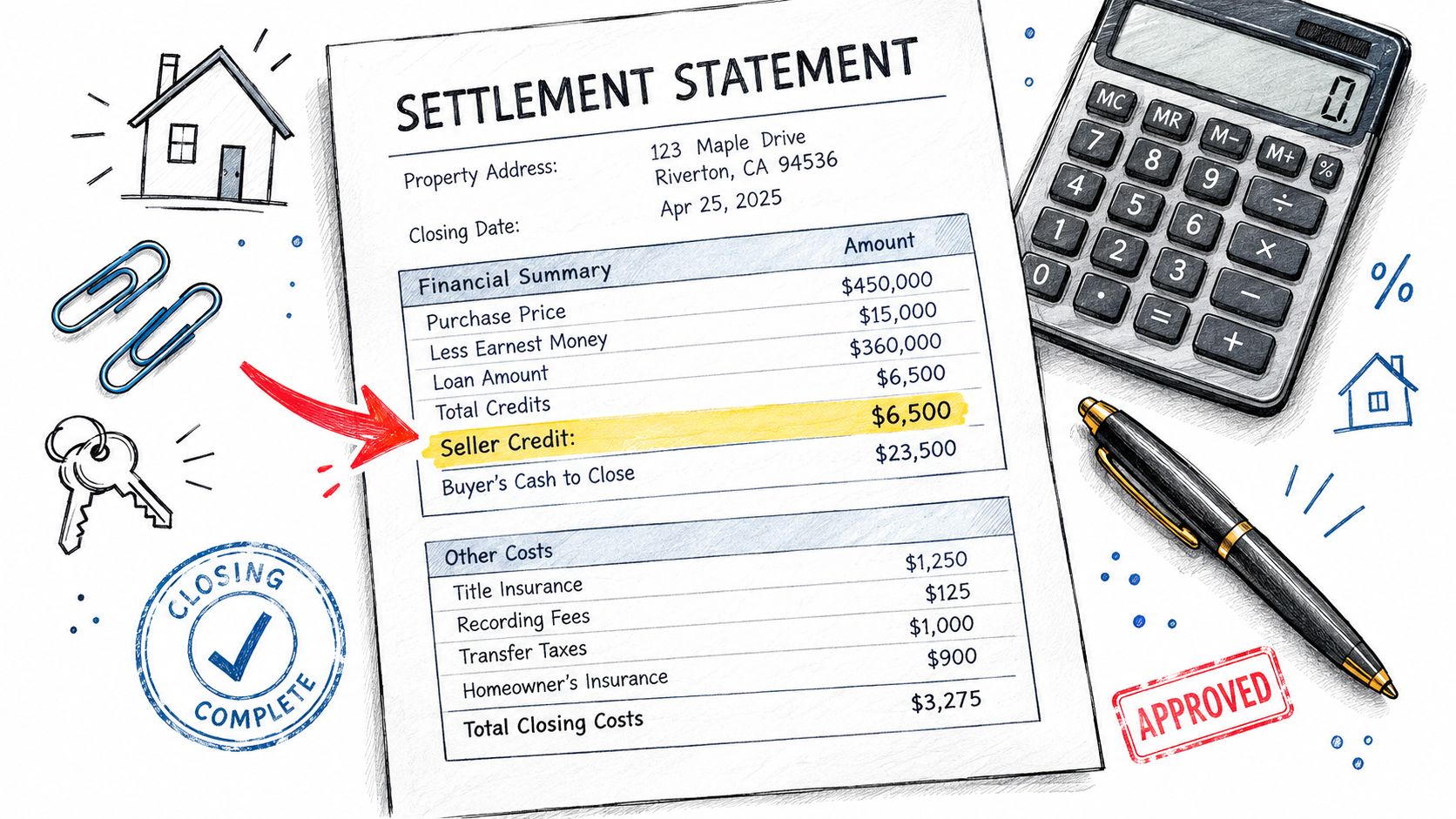
On the settlement statement, the seller credit appears as a debit against the seller's proceeds. On the buyer's side, it appears as a credit that reduces the amount the buyer must bring to closing.
The contract price itself doesn't change. That distinction can help preserve the recorded sale price for comparable-sale analysis, but it doesn't remove the seller's economic cost. Your net proceeds still reflect the credit.
The closing agent prepares the final figures, and the lender reviews the credit against the buyer's loan program and actual eligible expenses. Sellers should request the buyer's lender approval before treating the credit as final. A credit written casually into an offer can become a problem if the buyer's costs, loan type, or appraisal don't support it.
Why Seller Credits Matter More in 2026
Seller credits have become a more visible negotiation tool as buyers face affordability pressure. In May 2026, 46% of home sellers offered concessions, compared with 43% a year earlier, according to a Redfin-based report summarized by Tomo. Another recent national estimate placed the 2026 share at 27%, compared with 46% in the slower 2020 market, illustrating how incentives move with rates, inventory, and buyer purchasing power.
Recent national summaries have placed average seller concessions around 1.5% to 3% of the sale price. On a $400,000 home, that represents approximately $6,000 to $12,000 in potential closing-cost assistance, as detailed in Zillow's seller-credit explanation.
Those figures don't predict exactly what will happen in Palm Coast or St. Augustine. They do show why sellers should be prepared to discuss concessions rather than treating every credit request as unusual. Buyers may compare your listing with homes offering closing-cost help, repair allowances, or rate buydown assistance.
Where the strategy works
A credit can keep a qualified buyer engaged when the buyer has income and financing approval but limited liquid cash. It may also help a seller offer a temporary or permanent rate buydown without reducing the advertised price.
The strategy works best when the home is correctly priced, the appraisal has room, and the buyer's lender has confirmed the credit can be used. It works poorly when the seller offers more than the buyer can apply or when the credit disguises a price that comparable sales don't support.
In metro markets where concessions and rate buydowns are returning, sellers need to compare the full cost of each incentive. The smarter option isn't always the one that protects the headline price. It's the one that attracts a capable buyer while preserving a reasonable net.
Negotiation Tips for Palm Coast and St. Augustine Sellers
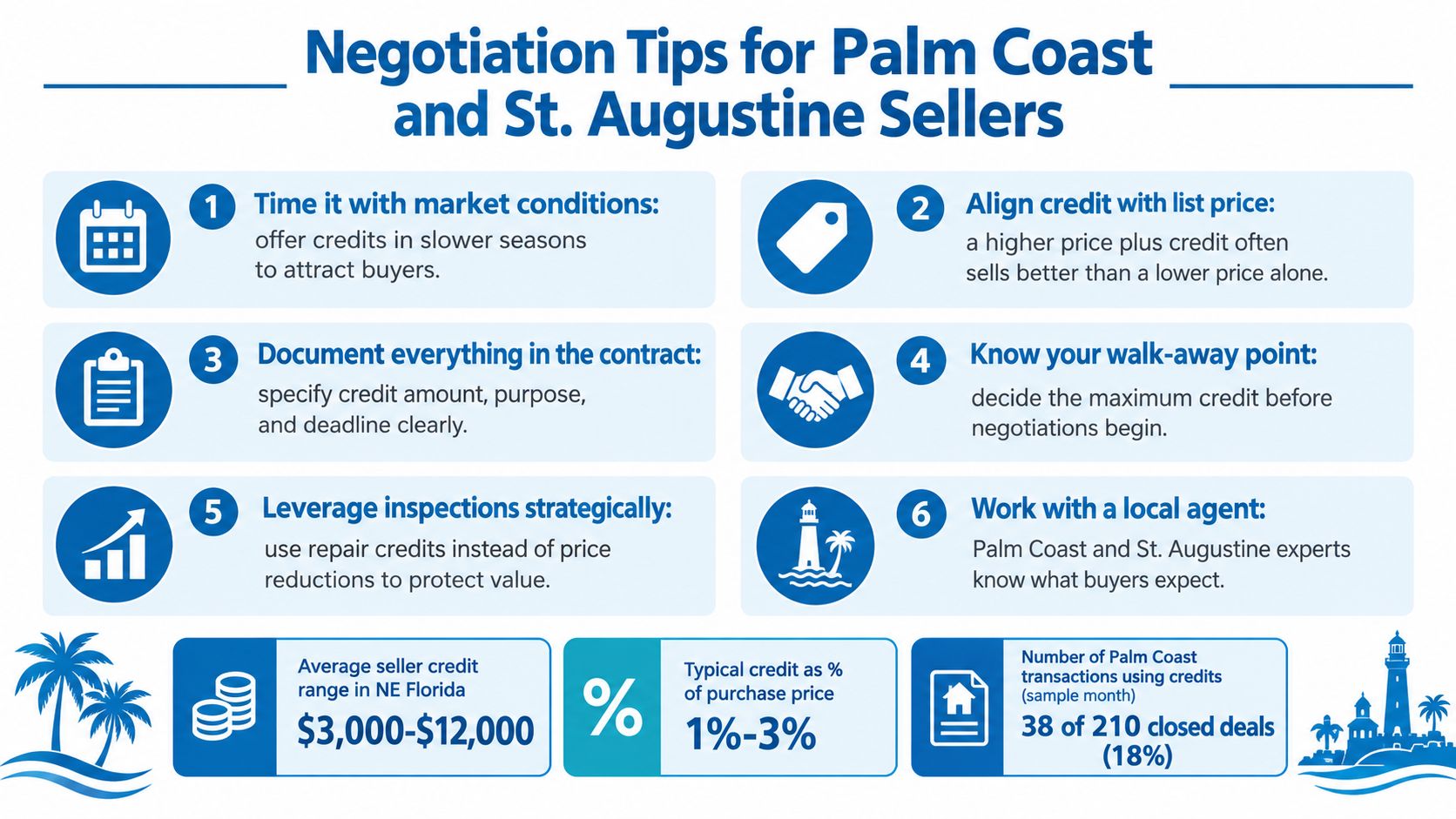
A seller credit should support your pricing strategy, not replace it. Before responding to a request, determine whether the buyer needs help with cash-to-close expenses, wants a rate buydown, is negotiating over inspection findings, or wants a lower effective price.
Build the request into the full offer
A strong negotiation considers more than the credit amount. Review the buyer's financing, appraisal contingency, inspection terms, closing timeline, and proof of funds. An offer with a credit may still be attractive if the buyer is well qualified and the contract terms reduce execution risk.
Use this checklist before agreeing:
- Confirm the loan program: Ask whether the buyer is using conventional, FHA, USDA, or VA financing.
- Verify lender approval: Require the buyer's lender to confirm the permitted credit and eligible uses.
- Review actual costs: Don't offer more than the buyer can use.
- Protect your net: Calculate the credit alongside commissions, repairs, taxes, and other settlement expenses.
- Set a limit: Decide your maximum contribution before the negotiation becomes emotional.
- Document the terms: Identify the amount, purpose, and deadline in the contract or addendum.
Match the tool to the problem
If an inspection uncovers a manageable issue, a credit may be cleaner than completing repairs, provided the lender and contract permit that structure. If the home is priced above what current Flagler County or St. Johns County comparable sales support, a price reduction may produce a more credible offer position.
Timing matters as well. A credit can attract attention when buyers have more choices, while a strong listing with multiple interested buyers may not require one. For absentee owners, move-up sellers, and 55+ homeowners planning a transition, a precise net calculation is especially important because the credit affects the funds available for the next move.
A local professional can help compare the credit with a price adjustment and review buyer expectations in Palm Coast, St. Augustine, and surrounding communities. Marilynn Wolfe, LLC provides local valuation, pricing, contract, and transaction guidance for homeowners evaluating these choices.
Next Steps for Selling Your Home Locally
A seller credit can position your Palm Coast or St. Augustine home effectively, but choose it only after reviewing value, buyer demand, financing, and net proceeds. Compare the credit with a price reduction before agreeing.
Marilynn Wolfe
LPT Realty LLC
Phone: 904-429-2829
Email: marilynnwolfe.realtor@gmail.com
Website: marilynnsellsfl.com
Marilynn Wolfe, LLC offers local pricing, valuation, and contract guidance. Sellers in Flagler or St. Johns County can contact her for a practical comparison based on their home and goals.