
If you're considering downsizing to move in Palm Coast or St. Augustine, have you first confirmed that the smaller home you want is actually available? Many homeowners assume they can sell a larger property, find a comparable home with less space, and complete the transition in a straightforward swap. In Northeast Florida, limited active-adult inventory and strong demand can make that assumption costly.
Downsizing may mean less space, but it can also mean fewer stairs, easier maintenance, a different neighborhood, or a move closer to family. Some homeowners in Flagler County want an active-adult setting. Others prefer a single-story home in Palm Coast, a condo near St. Augustine, or a simpler property in a familiar community. The right strategy starts by defining the lifestyle change, then matching the sale timeline to the housing options available.
Understanding Your Downsizing Journey
Downsizing doesn't always mean moving from a large family home into a much smaller property. In Palm Coast real estate, it may involve decluttering a home while staying in the same neighborhood. In St. Augustine real estate, it might mean replacing a high-maintenance property with a condo or townhome closer to services. For some Flagler County homeowners, the most important change is moving to a single-story layout rather than reducing the number of rooms.
Start by identifying the problem you want the move to solve. Is the home difficult to maintain? Do you want to reduce expenses? Are stairs, yard work, or distance from family becoming less convenient? Your answer will shape your search more effectively than a simple target square footage.

Choose the type of change you need
Consider these possibilities before you decide to list:
- Simplify in place: Remove unused belongings, improve accessibility, and make the existing home easier to manage.
- Right-size locally: Move into a smaller house, condo, or townhome while remaining near friends, healthcare, shopping, and familiar routines.
- Change the setting: Explore an active-adult community, a single-story neighborhood, or a more walkable area.
- Relocate closer to family: A move within Palm Coast, toward St. Augustine, or into a surrounding community may matter more than the size reduction itself.
National housing behavior also challenges the idea that older homeowners automatically make dramatic cuts in space. A 2026 analysis of U.S. Census data found that Americans who were ages 55 to 64 in 2014 and ages 65 to 74 a decade later showed no change in typical housing size. The median remained 6 rooms and 3 bedrooms, as reported in this analysis of retirement downsizing patterns.
That finding supports a practical local lesson. Right-sizing can be more useful than downsizing by a strict measurement. A Palm Coast homeowner may keep a comfortable guest room but eliminate unused furniture, while someone searching in St. Augustine may prioritize location and maintenance over a dramatic reduction in floor space.
Practical rule: Decide what you want your next home to make easier before deciding how much space you want to lose.
Navigating the Local Active Adult Market
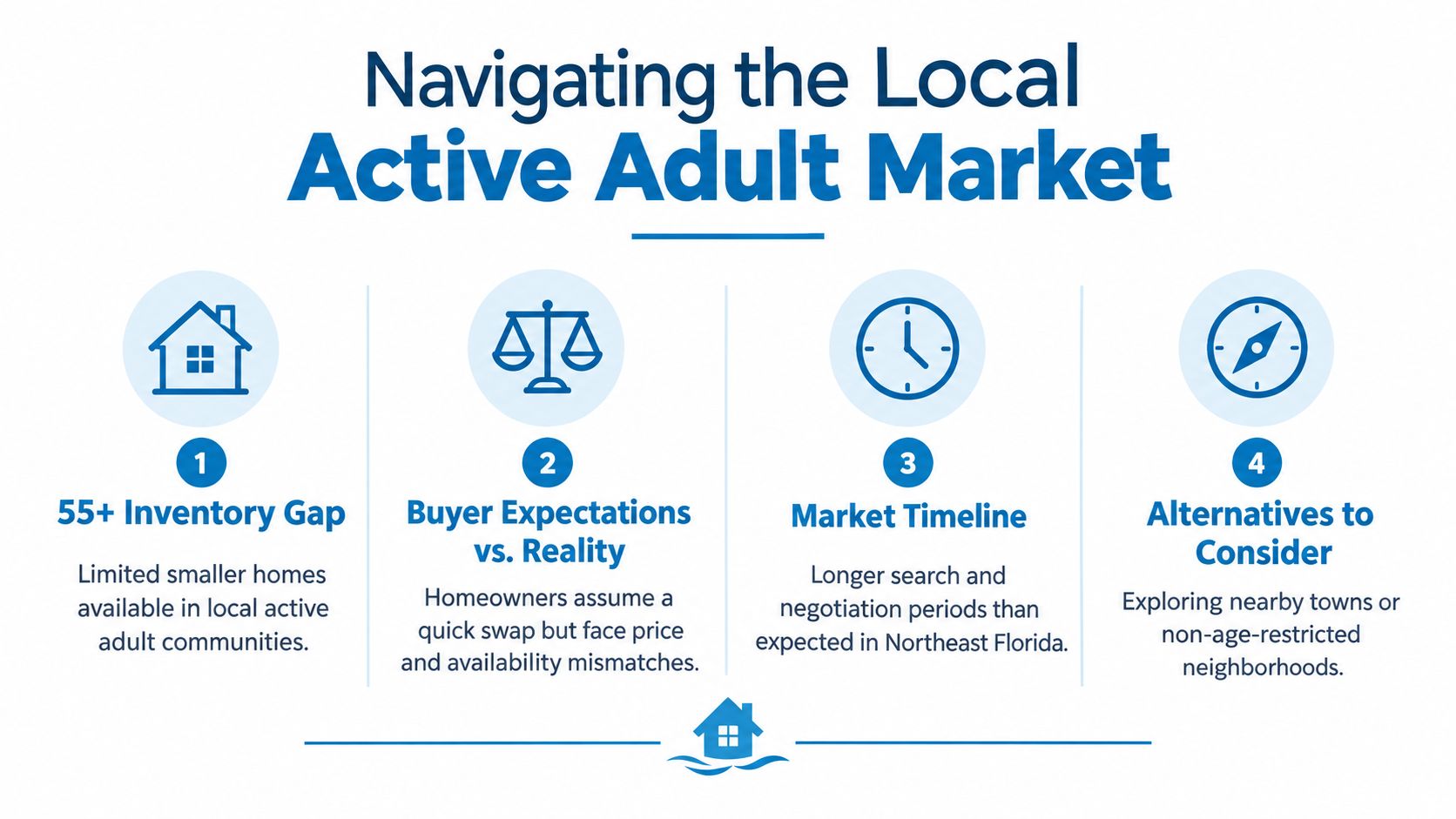
The common plan sounds simple: sell a large home, then buy a smaller property in a preferred 55+ community. The challenge is that the second step may take longer than expected. Senior housing demand is strengthening while new supply remains constrained, which can affect homeowners searching for active-adult or senior-oriented options around Palm Coast, St. Augustine, and nearby communities.
NIC reported 89.1% occupancy at the end of 2025, while annual inventory growth fell below 1% in the second quarter of 2025, the lowest level since tracking began in 2006, according to its senior housing occupancy and inventory report. Separate industry coverage reported senior housing occupancy at 90% in the fourth quarter of 2025, described as the highest level since 2017, while construction starts remained very low and many markets had no active senior housing development.
Why the sale and purchase may not line up
A homeowner may find the preferred community has limited resale opportunities, a waitlist, or a home that doesn't meet the desired budget or accessibility needs. Meanwhile, the current property may require preparation before it can attract the strongest offers. Selling first without a transition plan can create pressure, but waiting indefinitely for a perfect replacement can also delay the move.
Use a decision framework rather than relying on a single neighborhood preference:
| Situation | Practical response |
|---|---|
| A suitable home is available | Review the purchase terms, sale timing, and financial exposure before committing. |
| The preferred community has limited availability | Consider a broader search across Palm Coast, St. Augustine, and surrounding areas. |
| The current home needs preparation | Begin repairs, decluttering, and pricing analysis before an ideal replacement appears. |
| You need flexibility | Compare a temporary rental, condo, townhome, single-story home, or non-age-restricted neighborhood. |
Should you wait for a “better” downsizing market? Limited inventory means many buyers may face competition rather than abundant choice. A flexible plan could include selling now and renting temporarily, widening the search to active-adult and non-age-restricted communities, or considering nearby towns instead of holding out for one specific development.
Flagler Estates homes, Palm Coast neighborhoods, and communities near St. Augustine can differ substantially in layout, maintenance requirements, commute patterns, and buyer demand. The right choice depends on the lifestyle goal, not just the label attached to the community.
Preparing to Sell and Simplify Early
Waiting until you've found the next home before sorting your belongings creates unnecessary pressure. Expert guidance recommends beginning 6 to 12 months before the move, using that period to set a target home size, measure the current and future spaces, and declutter before listing, as explained in this downsizing preparation guide.
Start with the spaces that influence buyers most. Clear crowded closets, remove excess furniture from walkways, and make rooms feel functional without stripping away personality. In a Palm Coast home, that may mean reducing garage storage or simplifying outdoor equipment. In an older St. Augustine property, it may mean highlighting accessible living areas and making circulation through the home easier to understand.
A calmer preparation sequence
- Set a destination standard: Decide which belongings fit your likely next-home lifestyle, not just what can fit in the current home.
- Measure before discarding: Record furniture dimensions and compare them with the rooms you may consider buying.
- Sort by action: Create clear groups for keeping, donating, selling, gifting, and disposing.
- Prepare selectively: Address repairs and updates that improve presentation, safety, and buyer confidence.
- Photograph after editing: A spacious, orderly home gives buyers a clearer sense of scale.
Decluttering isn't only a moving task. It helps reveal the property's strengths and exposes maintenance issues while there's still time to address them. It also prevents a common mistake, buying a smaller home and discovering that the belongings, storage needs, and daily routines don't fit.
A local pricing consultation before major improvements can keep preparation focused. Sellers don't need to spend money on every possible project. They need to understand which changes support the likely buyer for their location and property type.
Financial Planning for Your Transition
Downsizing to move is a full transaction, not a mere sale followed by a cheaper purchase. Your calculation should include the net sale proceeds, purchase expenses, moving costs, repairs, temporary housing, storage, and potential taxes.
Closing costs typically run 2% to 5% of the home's sale price, according to this overview of downsizing expenses. The same source notes that a 250-mile move can range from about $600 to $5,000, while long-distance moves can reach $8,300. Even a move within Northeast Florida can involve packing, labor, storage, cleaning, utility transfers, and timing complications.
Build the net-proceeds picture
| Financial item | Question to answer |
|---|---|
| Sale proceeds | What could the home realistically sell for after preparation and negotiation? |
| Selling expenses | Which commissions, closing costs, repairs, and concessions may reduce proceeds? |
| Replacement housing | What will the next home require for purchase costs, insurance, maintenance, and updates? |
| Moving logistics | Will you need storage, temporary housing, or specialized assistance? |
| Tax exposure | Does the home qualify for the primary-residence exclusion, and when was any prior home sold? |
The IRS says eligible sellers may exclude up to $250,000 of capital gains, or up to $500,000 for married couples filing jointly, if they meet the ownership and use tests. Generally, the homeowner must have owned the property for at least two years and lived in it as a main home for at least two of the five years ending on the sale date, according to IRS guidance on selling a home.
Potential gain is based on the selling price minus the property's cost basis, which includes the original purchase price plus certain adjustments. The exclusion isn't a lifetime-only benefit, but the IRS says it generally can't be used more often than once every two years, as explained in its Section 121 home-sale guidance. Certain employment, health, or unforeseen circumstances may support a reduced exclusion when the full tests aren't met. Because tax results depend on individual facts, discuss the details with a qualified tax professional before setting your moving budget.
The Value of Local Expert Guidance
A successful sale in Northeast Florida depends on more than selecting a list price from a broad regional average. Palm Coast home values can vary by neighborhood, property condition, age, layout, lot characteristics, and buyer expectations. St. Augustine housing market conditions may look different from those in Palm Coast, while Flagler Estates homes can attract a different set of buyers than properties near established amenities.
A local specialist helps turn those differences into practical decisions. Start with a property review that separates essential preparation from optional work. Then examine comparable homes that buyers are actually considering, not just properties with similar bedroom counts.
What a useful pricing process includes
- Property-specific analysis: Review condition, improvements, layout, lot, location, and likely buyer objections.
- Competitive positioning: Compare active listings, recent sales, and homes that failed to attract an acceptable offer.
- Launch timing: Coordinate preparation with the availability of your next housing option.
- Offer evaluation: Consider financing strength, contingencies, closing timing, and the risk of accepting a higher but less reliable offer.
- Transition planning: Build a sale strategy that reflects whether you need a replacement home, rental period, or flexible closing.
The best pricing strategy isn't automatically the highest possible number. An unrealistic price can reduce early buyer interest and leave the home competing against newer or better-positioned properties. A well-supported price gives the listing a clearer position in the local Palm Coast real estate market and helps serious buyers understand its value.
Local knowledge also matters for absentee owners and homeowners preparing to relocate. A property owner living outside Flagler County may need help coordinating vendors, access, inspections, repairs, and closing logistics. Someone moving toward St. Augustine may need advice that accounts for both the sale and the search.
Planning Your Next Chapter in Florida
Once the current home is ready to sell, keep more than one destination in play. A homeowner might find a manageable condo in Palm Coast, a townhome near St. Augustine, a single-story home in a familiar neighborhood, or a place outside an age-restricted community that offers the same practical benefits.

One practical path is to prepare the existing home, establish its likely net proceeds, and search across several property types before making a final commitment. Another is to sell and rent temporarily when a preferred active-adult community has limited availability. A waitlist may also make sense if the community fits your long-term needs, but the timing should be weighed against storage, rental, and moving costs.
Review each option through the same questions: Can you manage the maintenance? Does the layout support your routine? Is the location convenient? Will the purchase leave enough financial room for repairs and ongoing expenses?
For homeowners comparing Palm Coast, St. Augustine, Flagler County, and surrounding communities, a local conversation can clarify which compromises are reasonable and which may create problems later.
Before making a decision, review your preferred transition plan with someone who understands both the local market and the practical sequence of selling, purchasing, renting, and moving.
Marilynn Wolfe, LLC offers thoughtful pricing strategy, strong marketing, and clear guidance for homeowners downsizing or relocating in Palm Coast, St. Augustine, Flagler County, and surrounding areas. Visit Marilynn Wolfe, LLC for a personalized home value discussion and local insight to help you plan your next move with confidence.