
If you're touring homes in Palm Coast right now, you're probably seeing the same split a lot of buyers see. One weekend it's a clean spec home with bright finishes and low-maintenance appeal. The next weekend it's an existing home in an established neighborhood with better trees, a faster closing path, and a price that may or may not make more sense once you look past the list number.
That's the new construction vs existing home decision in Northeast Florida. It isn't about which one wins on paper. It's about timing, risk, monthly cost, and how much uncertainty you can tolerate while you're trying to move, sell, relocate, or downsize.
For buyers in Palm Coast, St. Augustine, Flagler Estates, and surrounding communities, this matters more than people admit. New construction gets a lot of attention in newer pockets, but the resale market still dominates overall. Nationally, 2024 saw about 679,000 new-home sales versus about 4.06 million existing-home sales, roughly a 6 to 1 ratio in favor of existing homes, according to Housing Almanac's summary of Census and NAR data. That tracks with what buyers feel here too. Most buyers still start with resale options, even when they're curious about builders.
Two Homes, One Big Decision in Palm Coast and St Augustine
A common local scenario goes like this. A buyer spends Saturday in a newer area near Palm Coast looking at a builder inventory home, then spends Sunday touring a resale in the same general school zone. The new home feels easy. The existing home feels lived-in, settled, and often better connected to the parts of town people already know well.
In Flagler County real estate, that tension shows up constantly. New communities attract buyers who want modern layouts, lower early maintenance, and a simpler first few years of ownership. Existing neighborhoods in Palm Coast and St. Augustine attract buyers who care more about lot size, mature landscaping, established streets, and not waiting on construction schedules.
What buyers are actually deciding
Most buyers think they're deciding between “new” and “used.” They're really deciding between these three things:
- Certainty of condition versus certainty of closing date
- Customization versus immediate usability
- Builder incentives versus resale negotiation flexibility
That last one matters more than many people expect. New homes don't always carry the same premium they once did. Realtor.com reported that in Q2 2026, the median listing price for newly built homes was 10.3% above the median existing-home price, compared with 8.2% a year earlier, while still sitting well below the larger premium builders often carried in earlier cycles, according to Realtor.com's 2026 new-construction analysis.
Local reality: In Palm Coast and St. Augustine, a buyer who only compares sticker prices usually misses the real decision. The bigger issue is whether they need speed, control, or fewer repair surprises.
For move-up sellers, absentee owners planning a local purchase, and downsizers trying to simplify, this choice also affects how and when they list their current property. That's why Palm Coast real estate decisions and selling a home in Palm Coast often connect directly to the new construction conversation.
What Really Sets New Construction and Existing Homes Apart
Before price enters the conversation, buyers usually feel three differences first. Condition, customization, and timeline.
| Factor | New Construction | Existing Home |
|---|---|---|
| Condition | New systems, current code standards, builder delivery | Condition depends on age, maintenance, and prior updates |
| Customization | Possible finish, lot, and plan choices if build stage allows | You buy the home largely as it sits |
| Timeline | Usually measured in months | Often closes in a standard contract window |
| Repairs after move-in | Usually lighter at the start | Can begin immediately depending on inspection findings |
| Neighborhood feel | Newer streets, developing landscaping, evolving amenities | Established setting, mature trees, known traffic patterns |
Condition is the first fork in the road
A new home in a developing area can remove a lot of early maintenance stress. Roof, HVAC, appliances, windows, and major surfaces are all starting at day one. That matters for buyers who don't want to spend their first year pricing out repairs.
An existing home in St. Augustine or older sections of Palm Coast can still be a smart buy, but condition has to be judged house by house. A beautifully updated resale may beat a basic builder package. A neglected resale can become expensive fast.
Customization sounds better than it feels
Buyers love the idea of picking cabinets, flooring, and lot placement. Sometimes that's useful. Sometimes it turns into decision fatigue and added cost.
In Flagler Estates homes and other build-friendly areas, customization makes sense if you care about layout or plan to stay long enough to enjoy those choices. If you're buying for convenience, a finished resale often wins because the decisions are already made and visible.
Timeline changes everything
Many guides get too soft here. Timeline is not a side issue. It's the issue for a lot of Northeast Florida buyers.
Buying an existing home can typically close in about 30 to 60 days, while new construction usually plays out over months because permitting, construction, and utility hookup all take time, according to Opendoor's build-versus-buy timeline overview.
A buyer relocating for work, school, or a sale deadline usually has less room for error than a buyer who can wait through a build.
Price, Total Cost, and Builder Incentives Compared
Price is where buyers often get trapped. They focus on base price and ignore the contract details that change the cost of ownership.
There's no single national rule anymore that says new homes always cost more. One 2026 comparison cited a median of $398,300 for new homes versus $431,400 for existing homes, a gap of about $33,100, according to Real Cost Report's comparison of new and existing home prices.
At the same time, total ownership cost can flip the picture again. Realtor.com's analysis found that new homes can save buyers about $25,335 over the first 10 years of ownership, even though the median new-build list price sits roughly $60,000 above the median existing-home price, as summarized by HousingWire's report on Realtor.com's 10-year ownership-cost analysis.
What Palm Coast and St. Augustine buyers should count
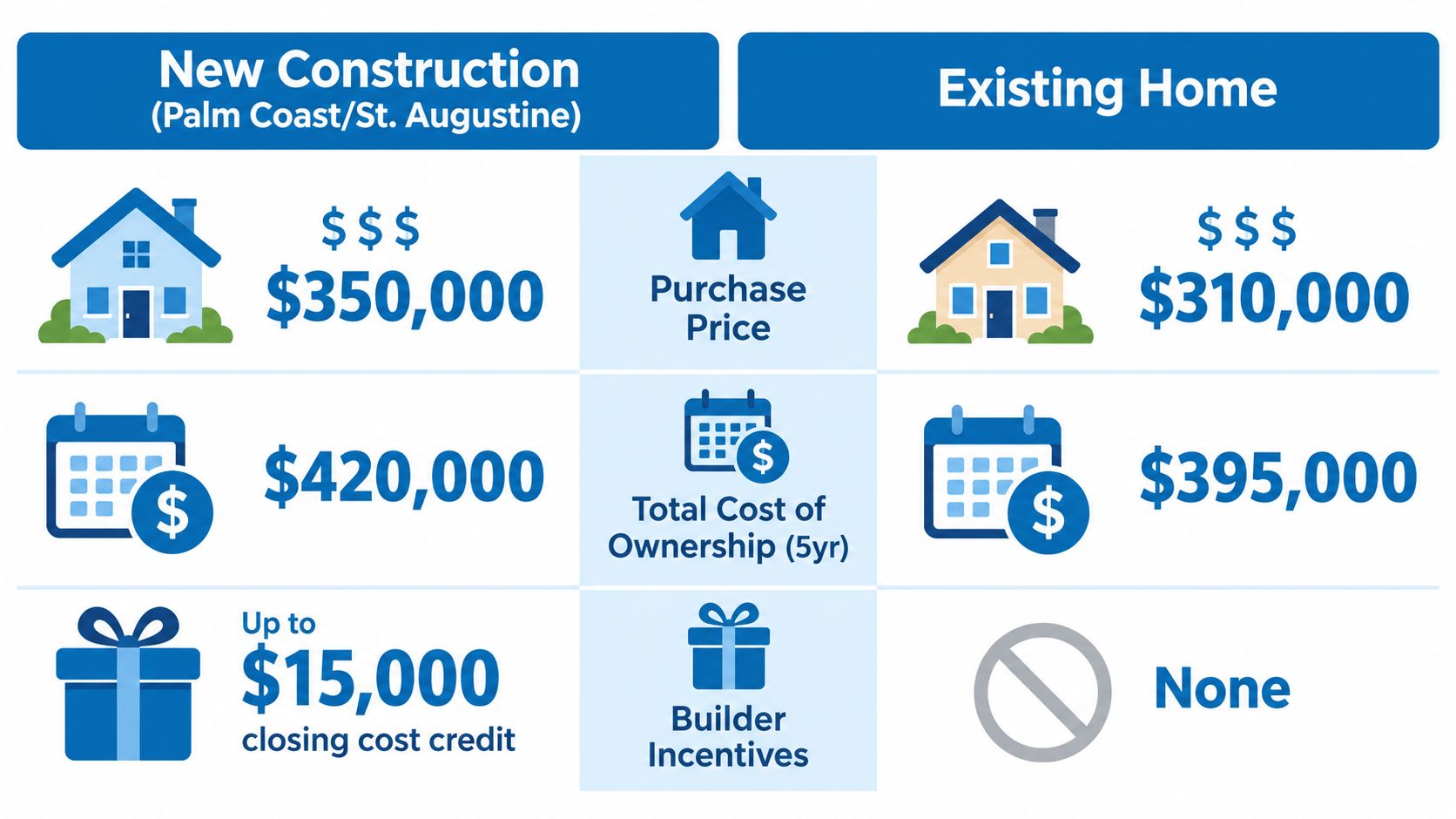
In local contracts, buyers need to look beyond list price and ask what's included and what isn't.
- With new construction: Buyers may need to ask about appliance packages, blinds, landscaping scope, HOA startup charges, and what happens if preferred lender incentives require specific financing terms.
- With resale: Buyers need to budget for inspections, likely repair requests, and updates they already know they want after closing.
- With either path: Insurance, taxes, flood-zone implications, commute patterns, and HOA rules affect the actual monthly cost.
Incentives matter, but only if they fit your plan
Builders often protect headline pricing and get more flexible through credits, buydowns, or upgrade packages. Sellers of existing homes tend to negotiate more directly on price, repairs, or timing.
That difference matters in the Palm Coast real estate market because buyers often assume the better “deal” is the lower list price. Sometimes it is. Sometimes it's the home with a cleaner monthly payment and fewer year-one surprises.
A practical way to compare options is simple:
- Start with the all-in cash needed at closing
- Add realistic monthly payment scenarios
- Estimate near-term maintenance
- Decide whether the incentive is helping your budget now or just dressing up the contract
Timeline and Closing Speed Side by Side
The biggest mistake I see in new construction vs existing home decisions is treating timeline as if it's just an inconvenience. It affects lease endings, school timing, rate-lock strategy, storage costs, and whether you need temporary housing.
Nationally, the housing pipeline has been uneven, not smooth. In August 2026, single-family starts were about 918,000, up 7.6% from July, while overall housing starts fell 2.6% month over month, according to Real Estate News coverage of housing-start data and 2026 housing projections. That same report noted a 2026 forecast expecting existing-home sales to edge up 1.0% to 4.10 million and single-family starts to rise 2% to 960,000. That isn't a picture of a runaway builder boom. It's a constrained, uneven market.
| Milestone | New Construction | Existing Home |
|---|---|---|
| Contract signing | Builder contract and addenda | Standard resale contract |
| Early phase | Site prep, permitting, build scheduling | Inspection scheduling, loan processing |
| Mid-process risks | Construction pace, utility coordination, approval timing | Inspection findings, appraisal, insurance underwriting |
| Final phase | Walkthrough, punch list, certificate of occupancy | Final repairs, HOA estoppel, final walkthrough |
| Move-in timing | Can shift during the build cycle | Usually more predictable once under contract |
Where delays actually happen
In Palm Coast and St. Augustine transactions, friction points for new construction are often permitting, utility coordination, and final completion items. Buyers hear “almost done” and think that means closing is imminent. Sometimes it is. Sometimes it isn't.
For resale, delays usually come from a different set of issues:
- Insurance questions tied to four-point or wind mitigation reports
- Appraisal problems if pricing gets ahead of nearby comparables
- Inspection renegotiation when roof, plumbing, or electrical concerns show up
- HOA paperwork lag in some communities
Who should care most about speed
Relocators with a hard move date should be very cautious about assuming a build will line up perfectly. Buyers who need a home quickly, or who must coordinate a sale and purchase tightly, often do better with resale inventory because the timeline is easier to control.
Practical rule: If your life has a fixed date, resale usually gives you more control. If your life has flexibility, new construction becomes much easier to justify.
Inspections, Warranties, and Long-Term Maintenance
This section is where buyers either get practical or get burned.
A lot of people assume a new home means no inspection concerns. That's not how smart buying works. New homes need inspections. Existing homes need deeper skepticism. The difference is what happens after something is found.
What a builder warranty does and doesn't do
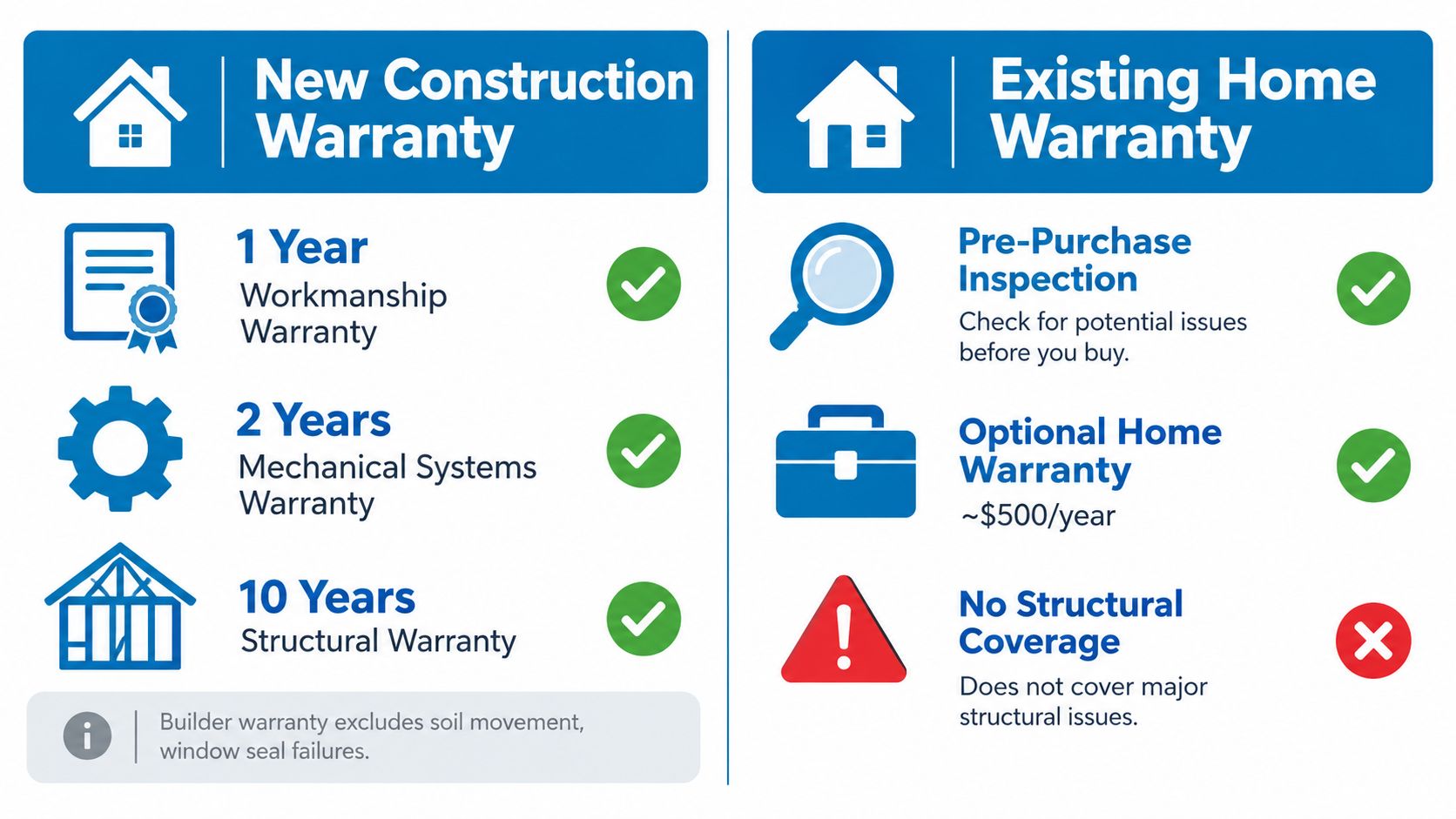
A builder warranty can offer real peace of mind, especially for buyers who want fewer early repair costs. But buyers should read the exclusions carefully and not treat the word “warranty” like magic.
The common structure buyers hear about often includes:
- One year on workmanship
- Two years on mechanicals
- Ten years on structural coverage
That framework is widely discussed in builder sales conversations, but the exact terms can vary by builder and paperwork. The important point is this: warranty coverage helps, but it doesn't remove the need for independent inspections or careful walkthroughs.
What coastal Florida buyers need an inspector to catch
In Palm Coast, St. Augustine, and nearby coastal communities, resale inspections need to focus on the things that tend to matter here:
- HVAC wear in salt air
- Roof age and remaining life after storm seasons
- Older plumbing materials in some neighborhoods
- Moisture issues, prior repairs, and signs of deferred maintenance
- Window and door performance in humid, wind-driven rain conditions
With an existing home, you're inheriting a maintenance history. Sometimes that history is excellent. Sometimes it's a stack of shortcuts.
Maintenance isn't just repair cost
New homes usually mean lower near-term repair pressure, but that doesn't always mean they're finished in a way buyers expect. Landscaping may be basic. Shade may be minimal. Community surroundings can still feel under construction.
Existing homes often come with more established outdoor space and a more settled feel, but they may require cash sooner. Buyers in the St. Augustine housing market and Palm Coast home values conversation need to think carefully about whether they want predictability or finished surroundings.
Don't choose resale because it “has character” if you don't have the budget or patience for upkeep.
Which Path Fits First-Time Buyers, Relocators, and Downsizers
Blanket advice is useless here. Different buyers should make different choices.
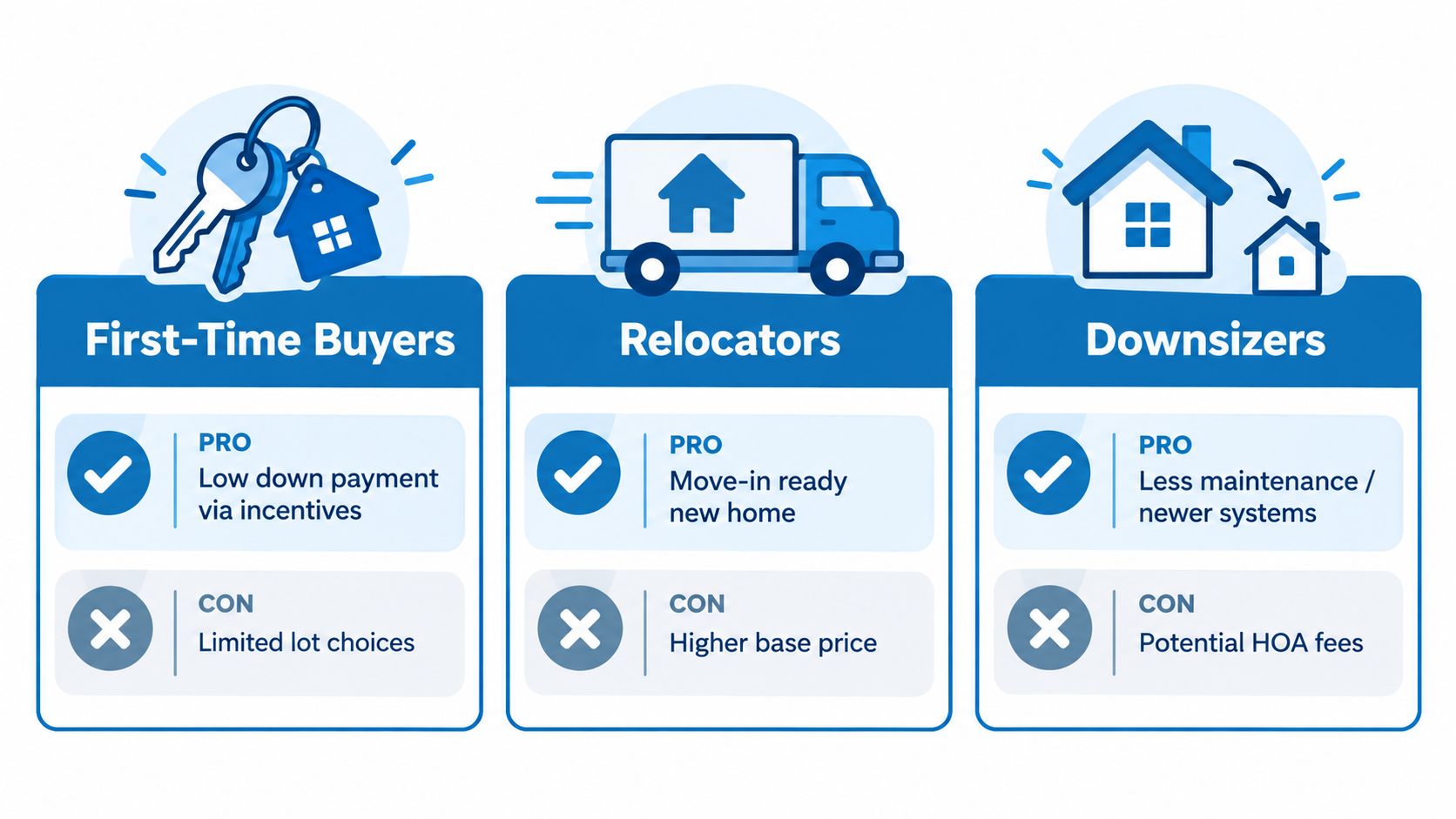
First-time buyers
First-time buyers often do well with new construction if monthly affordability can be improved through builder incentives and if the move-in date is flexible. The appeal is simple. Fewer immediate repairs, modern systems, and less guesswork early on.
The trade-off is patience. If a buyer needs a very specific school zone, a quick move, or more room to compare street-by-street neighborhood feel, resale usually gives better control.
Relocators and move-up buyers
Relocators coming into Palm Coast or St. Augustine usually care about certainty more than customization. If a job starts on a hard date, or a prior home has to close first, resale tends to be the safer path.
Move-up buyers can go either direction, but they need discipline. If they're selling a home in Palm Coast and trying to time the next purchase, a delayed build can create unnecessary pressure. If they can sell first and rent or stay flexible, builder inventory may work well.
Downsizers and 55-plus buyers
Downsizers usually aren't shopping for a project. They want less maintenance, a practical layout, and a location that makes daily life easier.
In communities tied to Palm Coast real estate and nearby areas, that often means carefully comparing established options with newer one-level homes. Many downsizers prefer resale because the neighborhood feel is already visible. They can judge parking, guest access, HOA intensity, walkability, and traffic patterns without guessing.
A simple fit check looks like this:
- Choose new construction if you want newer systems, lower early maintenance, and can absorb schedule movement.
- Choose resale if you need timing control, established surroundings, and stronger contract flexibility.
- Choose either if the specific property solves your location and budget better than the category itself.
Negotiation Strategy for Builders Versus Sellers
Builder negotiation and resale negotiation are not the same sport. Buyers who use the same approach for both usually leave money on the table.
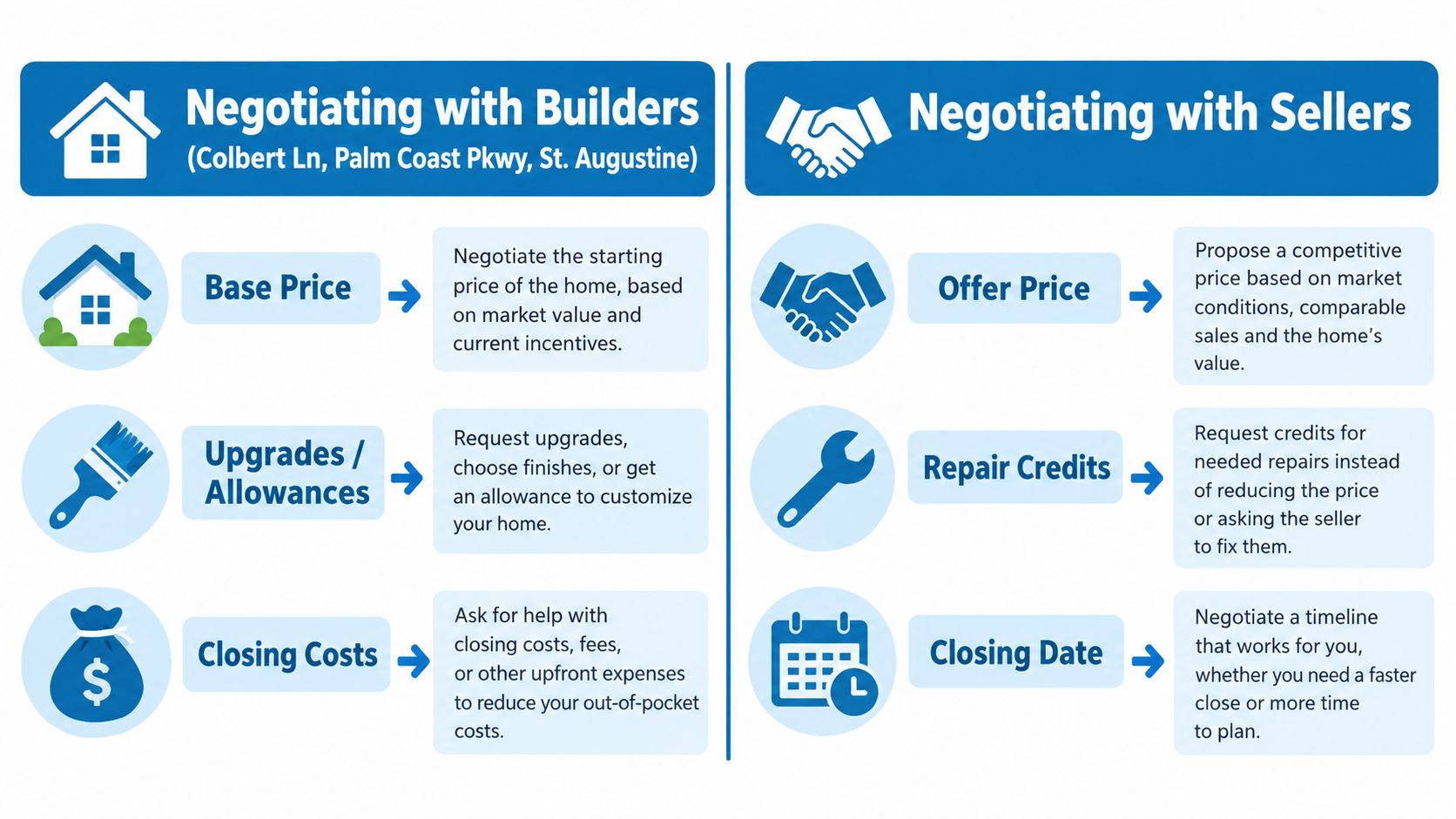
How to negotiate with builders
Builders usually want to protect published pricing. That means your bargaining power often shows up elsewhere.
Push on items like:
- Closing cost credits
- Interest-rate buydowns through the preferred lender
- Upgrade allowances
- Appliance or finish-package adjustments
- Extended rate-lock support if the home isn't ready
In builder deals across Northeast Florida, contract certainty has value to the builder. That's where buyers can often get movement. A clean buyer with financing lined up and realistic expectations is easier for a builder to work with than a buyer focused only on a headline price cut.
How to negotiate with sellers
Existing-home sellers are often more flexible on the pieces that matter most to buyers.
That may include:
- Offer price
- Inspection repair credits
- Closing-date timing
- Appraisal-related adjustments
- Home warranty requests
- Seller concessions tied to needed updates
In coastal Flagler County real estate, insurance and property condition shape negotiations fast. Wind mitigation, four-point concerns, older roofs, and plumbing questions can all change what a fair contract looks like.
Why representation matters more with builders than buyers think
Some buyers assume they don't need outside guidance because the builder has a sales team on site. The sales team knows the community and product. They don't represent the buyer's side of the deal.
For buyers comparing a builder contract against resale alternatives, one practical option is working with Marilynn Wolfe, LLC, which helps buyers evaluate contract terms, compare neighborhood value, coordinate inspections, and weigh resale versus builder inventory based on timing and price strategy.
Builders usually won't slash price like an individual seller might. They're more likely to trade incentives for a stronger contract.
A Simple Decision Checklist and How I Can Help
If you're deciding between new construction vs existing home in Palm Coast, St. Augustine, or Flagler Estates, keep the checklist simple.
Use this before you tour
Move-in date matters most
Choose existing if your timeline is firm. Choose new if you have room for delays.You care more about payment than sticker price
Compare incentives, insurance, likely repairs, and utility expectations before calling one option cheaper.You want to make design choices
New construction makes more sense if you want control over finishes and can live with builder process and deadlines.You don't want repair surprises
A well-built new home can reduce early headaches. A carefully chosen resale can still work, but only if the inspection and maintenance history are solid.You may sell again in five to ten years
Think about location, flood-zone realities, school access, and neighborhood maturity. A great floor plan won't rescue a weak location.
What local guidance should actually include
A buyer in Palm Coast or St. Augustine needs more than online listings. They need someone comparing resale comps, reading builder addenda closely, watching timing risk, and spotting the contract terms that affect the bottom line.
That means looking at the house, the street, the insurance picture, the timeline, and the exit strategy. It also means being honest when a shiny new home is overpriced for the area, or when an older resale is going to need more work than the buyer really wants.
If you're six weeks out, that conversation looks different than it does for someone planning a move in six months. Either way, the decision gets easier when the trade-offs are clear.
If you want help sorting through builder inventory, resale options, pricing strategy, or the timing risks that come with both, Marilynn Wolfe with LPT Realty LLC offers practical guidance for Palm Coast, St. Augustine, Flagler County, and surrounding Northeast Florida communities. If you're weighing a move, downsizing plan, or purchase tied to selling your current home, visit Marilynn Wolfe, LLC for local insight matched to your neighborhood, budget, and timeline.