

Seller concessions are credits the seller pays toward the buyer's closing costs, rate buydown, or certain negotiated expenses instead of lowering the list price, and they're capped by loan type. In today's market, they're not unusual at all. 46.2% of U.S. home sales in May 2026 included concessions according to Redfin's seller concessions report.
A lot of homeowners in Palm Coast and St. Augustine still think the only way to make a deal work is to cut the price. That's outdated thinking. If you're selling in a more buyer-friendly market, the smarter question is often this: Should you lower the price, or keep the price stronger and offer help where the buyer feels the pain, at closing?
That matters in Palm Coast real estate, St. Augustine real estate, and across Flagler County real estate because buyers aren't just watching price. They're watching cash to close, monthly payment, and whether a house feels manageable after inspections. If you understand seller concessions as a pricing tool, not just a definition on a contract, you'll make better decisions and protect your bottom line.
What Are Seller Concessions in Real Estate and Why They Matter
What gets your home sold faster in Palm Coast or St. Augustine. A $10,000 price cut, or $10,000 that helps the buyer get to the closing table?
Seller concessions are negotiated costs the seller agrees to pay so the buyer brings less cash to closing. In plain terms, you keep the contract price higher and use part of your proceeds to cover buyer expenses that are allowed under the loan. HUD's guidance explains that seller or third-party contributions can include discount points, rate buydowns, closing-cost help, condo fees, builder incentives, and other credits. It also explains that with FHA-style financing, contributions above 6% of the sales price are treated as inducements to purchase that reduce the mortgage amount, as outlined in HUD's guidance on seller contributions.
That matters because a concession solves a different problem than a price cut.
A price reduction lowers the purchase price. A concession targets the buyer's cash squeeze. If the buyer can handle the monthly payment but is short on closing funds, a concession is usually the better tool. Sellers who miss that point leave money on the table.
Why sellers in Northeast Florida should care
In this market, buyers are payment-sensitive and cash-sensitive at the same time. They may like your house, agree with the price, and still hesitate because they do not want to drain savings on lender fees, prepaids, and insurance escrows.
That is where smart sellers separate price from terms.
If your listing is getting traffic but buyers are slow to commit, offering a concession can make your home feel more affordable without advertising a lower sale price to the whole market. That can help in neighborhoods where comparable sales are uneven and you do not want to drag your final number down more than necessary.
According to Redfin's seller concessions report, concessions have become common in a softer market because they help bridge affordability gaps without requiring an outright price slash.
What this means for your listing strategy
Treat concessions as a pricing lever, not a giveaway.
Here is the practical advice. If the buyer's problem is cash to close, offer a concession before you reach for a bigger price cut. If your home is overpriced, cut the price and fix the issue. Concessions work best when the home is already close to market value and the deal needs help getting across the finish line.
A seller who understands that difference negotiates from strength. A seller who does not usually ends up cutting price first, then giving concessions later anyway.
How Seller Concessions Work at the Closing Table
Want to help a buyer without publicly dropping your price? This is how you do it.
A seller concession is money you agree to credit to the buyer at closing. It does not create extra cash. It changes who pays certain closing expenses out of the proceeds already in the deal.
The key point for sellers is simple. You can keep the contract price stronger on paper while solving the buyer's real problem, which is often cash due at settlement.
What the credit can actually cover
The credit has to be written into the contract, or added later by signed addendum, and it shows up on the closing statement as a seller-paid buyer cost. According to Yahoo Finance's explanation of how seller concessions function in mortgage transactions, these credits can go toward closing costs, prepaid items, discount points for a rate buydown, and some negotiated repair-related costs if the lender allows them.
In practice, sellers usually see concessions applied to:
- Lender charges: Origination fees and other loan costs
- Title and settlement fees: Title work, escrow, and closing services
- Prepaid items: Homeowners insurance, property taxes, and escrow setup
- Discount points: Money used to lower the buyer's interest rate
- Repair credits: A credit in place of doing the work before closing
That last one matters in Northeast Florida. A Palm Coast or St. Augustine buyer may accept an older roof, aging HVAC, or cosmetic issues if the numbers work at closing.
Why this hits differently than a price cut
At the closing table, a concession reduces your net. A price cut reduces your price and your net.
Those are not the same thing.
If you cut the price by $10,000, the whole market sees the reduction, the appraisal conversation can shift, and the buyer's loan numbers change with it. If you offer a $10,000 concession instead, the contract price may stay put while you use your proceeds to cover buyer costs. For a payment-sensitive buyer who is short on cash, that can be the better move.
This is why I tell sellers to match the tool to the problem. If buyers like the home but are stretched on cash to close, a concession usually beats a straight price reduction.
Where sellers get into trouble
You cannot promise any number you want and assume the lender will sort it out. Loan programs cap how much of the buyer's costs a seller can pay, and the home still has to appraise well enough for the contract structure to hold.
The Consumer Financial Protection Bureau's closing disclosure explainer gives a good plain-English look at how seller credits appear on final closing paperwork. If the agreed credit is higher than the buyer is allowed to receive under loan rules, the excess usually does not work as a closing-cost credit. At that point, you are back to renegotiating price, terms, or both.
Get this right early. Before you agree to a concession, ask your agent and the buyer's lender one direct question: how much of this credit can be used under this loan?
Common Types of Concessions Sellers Offer Today
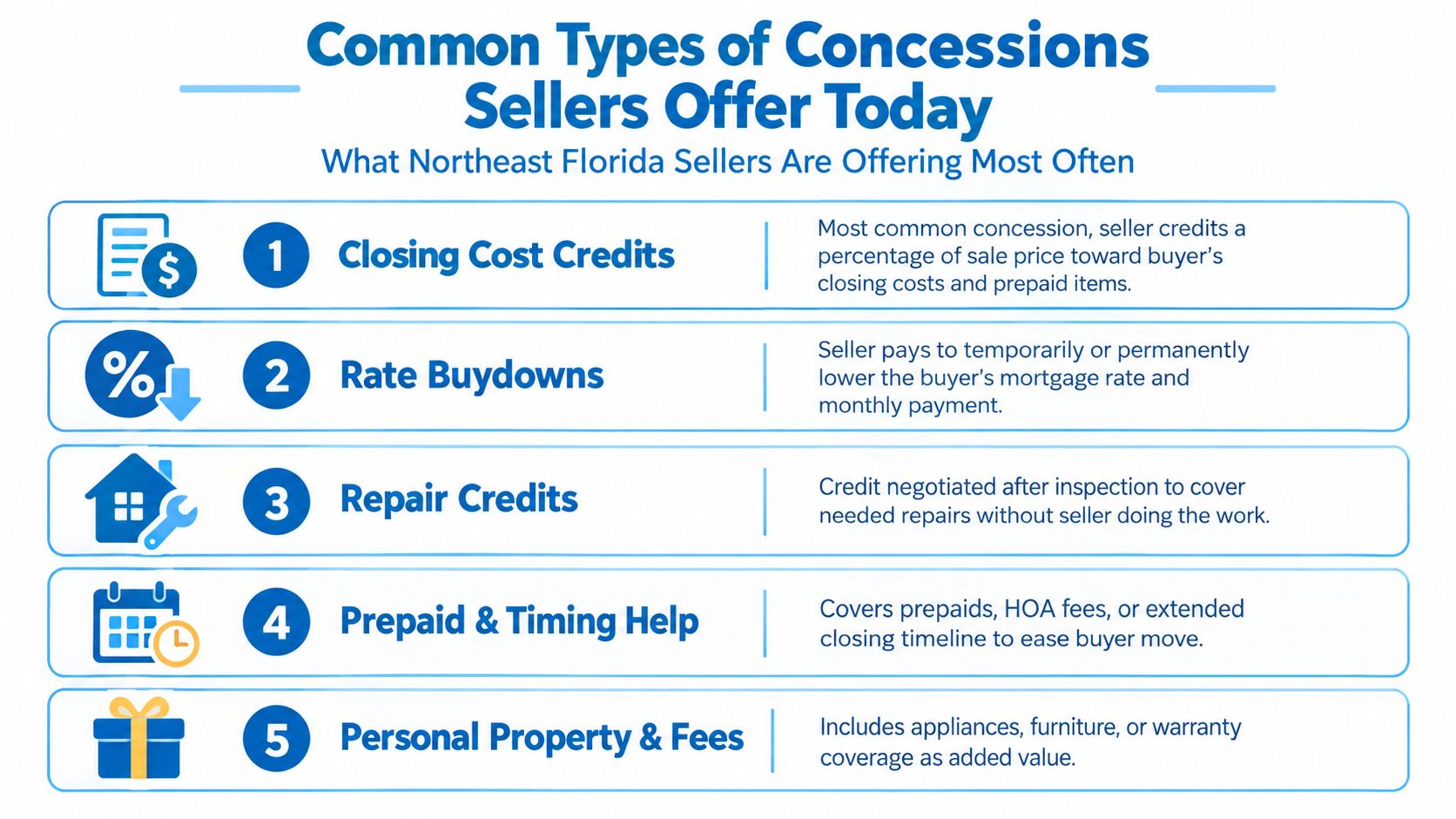
Sellers in Palm Coast and St. Augustine usually have four concession tools that move a deal. The right one depends on what is stopping the buyer. Cash to close, monthly payment, repair anxiety, or timing.
Closing cost credits
This is the one I recommend most often. You agree to pay a set dollar amount toward the buyer's allowable closing costs and prepaid items.
Use it when the buyer likes your price but is light on cash. In that situation, a credit often does more than trimming the price by the same amount because it attacks the objection.
Rate buydowns
A rate buydown uses seller money to pay discount points so the buyer gets a lower interest rate. That can matter more than a small price drop if the buyer is focused on monthly payment.
Use it when showings are decent, buyers are interested, and the payment is what kills momentum. Keep your eye on the math. A buydown can be a smarter pricing lever than a visible list price reduction, especially if you want to protect the contract price.
A short video can help if you want a plain-language walkthrough of how these negotiations often play out:
Repair credits and inspection credits
This shows up all the time with older homes, dated systems, and properties that raise questions after inspection. Instead of hiring contractors, waiting on invoices, and risking delays, the seller offers a credit.
Use it when the issue is real but manageable, and you do not want the deal bogged down over a handful of repairs. For many sellers, that is the cleaner move. The buyer gets control over the work, and you keep the closing on track.
Prepaids, HOA costs, and small sweeteners
Some concessions are smaller but still useful. Sellers may cover prepaid taxes or insurance, help with HOA transfer costs, or include a home warranty.
Use these when the deal is close and needs a nudge, not a full renegotiation. They will not rescue a badly overpriced listing. They can help one buyer say yes without sending a public pricing signal to every other buyer watching your home.
A few rules matter:
- Seller concessions cannot cover the buyer's down payment: FHA's explanation of what seller concessions can cover lays that out plainly.
- Unused credit does not turn into cash for the buyer: if eligible closing costs are lower than the credit, the extra usually goes away.
- Side deals are a bad idea: debt payoff promises, off-contract credits, or cash-like arrangements can get rejected by the lender and wreck the closing.
My advice is simple. Pick the concession that solves the buyer's actual problem. If the buyer is short on cash, use a closing cost credit. If the payment is too high, look at a buydown. If inspection items are stalling the deal, offer a repair credit and keep moving.
Seller Concessions Versus a Price Cut
Want to protect your sale price without losing a buyer over cash? A concession often beats a price cut.
Sellers in Palm Coast and St. Augustine make the same mistake all the time. They drop the price because it feels clean and obvious. But if the buyer's real problem is cash due at closing, a price cut barely helps. A concession targets the problem directly.
Same cost to you, different effect for the buyer
| Factor | $5,000 Concession | $5,000 Price Cut |
|---|---|---|
| Buyer's cash due at closing | Lower | Usually only slightly lower |
| Buyer's loan amount | Usually stays higher | Usually lower |
| Buyer's monthly payment | Can improve more if used for points or a buydown | Improves a little through lower principal |
| Contract price and comp support | More likely preserved | Reduced |
| Seller's net proceeds | Reduced | Reduced |
| Marketing signal to new buyers | Usually stays off the public price history | Shows as a price drop |
That distinction matters.
If your home is getting traffic and offers, your price is probably close. At that point, I would rather give a measured credit than train every new buyer to ask, "What is wrong with this house?" after a visible price drop in the MLS.
When a concession is the smarter play
Use a concession when the house is marketable but the buyer needs help getting to the closing table.
That usually means one of these situations:
- The buyer is tight on closing cash
- The payment works, but the upfront costs do not
- You want to keep the contract price stronger for appraisal and neighborhood comp support
- You have one solid buyer in hand and want to keep the deal together without advertising weakness to the whole market
This is the key strategic point. A concession is a private fix inside one negotiation. A price cut is a public statement to every buyer still watching the listing.
When the price cut is the better choice
A concession will not rescue an overpriced listing.
If showings are weak, online saves are low, and buyers are skipping past your home for better-value options nearby, cut the price. Do it clearly, and do it enough to matter. A $3,000 nibble on a stale listing in Palm Coast usually does nothing. A real adjustment can put you back into the right search bracket, create fresh attention, and bring a new buyer to the table.
A price cut also makes more sense when:
- The buyer already has enough cash to close
- Your listing needs a stronger value signal to attract showings
- You see appraisal risk at the current price
- The market response says the asking price missed the mark
My advice is simple. If the problem is affordability at closing, offer a concession. If the problem is lack of demand, cut the price. Sellers who confuse those two problems usually give up money the wrong way.
Loan Program Rules That Limit Concessions
Loan rules set the ceiling. Sellers who ignore that usually waste time negotiating a credit the lender will cut back anyway.
Before you agree to any concession, get the buyer's loan type in writing and ask the lender or buyer's agent for the actual seller-paid closing cost cap under that program. Do not guess. Do not accept “we should be fine.”
The caps that matter most
For conventional financing, the allowed seller contribution usually rises as the buyer puts more money down. Investment properties are tighter. Fortune's breakdown of how seller concessions vary by loan type is a useful summary.
FHA is different. The cap is generally tied to the lower of the sales price or appraised value, and that matters if value comes in light, as noted earlier in the article.
| Loan Type | Max Concession | What It Can Cover |
|---|---|---|
| Conventional under 10% down | 3% | Eligible closing costs and approved prepaid items |
| Conventional 10% to 24.99% down | 6% | Eligible closing costs and approved prepaid items |
| Conventional 25% or more down | 9% | Eligible closing costs and approved prepaid items |
| Conventional investment property | 2% | Limited eligible costs, subject to lender rules |
| FHA | 6% | Closing costs, prepaid items, and discount points |
Here's the practical takeaway for a seller in Palm Coast or St. Augustine. A concession only works if the buyer can use it. If their loan program caps the credit at 3%, offering 4% does not make you generous. It makes the contract sloppy.
What to check before you sign
I tell sellers to ask these three questions every time:
- What loan program is the buyer using?
- What is the maximum seller contribution allowed under that program?
- Does the buyer have enough real closing costs and prepaid items to use the credit?
That third question gets missed all the time.
Buyers cannot use concession money as cash in their pocket. If their total allowable costs are lower than the credit, the extra amount usually disappears. That is why I prefer targeted credits over random round numbers. Match the concession to an actual need, keep the contract clean, and protect your net.
Appraisal changes the math
Appraisal risk matters more with concessions than many sellers realize.
If the appraisal comes in low, the room for an FHA-style credit can tighten because the calculation is based on the lower value figure. That can force a late renegotiation, especially if the original deal already pushed the edge of what the loan allows. Sellers should treat concessions as part of deal structure, not just a courtesy line item. In a buyer-friendly Northeast Florida market, that discipline helps you hold price where it makes sense and avoid giving away money in a form the lender will not approve.
A Palm Coast Example With Real Numbers
What puts more money in your pocket. Dropping the price, or giving the buyer a credit?
Here's a clean Palm Coast scenario.
Your home is listed at $425,000. A buyer comes in at $420,000 and asks for a seller credit toward closing costs. The buyer is using FHA financing.
The loan matters, but the strategy matters more. FHA buyers can use a seller concession for allowable closing costs and prepaid items, not for the buyer's down payment, and the credit has to stay within program limits already covered earlier in this article. So before you react to the request, do the math on the structure.
Two ways this deal could look
Option 1: Accept the lower price
- Contract price: $420,000
- Seller concession: $0
Option 2: Hold price stronger and give a credit
- Contract price: $425,000
- Seller concession: $5,000
From a seller's seat, those two offers can produce a similar result on paper. But they do not behave the same way in the world.
A concession can be the better play when the buyer's real problem is cash to close. That is common in Palm Coast and St. Augustine, especially with financed buyers who can afford the payment but are stretched on upfront costs. In that case, a targeted credit solves the actual obstacle faster than a price cut.
A price cut spreads the benefit over the life of the loan. A concession helps the buyer get to the closing table now.
How I would call this one
If the home is getting solid traffic and the comps support the number, I would rather keep the contract at $425,000 and negotiate a measured credit than cut the price to $420,000 right away. That keeps your headline sale price stronger and may make the deal easier for the buyer to close.
I would change that advice in two situations.
First, if the appraisal already feels tight, inflating the contract price just to give money back can create trouble. Second, if the buyer is asking for a credit that does not match a real closing-cost need, I would push back and cut price only if that is the cleaner fix.
That is the part sellers miss. Concessions are not courtesy money. They are a pricing tool.
The practical takeaway
In a buyer-friendly Northeast Florida market, a seller concession often beats a price cut when the buyer needs help with upfront costs and the contract still makes sense on appraisal. If the credit strains the appraisal or exceeds what the buyer can use, cut the price or hold firm instead.
Run the numbers line by line. Protect your net. Solve the buyer's real problem, not the one that sounds nicest in the offer.
Common Misconceptions About Seller Concessions
Seller concessions get misunderstood because buyers and even some sellers treat them like bonus money. They are not bonus money. They are part of your pricing strategy, and if you handle them carelessly, you give away net proceeds without fixing the deal problem.
The first mistake is assuming a concession is harmless because the contract price stays higher. Your net still drops. If you agree to a $7,500 credit, you gave up $7,500 unless that credit helped you hold a stronger price, keep the deal together, or attract the right buyer.
What sellers often get wrong
- “The buyer can use it for anything.” No. Lenders limit how concession money gets applied, usually to approved closing costs, prepaid items, or other allowed expenses.
- “A higher contract price with a credit always beats a price cut.” No. If the appraisal is tight, that structure can blow up the deal faster than a straightforward reduction.
- “The buyer gets any leftover credit back in cash.” No. Unused concession money stays in the transaction. It does not become a rebate check to the buyer.
- “A concession makes me look desperate.” Wrong. In Palm Coast and St. Augustine, a smart credit often signals that the seller understands how to solve financing friction without slashing the list price.
- “It won't change my bottom line much.” It changes it dollar for dollar, so treat it with the same scrutiny you would give any other price change.
Here is the part I want sellers to remember. A concession is not a favor. It is a targeted move. Use it to remove a buyer's closing-cost obstacle, protect your asking price when the comps support it, or keep a financed buyer from walking over cash-to-close.
If none of those goals apply, do not offer one.
How to Decide if a Concession Makes Sense for Your Sale
Should you give the buyer a credit, or are you just paying to avoid a hard conversation about price?
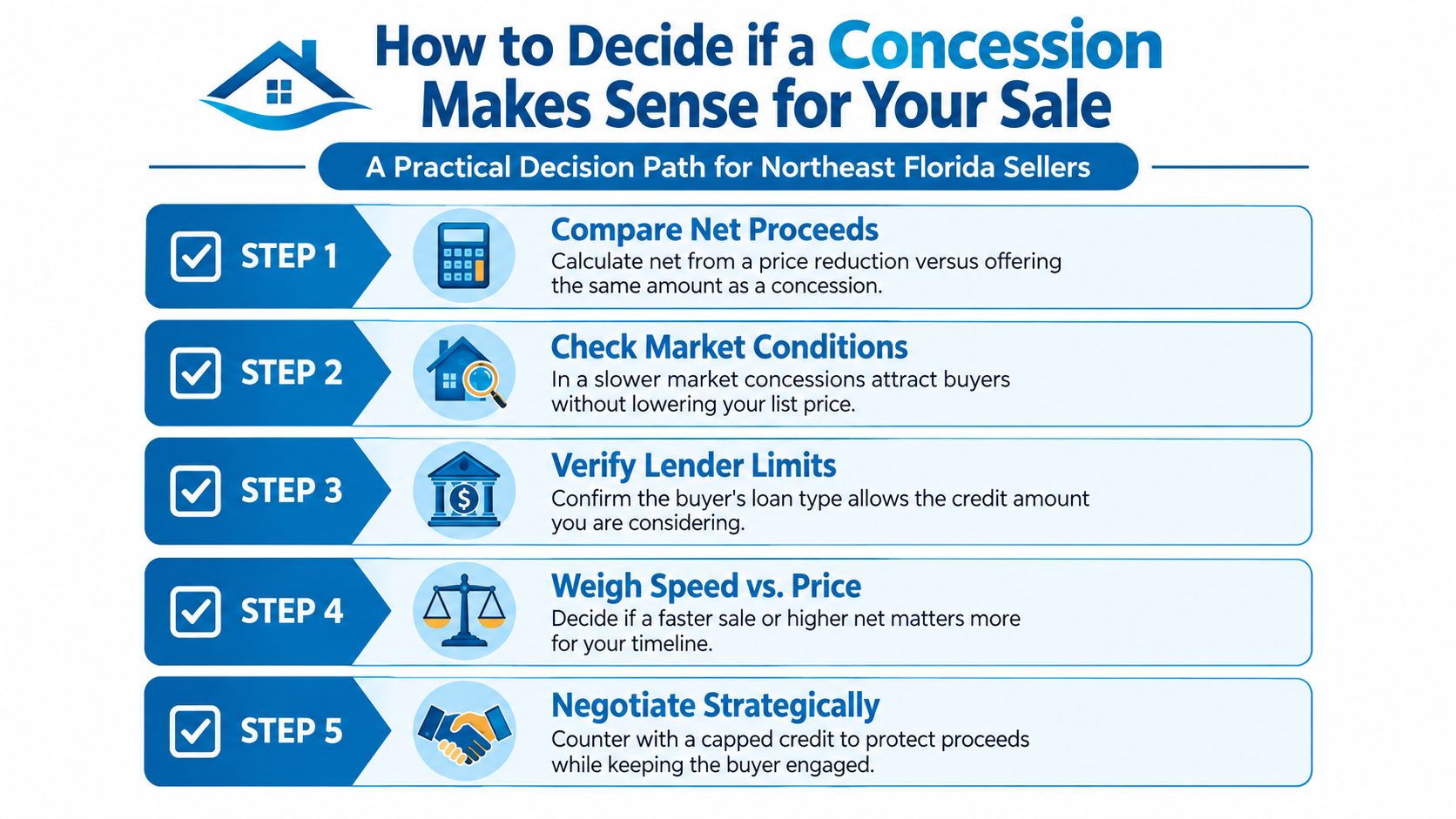
If you are selling in Palm Coast, St. Augustine, or Flagler County, decide based on one thing first. Does the concession solve a specific problem that is blocking this sale?
A good concession fixes buyer cash-to-close, helps you hold a contract price that the comps support, or keeps a solid financed buyer from falling apart late in the deal. A bad concession covers up weak pricing, weak condition, or weak demand. Sellers mix those up all the time.
Start with your net. Then look at the market.
If your home is getting traffic but buyers hesitate because of closing costs, a credit often works better than a straight price cut. The buyer feels less cash pressure up front, and you may protect the headline sale price. If the home is sitting with low activity, stale days on market, and soft feedback on value, cut the price. Do not use a concession as camouflage for an overpriced listing.
Ask these questions before you say yes
- What problem am I solving? If you cannot name it clearly, do not offer the credit.
- Would a price cut attract more buyers than a credit helps one buyer? If your showing activity is weak, price is usually the issue.
- Can the home support the contract price? If appraisal support is thin, forcing a higher price with a concession can backfire.
- Is the buyer short on cash to close? If yes, a concession may keep a good buyer in the game.
- What is my cap? Counter with a firm dollar limit tied to documented closing costs, not an open-ended promise.
Here is the plain rule I give sellers. Use concessions as a pricing tool, not a reflex.
One smart move is to have your Realtor and the buyer's lender map out the numbers before you sign the counteroffer. That lets you compare proceeds, check loan limits, and see whether the credit helps more than a reduction in price. Sellers who want help with pricing strategy, local comps, and contract negotiation can also work with Marilynn Wolfe, LLC as part of that process.
If the credit helps you keep a qualified buyer and protect a realistic price, approve it. If it only makes an overpriced deal look prettier on paper, say no.
If you're selling in Palm Coast, St. Augustine, Flagler County, or nearby communities, Marilynn Wolfe with LPT Realty helps homeowners evaluate pricing, concessions, buyer demand, and net proceeds before they accept an offer. If you'd like a practical opinion on whether a credit or a price cut makes more sense for your home, visit Marilynn Wolfe, LLC or reach out directly at 904-429-2829 or marilynnwolfe.realtor@gmail.com.