
What can derail a local closing even when the buyer, seller, and agents feel confident about the deal? One missed inspection deadline, an unresolved title issue, an incomplete HOA package, or a financing condition can create unnecessary stress for buyers and sellers in Palm Coast, St. Augustine, and Flagler County.
A real estate transaction coordinator checklist turns the contract-to-closing period into a documented workflow. It assigns responsibility, records deadlines, tracks documents, and gives every participant a clear status update. That structure matters even more when an owner lives out of state, a buyer is relocating, a property has coastal or HOA considerations, or a transaction involves new construction.
Industry guidance commonly organizes the process into a phased contract-to-close workflow. One widely used model begins with the fully executed contract, escrow or title opening, earnest money verification, and a calendar of contingencies and deadlines during the first few days. Thorough checklists can contain 80 to 120 or more individual items, depending on the state and transaction type, as shown in industry guidance on transaction coordinator workflows. The following eight checkpoints keep the file moving from pre-listing preparation through post-closing follow-up.
1. Pre-Listing Property Inspection and Documentation
A strong transaction often begins before the property reaches the MLS. Sellers should understand the home's condition before photography, showings, and offer negotiations begin. A coordinator helps organize inspections, maintenance records, warranties, receipts, and photographs so the listing agent can build a more informed pricing and preparation strategy.
For homes in Palm Coast and Flagler County, the review should pay close attention to roofing, exterior weather exposure, drainage, HVAC performance, plumbing, electrical systems, mold, and pests. Older homes in St. Augustine may require additional attention to foundation settling, historic construction details, and repairs that have accumulated over time.
Consider a Palm Coast homeowner who learns that the roof needs replacement before listing. The coordinator can collect repair estimates, preserve the inspection report, organize photographs, and give the listing agent a reliable record for pricing discussions. In St. Augustine, an inspection of a historic home may identify foundation settling. Previous inspection records can help show whether the condition appears stable or requires further investigation.
Practical rule: Document the condition before marketing the property. Clear records reduce confusion when buyers ask questions later.
Schedule inspections early, ideally before professional photographs are taken. For absentee owners, a video walkthrough with the inspector, listing agent, or property representative can provide useful visibility when the owner can't attend in person.

The file should include:
- System records: Gather HVAC, roof, plumbing, electrical, pest, and appliance information.
- Repair evidence: Save invoices, warranties, permits, and contractor communications.
- Visual documentation: Store dated photographs and written notes in a shared digital folder.
- Remote access: Make sure an absentee seller can review the same information as the local team.
A coordinator's role is administrative and organizational. Licensed agents and brokers must handle pricing advice, negotiations, and other activities that require a license under applicable rules.
2. Buyer Qualification and Financing Verification
An accepted offer is only as dependable as the buyer's ability to complete the financing process. The coordinator should collect the pre-approval letter promptly, identify conditions that still need to be satisfied, and map the financing and appraisal deadlines into one shared calendar.
A pre-approval may depend on employment verification, updated income documents, asset statements, or other lender conditions. Relocating buyers moving to Palm Coast or St. Augustine may also rely on employer relocation assistance. That information should be confirmed early, particularly if the buyer is changing jobs, selling another property, or moving from another state.
Property characteristics matter, too. A loan program may have requirements related to flood zones, insurance, property condition, HOA documentation, or the type of construction. For a property in Flagler Estates or a coastal area, the coordinator should ask the lender whether the chosen loan program can accommodate the property's location and documentation requirements before deadlines become tight.
A practical file should record:
- Loan type: Note whether the buyer is using a portfolio, conventional, FHA, VA, or USDA loan.
- Outstanding conditions: List each lender condition, the responsible party, and the expected delivery date.
- Funds verification: Track the source and documentation of the down payment and closing funds.
- Contingency dates: Tie financing and appraisal milestones to the signed contract.
- Seller communication: Give an absentee seller a clear summary of the buyer's documented financial position without overstating the certainty of closing.
Widely used workflow guidance recommends confirming signed contracts, entering the file into a management system, sending introductions, and verifying earnest money at the start of the transaction. It also emphasizes tying each task to a date or event rather than managing the deal informally, as described in this milestone-based transaction coordinator checklist.
The coordinator doesn't approve the loan or interpret underwriting decisions. The lender owns those decisions. The coordinator keeps the parties informed, records conditions, and escalates missed milestones to the appropriate professional.
3. Title Search and Clearance Resolution
Title work should begin immediately after offer acceptance, not shortly before closing. A qualified title company searches for liens, judgments, unpaid taxes, easements, encumbrances, HOA claims, and boundary concerns. Early discovery gives the seller time to resolve problems and gives the buyer and lender time to evaluate exceptions.
A Palm Coast property, for example, may have unpaid HOA assessments that result in a lien. The coordinator can request the association's payoff statement, keep the title company and seller informed, and confirm that the amount is addressed through the settlement process. The coordinator shouldn't promise a resolution before the title company confirms the required steps.
A St. Augustine property may present a boundary or survey discrepancy. In that situation, the title company, surveyor, agents, attorneys, and affected parties may need to coordinate before the title becomes insurable. Historic properties may also require careful review of preservation-related restrictions or other recorded matters that could affect the transfer.
Keep the title file easy to audit
The coordinator should maintain a chronological record of title communications and resolutions. That record may include the title commitment, payoff requests, survey documents, lien releases, tax information, HOA correspondence, and written confirmation that exceptions have been addressed.
For Palm Coast and Flagler Estates transactions, requesting an HOA lien search early can prevent a late surprise. Buyers should receive the relevant title information through the proper channels, while questions about legal rights, title exceptions, or contract remedies should be directed to the title company or an attorney.
The best practice is simple. Order title work early, read the commitment carefully, flag concerns quickly, and never let a title issue remain an undocumented verbal conversation.
4. Inspection Negotiation and Repair Coordination
Inspection results often create the most active period of communication in a transaction. The coordinator schedules inspections, distributes reports, collects contractor estimates, records requested actions, and tracks the response deadline. The buyer's and seller's agents handle negotiation and advice, while the coordinator keeps the administrative details visible.
In Palm Coast, an inspection may identify roof damage. The file should show who requested estimates, which contractors responded, what work was agreed upon, whether a credit was selected instead of a repair, and when the parties must provide written confirmation. In St. Augustine, outdated electrical work may lead the parties to agree on a credit so the buyer can choose an electrician after closing. The exact solution depends on the contract and negotiated agreement.
Put every repair agreement in writing, with a specific description, completion date, receipt requirement, and verification method.
Buyers need enough time to complete inspections and evaluate reports. The supplied local workflow plan identifies 7 to 10 days as a standard inspection timeframe in the Palm Coast market, but the controlling deadline is always the signed contract. A coordinator should never substitute a general timeframe for the actual agreement.
Repair tracking works best when the file separates facts from opinions:
- Report findings: Preserve the original inspection report and relevant photographs.
- Requested remedies: Record the buyer's written request and response deadline.
- Estimates: Obtain qualified contractor estimates when the parties need cost context.
- Completion proof: Save invoices, permits, photographs, and receipts.
- Final verification: Coordinate the buyer's review or the agreed credit at closing.
Cosmetic work may be better handled through a credit when the buyer wants control over materials or contractors. Safety, lender, insurance, and code-related concerns may require a more specific resolution. The coordinator should document the choice without making the legal or negotiation decision.
5. Appraisal Management and Value Protection
The appraisal connects the purchase contract to the lender's collateral decision. A coordinator can help the listing or buyer's agent assemble relevant property information, recent comparable sales, improvement records, and neighborhood context for the appraiser.
That context can be particularly useful in Palm Coast, where nearby properties may differ by subdivision, condition, lot characteristics, waterfront exposure, or improvements. A Flagler Estates property may also require careful comparison with homes that share similar construction, acreage, access, and utility characteristics. In St. Augustine, a historic home's character and location may be important context, but the appraiser must still apply the applicable valuation process.
If an appraisal comes in below the contract price, the coordinator should move quickly without promising that the value will change. The agent may compile comparable sales, receipts, permits, and improvement photographs for a reconsideration request when the facts support one. The parties may then consider contractually permitted options, which can include a price adjustment, additional funds, or another negotiated solution.
Build the appraisal packet early
A useful packet may contain:
- Recent improvements: Include invoices, permits, photographs, and completion details.
- Comparable sales: Provide relevant neighborhood sales selected by the agent.
- Property distinctions: Explain features that affect comparison, such as location, condition, additions, or lot characteristics.
- Timeline status: Track the order date, inspection date, report delivery, and any response deadline.
A late appraisal creates pressure even when everyone has acted in good faith. An absentee seller may not understand why the appraisal matters, so the coordinator should explain the process in plain language and route valuation questions to the listing agent or lender.
6. Insurance and HOA Document Collection
Insurance and HOA documents can affect both the buyer's decision and the lender's ability to approve the transaction. Request them soon after acceptance, especially for Palm Coast communities and properties with association rules, rental restrictions, architectural standards, or shared amenities.
The package may include bylaws, rules, budgets, reserve information, current fees, pending assessments, litigation disclosures, contact information, and architectural guidelines. The coordinator should also confirm whether the seller's account is current and whether the association has outstanding requests that could delay closing.
Suppose a Palm Coast HOA is slow to respond. The coordinator should contact the management company, document each request, identify an escalation contact, and set an internal follow-up date. If the records disclose a significant special assessment, the buyer should receive the information promptly and discuss its financial effect with the buyer's agent, lender, or attorney as appropriate.
A complete HOA package is not a formality. It can change a buyer's budget, financing path, intended use, or decision to proceed.
Insurance coordination deserves the same care. Coastal properties and homes in areas with flood considerations may require additional review by the buyer's insurance agent and lender. The coordinator can track requests and delivery, but shouldn't interpret coverage or guarantee insurability.
The file should clearly show:
- Request date: Record when the HOA and insurance documents were ordered.
- Review period: Confirm the buyer receives documents before the applicable contingency deadline.
- Financial concerns: Flag fees, assessments, low reserves, litigation, or restrictions for the appropriate professionals.
- Property use: Identify rental, occupancy, architectural, or improvement rules that may matter to the buyer.
- Delivery proof: Save emails or portal confirmations showing when documents were delivered.
7. Closing Document Preparation and Walkthrough Coordination
Closing week should confirm readiness, not reveal basic errors for the first time. The coordinator works with the title company and lender to track the Closing Disclosure, settlement statement, deed, loan documents, repair evidence, payoff information, and signing logistics.
The supplied workflow plan recommends requesting the Closing Disclosure and settlement statement at least 3 days before closing. That gives the parties time to review the property address, names, credits, commissions, taxes, fees, lender terms, and payoff amounts. If a document contains an incorrect address or another material error, early review gives the title company time to correct it.
The final walkthrough should usually occur the day before closing when schedules allow. A Palm Coast buyer may discover that an agreed roof repair remains incomplete. The coordinator can contact the agent, contractor, title company, and seller to determine whether the work can be completed, documented, or addressed through an agreed closing adjustment.
Prepare every participant
Closing instructions should state the time, location, identification requirements, expected participants, documents to bring, and approved communication channels. Wire instructions require special care. Parties should verify instructions directly with the title company using a trusted phone number and avoid relying solely on an unexpected email.
For absentee sellers, remote signing or a power-of-attorney arrangement may be possible, but it should be discussed and approved early with the title company and any required attorneys or lenders. Relocation buyers may also need help coordinating travel, remote document review, utility setup, and possession timing.
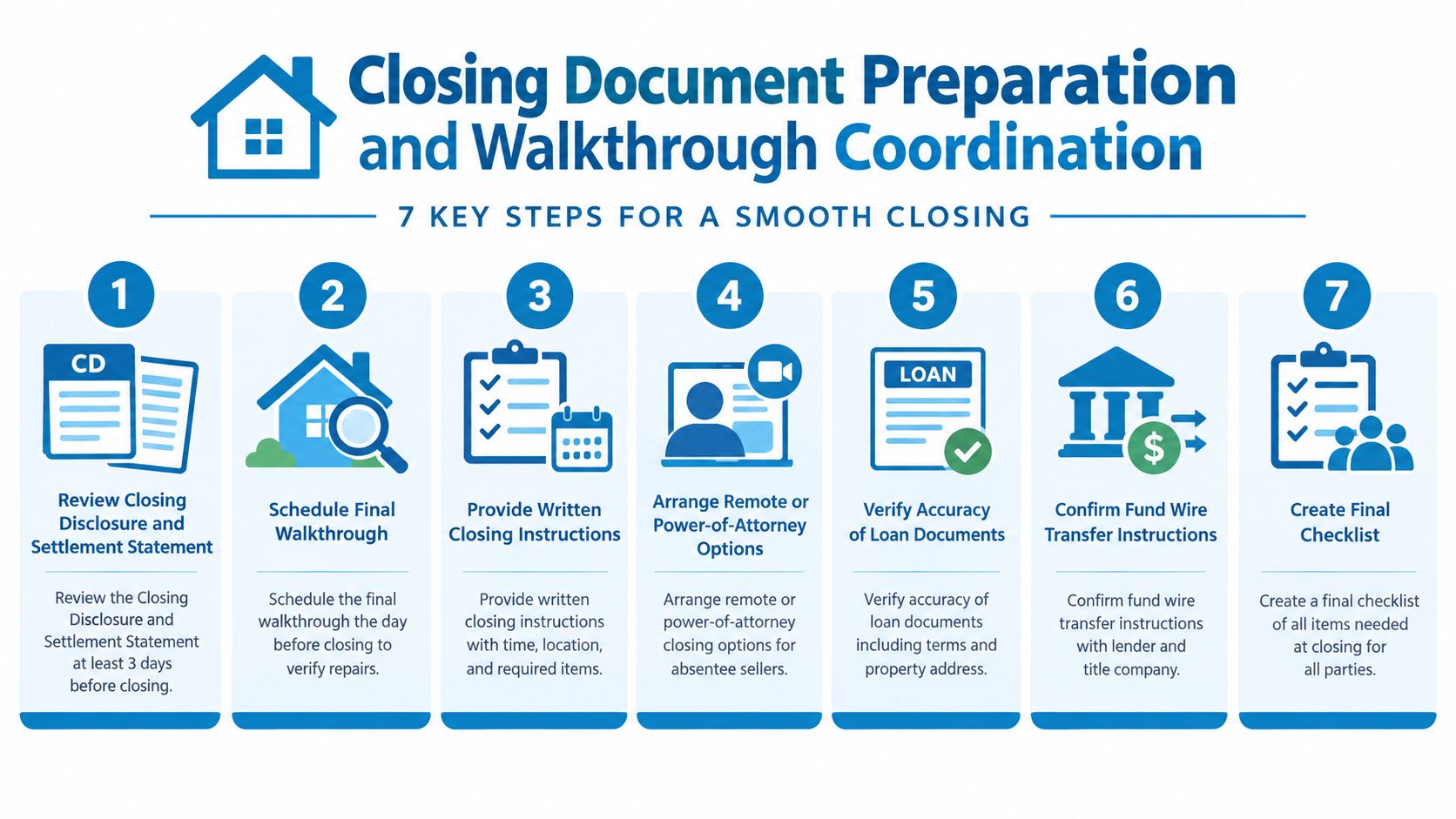
A final readiness review should confirm that contingencies are addressed, funds are scheduled, repairs are documented, title is clear or insurable, and every participant knows what happens next.
8. Post-Closing Follow-Up and Issue Resolution
The transaction isn't administratively complete when the signatures are finished. The coordinator should confirm recording, fund distribution, title transfer, key delivery, warranty information, utility arrangements, and any remaining document requests.
For an absentee seller, the closing file should include the final settlement statement and confirmation of funds received. A buyer relocating to Palm Coast or St. Augustine may need practical handoff information about utilities, HOA payments, warranties, service providers, or property management. A new construction buyer may also need builder warranty contacts and a record of outstanding punch-list items.
Follow-up should be specific rather than automatic. If deed recording is delayed, the coordinator contacts the title company and records the status. If a buyer later asks who is responsible for an HOA payment during the transition period, the coordinator can locate the relevant closing documents and direct the question to the HOA, title company, agent, or attorney who can provide the appropriate answer.
The file should be archived by category:
- Recorded documents: Save confirmation of recording and final title documents.
- Financial records: Retain the settlement statement and distribution information.
- Property handoff: Organize keys, codes, warranties, manuals, and service records.
- Open issues: Track post-closing questions, responsible parties, and resolutions.
- Client follow-up: Send clear next-step information and preserve current contact details.
A complete contract-to-close process can consume substantial coordinator time. A 2025 operational benchmark cited in industry coverage reports an average of 14.2 hours per deal and estimated coordinator labor at $635 per transaction, with deadline logging, document collection, contingency tracking, and closing confirmation identified as major time demands in this transaction coordination automation benchmark. That reinforces the value of compressing repetitive administrative work without removing human review.
8-Point Real Estate Transaction Coordinator Checklist Comparison
| Service | Implementation complexity | Resource requirements | Expected outcomes | Ideal use cases | Key advantages |
|---|---|---|---|---|---|
| Pre-Listing Property Inspection and Documentation | Medium, coordinates multiple inspections and multimedia documentation | Home inspectors, photographer/videographer, transaction coordinator, contractor estimates | Baseline condition report; informed pricing and disclosures | Coastal, older or absentee-owned homes before listing | Reduces surprises; enables proactive repairs; strengthens pricing rationale |
| Buyer Qualification and Financing Verification | Medium, time-sensitive coordination with lenders and buyers | Lender contacts, buyer financial documents, verification tools, communication time | Verified buyer capacity; fewer financing-related fall-throughs | Multiple-offer situations; distant/relocating buyers; flood-zone or HOA-restricted properties | Increases close certainty; early detection of financing issues; realistic timelines |
| Title Search and Clearance Resolution | Medium–High, legal and record searches plus defect resolution | Title company, legal counsel (as needed), tax and HOA records, survey data | Clear, insurable title; identified liens/encumbrances resolved pre-closing | Older properties, properties with complex ownership or HOA histories | Prevents closing blocks; protects buyer/lender; resolves liens early |
| Inspection Negotiation and Repair Coordination | High, negotiation, contractor sourcing, and timeline enforcement | Qualified contractors, repair estimates, communication tracking, funds/credit processing | Agreed repairs or credits; verified completion; maintained closing schedule | Properties with post-inspection repair requests or known defects | Keeps deal on track; documents repairs; reduces last-minute disputes |
| Appraisal Management and Value Protection | Medium, comp preparation and potential appraisal challenge work | Comparable sales data, improvement receipts/photos, lender/appraiser communication | Appraisal aligned with sale price or timely challenge; reduced financing risk | Rapidly changing markets, recently upgraded homes, historic properties | Protects sale price; enables appraisal reconsideration; supports lender case |
| Insurance and HOA Document Collection | Medium, obtaining HOA packets and insurance proof on schedule | HOA management, insurance agents, document fees, tracking system | Lender-ready HOA/insurance documents; buyer informed of obligations | Condo/HOA communities, properties subject to assessments or covenants | Prevents financing delays; reveals assessments/restrictions early; informs buyers |
| Closing Document Preparation and Walkthrough Coordination | Medium, synchronizes title, lender, and signing logistics | Title company, lender, scheduling tools, wire transfer confirmations, signing agents | Accurate closing docs; verified final condition; orderly closing execution | Remote/absentee closings, complex transactions, last-minute repair verifications | Reduces closing errors; ensures readiness; coordinates logistics |
| Post-Closing Follow-up and Issue Resolution | Low–Medium, monitoring recording and post-closing tasks | Title/escrow contacts, document archiving system, follow-up communications | Confirmed recording and fund distribution; archived transaction file; resolved post-close items | Absentee sellers, transactions needing utility or warranty handoffs | Catches post-close issues early; provides record retention; improves client satisfaction |
A Smoother Closing Starts With Clear Tracking
A useful real estate transaction coordinator checklist isn't just a long list of boxes. It connects documents, deadlines, inspections, financing, appraisal, contingencies, communication, and final handoffs in one visible workflow. Each task should identify an owner, a due date, a status, and the next escalation point.
That structure helps sellers prepare before problems reach the negotiation stage. It helps buyers understand what their lender, title company, HOA, inspector, and agent still need. It gives absentee owners a reliable way to follow a Palm Coast, St. Augustine, or Flagler County transaction without being physically present for every appointment.
The checklist should also change based on the property and transaction. A coastal home may require more careful insurance and flood-related coordination. An HOA property needs association documents, fee verification, and rule review. A historic St. Augustine property may require additional title, survey, condition, or preservation questions. Flagler Estates homes can call for closer attention to property characteristics, access, utilities, and lender requirements. New construction transactions may use builder milestones instead of a conventional contingency calendar.
Technology can support that process, but storage alone isn't enough. A 2025 technology study cited in industry coverage reported that 68% of agents use dedicated transaction management software, up from 45% in 2021, while only 31% have configured automation beyond basic document storage, according to industry coverage of transaction management software adoption. A useful system should include signature status, contingency dates, escalation triggers, client-update milestones, and fields that support data synchronization.
The coordinator must also respect licensing boundaries. Administrative professionals can organize documents, deadlines, communication, and compliance records, but licensed advice, negotiation, contract interpretation, and decisions about legal rights belong with the appropriate licensed professional. A strong brokerage workflow makes those boundaries clear instead of leaving staff to guess.
For homeowners considering selling, a practical checklist begins with preparation. Marilynn Wolfe, a Strategic Listing Agent with LPT Realty LLC, helps clients in Palm Coast, St. Augustine, Flagler County, and surrounding communities evaluate condition, pricing strategy, buyer positioning, and transaction readiness. That guidance can be especially valuable for absentee property owners, move-up sellers, downsizing homeowners, 55+ clients, relocation buyers, and people exploring new construction.
If you're preparing to sell or buy, organized local guidance can make the process easier to understand and easier to manage. Contact Marilynn Wolfe, LPT Realty LLC, at 904-429-2829 or marilynnwolfe.realtor@gmail.com, and visit marilynnsellsfl.com for help with Palm Coast real estate, St. Augustine real estate, Flagler County real estate, and your next transaction.
Marilynn Wolfe, LLC offers thoughtful pricing strategy, local market insight, and clear transaction guidance for sellers, absentee owners, relocating buyers, and new construction clients. If you want a better-organized path from preparation through closing, visit Marilynn Wolfe, LLC to start a conversation.