
A free agent CMA can value your house at no cost, while a standard full appraisal generally costs about $300 to $600. Desktop appraisals often run roughly $125 to $300, depending on property complexity and loan type.
So, how much does it cost to value a house in 2026? The honest answer is that the method matters more than the number. A Palm Coast homeowner preparing to sell has different needs from a buyer getting a mortgage, an absentee owner settling an estate, or a homeowner refinancing in St. Augustine.
Paying for the wrong valuation is one of the most common avoidable costs before listing. Most sellers don't need a lender-grade appraisal to choose a price. They need a current, local analysis of comparable sales, buyer demand, condition, and neighborhood competition.
What Most Homeowners Are Actually Asking
A Palm Coast homeowner recently sits at a kitchen table with three online estimates open on a laptop. One says the house is worth $365,000. Another suggests $405,000. A third lands somewhere between them. The gap is large enough to affect a listing decision, but the homeowner still doesn't know which number deserves trust.
The core question isn't just “What is my home worth?” It's, “Why do I need the valuation?” The answer determines whether you should spend nothing, a few hundred dollars, or more for a formal report.
Curiosity before listing
Many homeowners in Palm Coast, Flagler County, and St. Augustine are only testing the waters. They may be considering downsizing, relocating, moving closer to family, or buying a new construction home before deciding whether to sell. For that purpose, a local agent's Comparative Market Analysis, or CMA, is usually the practical starting point.
A CMA considers recent comparable sales, competing listings, property condition, improvements, and neighborhood characteristics. It gives you a pricing range designed for a real market decision, not just an automated estimate based on limited public data.
A lender requirement
A lender may require an appraisal for a purchase, refinance, or certain home-equity transactions. In that situation, the lender determines what type of valuation it will accept. A cheaper desktop report won't help if the underwriter requires a full inspection.
In a typical purchase, the lender orders the appraisal and the buyer usually pays the fee. During a refinance, the homeowner generally pays. Bankrate's appraisal cost guide explains this common payment structure and the typical few-hundred-dollar cost for a standard home.
Tax, estate, or legal planning
Estate settlement, divorce, tax appeals, and other documentation needs can call for an independent appraisal rather than an agent's pricing opinion. The report must fit the purpose, date, and authority requesting it.
Practical rule: Start with the reason for the valuation, then choose the method. Don't start with the cheapest fee.
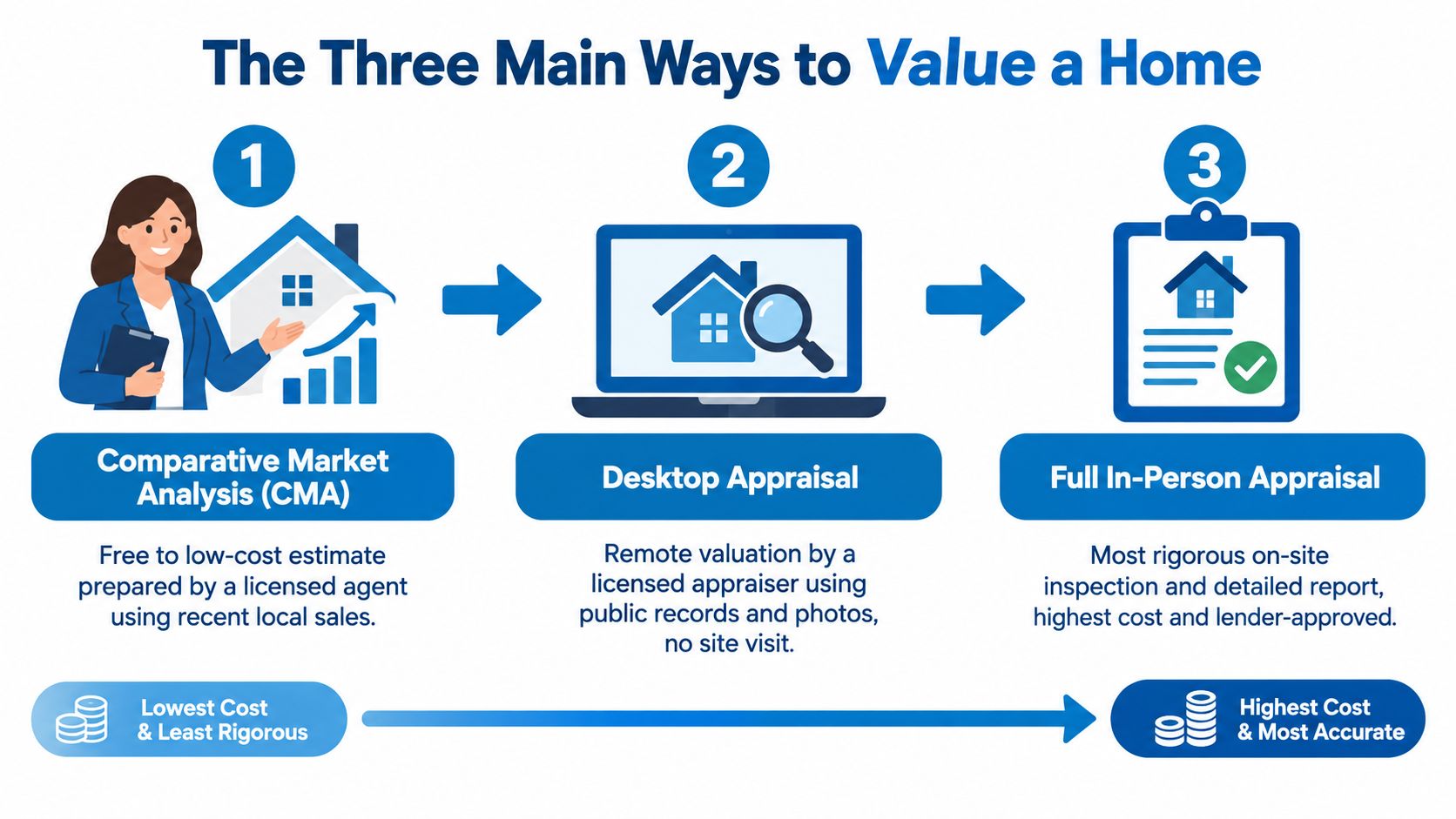
The three paths are straightforward: a free or low-cost CMA, a desktop appraisal, and a full in-person appraisal. The right choice depends on whether you're making a selling decision, satisfying a lender, or creating formal documentation.
The Three Main Ways to Value a Home
The simplest way to understand valuation is as a spectrum. A CMA offers local pricing guidance at the lowest cost. A desktop appraisal provides a more formal opinion without a site visit. A full appraisal involves an appraiser inspecting the property and preparing a lender-approved report.
Comparative Market Analysis
A licensed real estate agent prepares a CMA by reviewing recent local sales, active competition, withdrawn listings, property features, and market positioning. A good CMA isn't an automated guess. It reflects how buyers are likely to compare your home with other available properties.
For homeowners deciding whether to list, the CMA is normally the best first step and is often free when prepared as part of a listing consultation. The agent typically provides a suggested pricing range, explains the trade-offs between a faster sale and a higher initial price, and identifies improvements that may affect buyer perception.
A CMA isn't a substitute for a lender appraisal. It answers a different question: What price strategy gives this home a reasonable chance of attracting today's buyers?
Desktop appraisal
A desktop appraisal is completed remotely using public records, floor plans, photographs, and local market data. Angi's home appraisal guide describes desktop appraisals as a lower-cost alternative because they don't require a full interior inspection.
This method can work for straightforward properties with reliable records and consistent comparable sales. It may suit certain refinance or home-equity situations, but acceptance depends on the lender and transaction.
Full in-person appraisal
A full appraisal requires an appraiser to visit the property, inspect its condition and features, analyze comparable sales, and reconcile the evidence into a formal report. OpenDoor's explanation of the appraisal process distinguishes this more labor-intensive workflow from desktop and hybrid products.
This is the method most associated with traditional mortgage financing. It carries the greatest cost, but it also provides the documentation lenders and other institutions commonly require.
Here is a concise video overview of the appraisal process:
Typical Cost Ranges for Each Method
A listing-agent CMA is usually free. The agent prepares it to help you decide whether selling makes sense and how your home should be positioned. In Palm Coast, St. Augustine, and surrounding Flagler County communities, the value comes from interpreting neighborhood-level competition, not from charging for a report.
Online tools such as Zillow's Zestimate and Realtor.com's estimates are also free. Treat them as starting points only. Automated valuation models depend heavily on current comparable sales and accurate property information. A Brookings review of AVMs notes that only about 40% of homes may be suitable for valuation solely by an AVM, although some AVMs performed within 10% of the sales price for at least 95% of homes in test sets. Those figures describe model performance and suitability, not a guarantee for your property.
A desktop appraisal commonly costs $125 to $300 for a standard single-family home. A broader industry range places some desktop assignments as high as $400, depending on the property and assignment requirements.
A full in-person appraisal generally costs $300 to $600. A standard single-family appraisal often falls around $357 to $359, while recent 2025 to 2026 market data show a common range of roughly $314 to $423, according to Bankrate's current appraisal cost information. In Palm Coast, standard single-family appraisals commonly land between $350 and $500.
Larger, rural, unusual, or multi-unit properties can cost more. HomeAdvisor's inspectors and appraisers cost guide reports that multi-family appraisals often range from $600 to $1,500, while complex properties may push fees to $600 or above $1,000.
| Method | Typical Cost | Who Typically Pays | Best For |
|---|---|---|---|
| Agent CMA | Free to low cost | Seller or listing relationship | Pre-listing strategy and market positioning |
| Desktop appraisal | $125 to $300 | Homeowner or borrower | Some refinance and equity transactions |
| Full in-person appraisal | $300 to $600 | Buyer in a purchase, homeowner in a refinance | Mortgage financing and formal valuation needs |
Some mortgage transactions may qualify for an appraisal waiver, which can eliminate the appraisal fee. The lender, loan program, and property must meet the lender's requirements.
Which Option Makes Sense for Different Situations
The best valuation isn't automatically the most expensive one. It is the one that answers your question and will be accepted by the person making the decision.
| Situation | Best Method | Why It Fits | Lender Acceptable |
|---|---|---|---|
| Wondering whether to sell | CMA | Gives local pricing context without an upfront fee | Usually not a lender substitute |
| Preparing to list | CMA | Connects value with buyer competition and pricing strategy | Not intended for underwriting |
| Straightforward refinance inquiry | Desktop appraisal, if approved | Limits inspection work while producing a formal valuation | Only if the lender accepts it |
| Purchase transaction | Full appraisal, if required | Supports the lender's collateral decision | Commonly accepted |
| Estate or divorce documentation | Independent full appraisal | Creates a dated, formal opinion for documentation | Depends on the requesting institution |
| Unique or heavily renovated home | Full appraisal | Allows direct inspection and deeper analysis | More likely to satisfy formal requirements |
For early selling decisions, a CMA usually provides the most useful information. It can account for presentation, listing competition, buyer expectations, and the difference between a price that attracts showings and one that sits.
A desktop appraisal becomes more relevant when a lender wants a formal opinion but permits remote analysis. It can be efficient for a conventional property with dependable records. It is not automatically suitable for a waterfront home, a property with substantial additions, or a home whose features are difficult to verify remotely.
A full appraisal is the correct choice when the lender demands it, when the property is unusual, or when the valuation must stand as formal documentation. For FHA and VA assignments, added condition, safety, and compliance requirements can affect both the fee and the acceptable workflow, as Rocket Mortgage's appraisal overview explains.
The cheapest report becomes expensive when the lender rejects it and you have to order another one.
What Drives the Price Up or Down
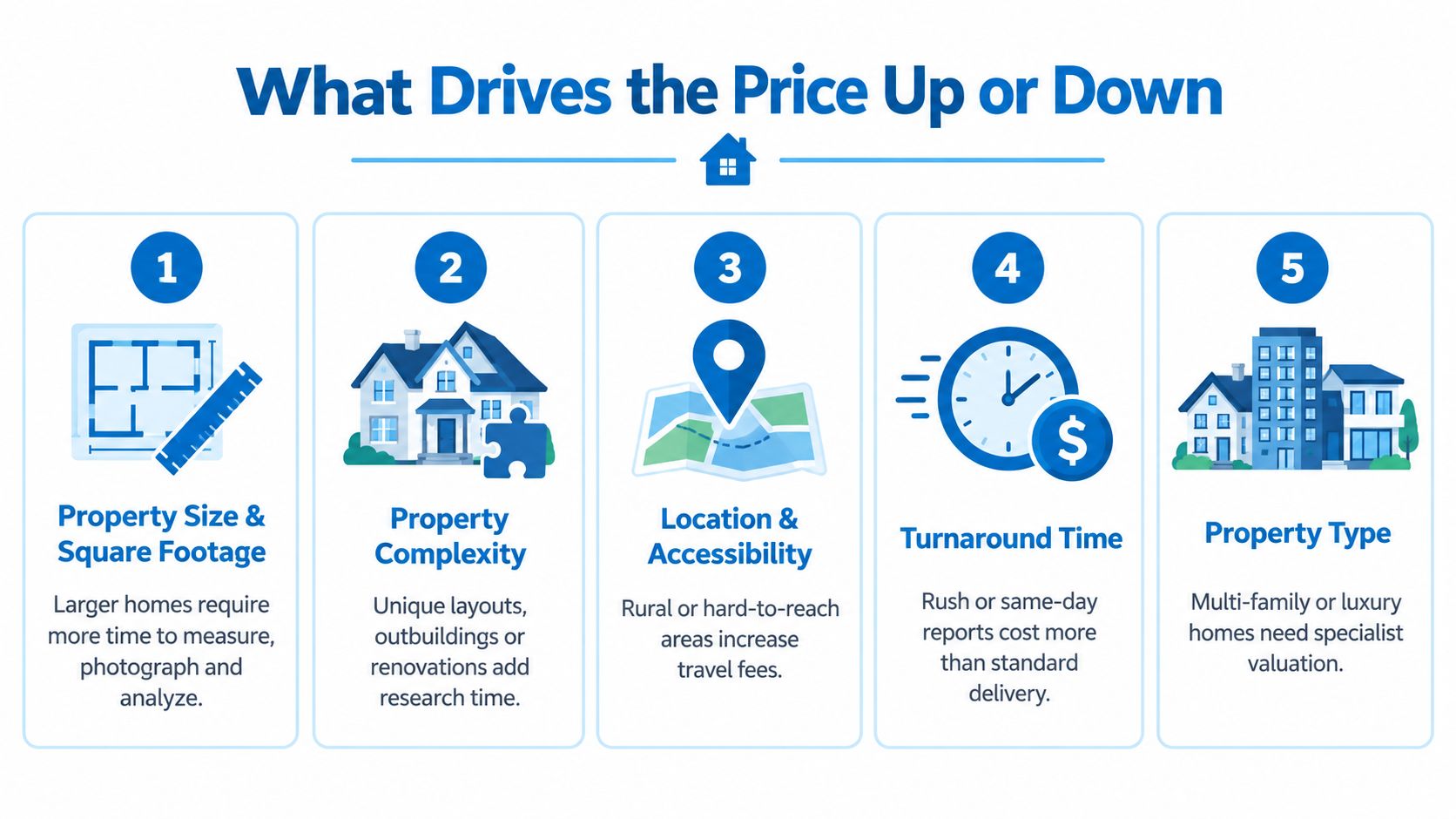
Appraisal fees change because appraisers spend different amounts of time collecting, verifying, and reconciling information. The property itself matters, but so do the loan program, location, timing, and report requirements.
Property size and complexity
A larger home requires more time to inspect, measure, photograph, and analyze. A compact, standard floor plan is easier to compare than a home with extensive additions, detached structures, unusual room layouts, or custom improvements.
Waterfront access, multi-parcel ownership, outbuildings, and specialized features can also complicate comparable selection. A Flagler Estates property with acreage may require a different analysis from a conventional subdivision home in Palm Coast.
Location and accessibility
Travel distance affects mobile assignments. Routing between Palm Coast, St. Augustine, rural Flagler County, and nearby communities can influence scheduling and fees, particularly when a property is difficult to access or requires a longer appraiser visit.
Location also affects the availability of suitable comparable sales. An appraiser may need to search beyond the immediate neighborhood when the property has features that aren't common in nearby listings.
Loan type and turnaround
Conventional appraisals are generally the least demanding standard lender assignments. FHA and VA appraisals commonly carry higher fees because the appraiser must address additional condition, safety, and compliance requirements. The loan program can matter more than a small difference in square footage.
Rush delivery can add a premium because the appraiser has to rearrange existing appointments and prioritize the report. Ask who controls the deadline and whether the quoted fee includes any rush service before ordering.
The Federal Housing Finance Agency's publication of Uniform Appraisal Dataset aggregate statistics since 2023 has made appraisal-report trends more visible at national, state, regional, and local levels, as noted by HomeAdvisor's cost overview. That public data infrastructure improves transparency, but it doesn't make every property interchangeable.
Choosing the Right Valuation in Palm Coast
A homeowner in Pine Lakes may be preparing to sell, while another owner in Grand Haven may be deciding whether to move closer to family. Both may ask how much their homes are worth, but neither should automatically order a paid appraisal.
For a typical pre-listing decision, a CMA answers the useful questions. How do Palm Coast home values compare with nearby competition? Which features matter to buyers? Should the home launch at a price designed to generate early activity, or should the seller test a higher position? A local agent can connect those answers to the Palm Coast real estate market rather than relying on a national algorithm.
The same principle applies in St. Augustine real estate, Flagler County real estate, and Flagler Estates homes. Neighborhood differences, property condition, access, construction style, and buyer demand can shift the practical list-price strategy even when online estimates look precise.
When a paid appraisal is justified
A paid appraisal makes sense when a lender requires it, when an estate or legal matter needs formal documentation, or when an unusual property requires an independent inspection. It may also help an absentee property owner who needs a formal record rather than a marketing recommendation.
Most sellers don't need to pay for an appraisal before listing. The avoidable mistake is ordering a formal report before confirming that the report will serve a specific purpose.
Marilynn Wolfe, LLC offers a home valuation page and a free consultation with a local agent to help homeowners estimate and understand property value. For a homeowner deciding whether to sell, downsize, relocate, or purchase a new construction home, that conversation is a sensible first step.
My recommendation: Get a local CMA first. Upgrade to a desktop or full appraisal only when the property, lender, or documentation requirement makes it necessary.
If you're considering selling in Palm Coast, St. Augustine, Flagler County, or a surrounding community, Marilynn Wolfe can review the property and neighborhood context before you spend money on a valuation you may not need.
Marilynn Wolfe, LLC offers local pricing guidance, market insight, and preparation advice for homeowners selling in Palm Coast, St. Augustine, Flagler County, and surrounding areas. Visit Marilynn Wolfe, LLC to request a personalized home value review, or call Marilynn Wolfe at 904-429-2829 or email marilynnwolfe.realtor@gmail.com.