
A home value estimate is an evidence-based opinion of what a house might sell for on a specific date, not a guaranteed sale price. In Palm Coast, St. Augustine, and Flagler County, that number is only useful if you understand how it was built and where it can miss.
If you're staring at an online number before you decide whether to sell, refinance, or just see where you stand, you're asking the right question. Most homeowners want a straight answer, but the honest answer is a little more specific, because the market is local, the data changes, and the method matters.
A Clear Definition for Homeowners
A homeowner in Palm Coast pulls up an online estimate and sees a number that feels close enough to plan around. A homeowner in St. Augustine does the same thing and gets a different figure from a different site. That's normal, and it's exactly why people need to understand what is a home value estimate before they treat it like a final answer.
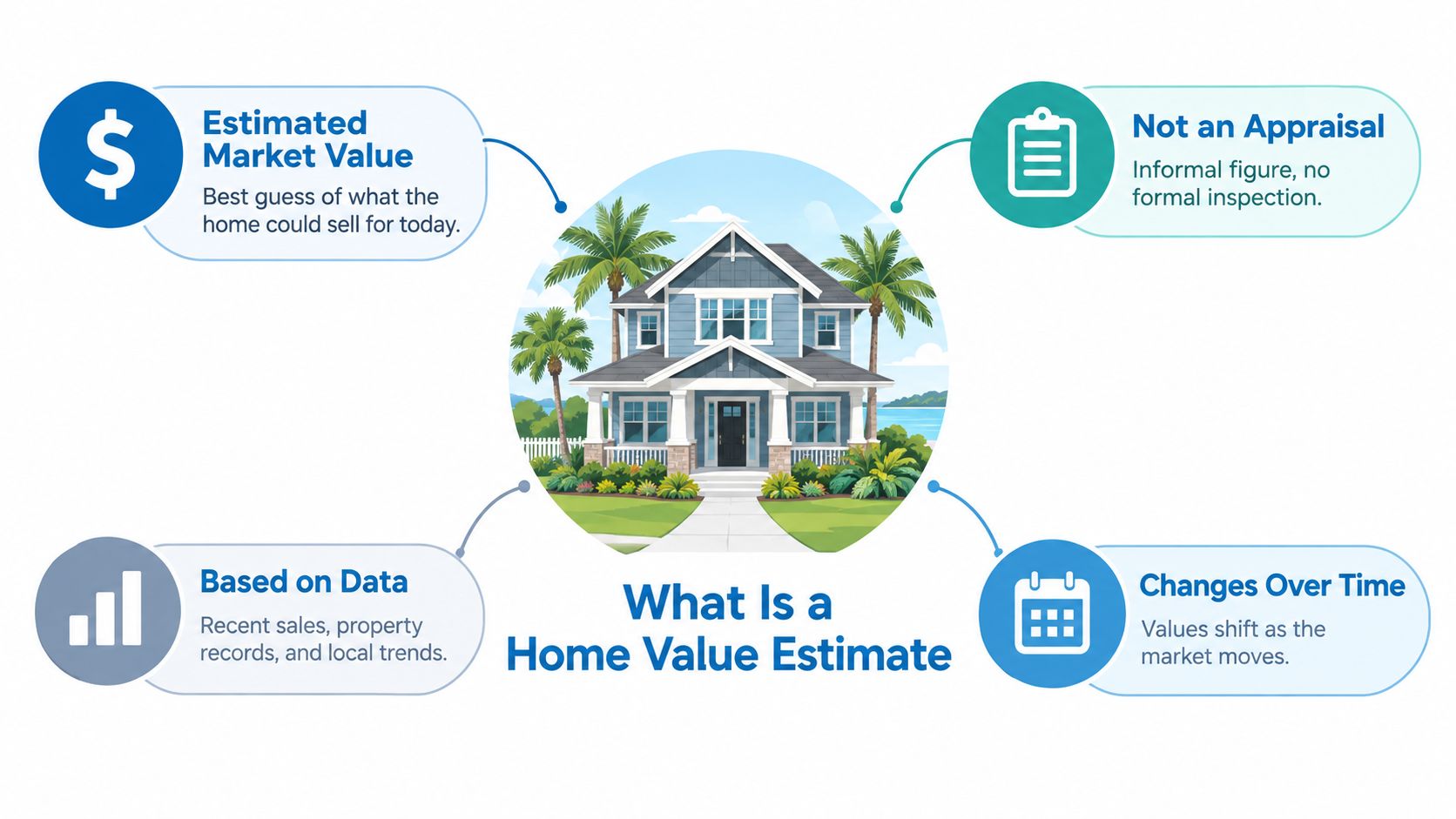
A home value estimate is an evidence-based opinion of a property's likely market value on a specific valuation date, not a sale price someone is promised to pay. The Consumer Financial Protection Bureau frames valuations the same way, as estimates tied to property details and market data rather than a guaranteed result (CFPB guidance on different valuations).
That distinction matters because sellers often confuse the estimate with the asking price or the tax bill. A tax assessment can lag the market, while an asking price is just what an owner hopes to get. A real estimate sits in the middle, closer to a market snapshot than a wish.
Practical rule: if you wouldn't use the number to sign a listing agreement without context, don't use it as your only pricing guide.
For homeowners in Palm Coast real estate and St. Augustine real estate, the smart move is to treat the estimate as a starting point. It tells you where the market might be, but it doesn't yet tell you what a buyer will pay for your kitchen, your roof, your lot, or your street.
How Comparable Sales Shape the Number
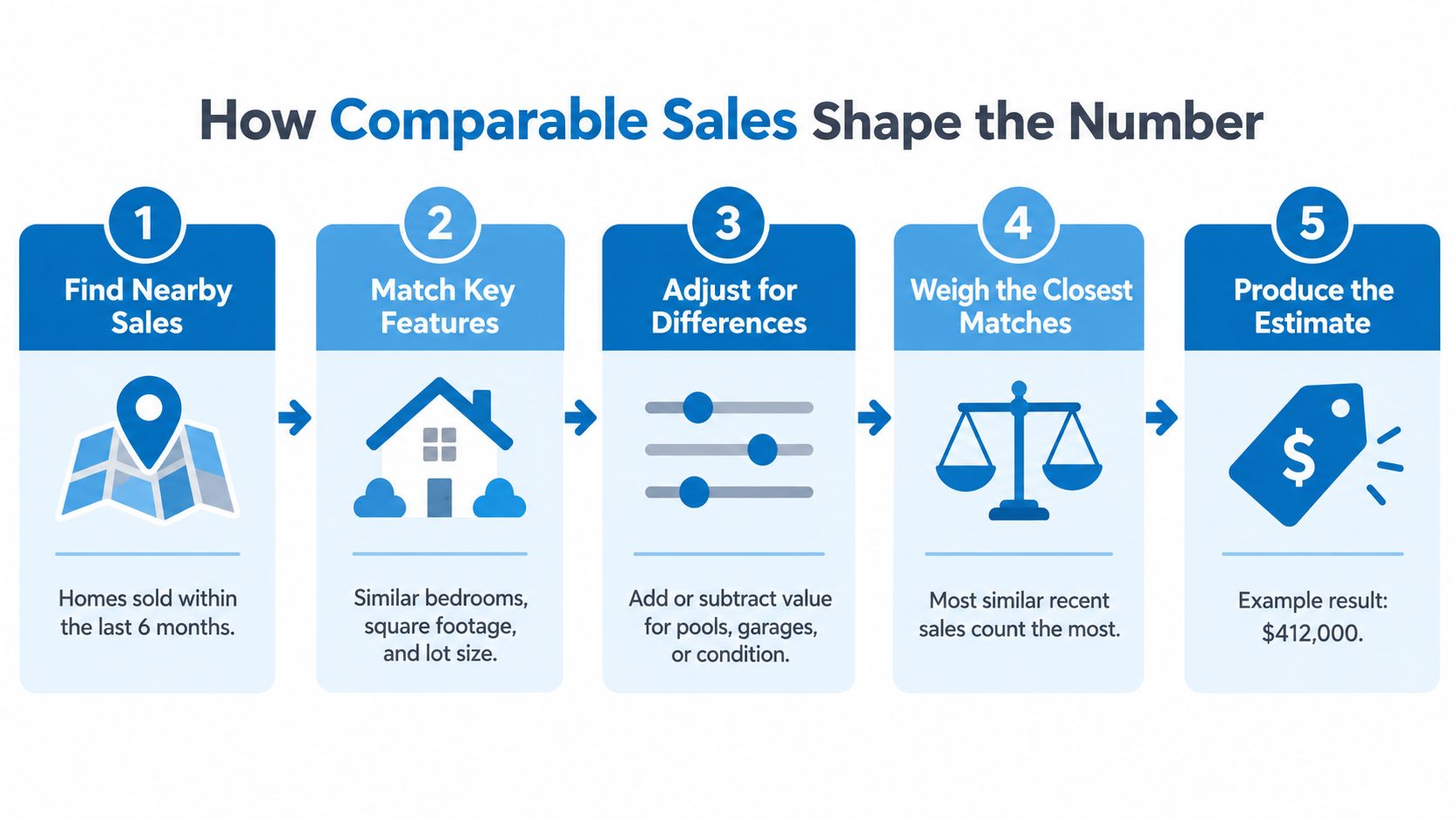
The backbone of a credible estimate is the sales-comparison approach. Federal appraisal guidance describes it in four steps, evaluate the subject property, select recently sold comparable properties, adjust for differences, and reconcile the results into an opinion of value (CFPB appraisal testimony). In plain English, that means a good estimate starts with real nearby sales, not a broad guess.
What makes a sale comparable
A sale helps only if it closely resembles the home being priced. Similar location, size, condition, and features matter. A home with a pool, a newer roof, or a better lot can't be matched to a less improved property without adjusting for those differences.
That's why neighborhood-level evidence beats a county average. A Palm Coast home in a newer subdivision and a Flagler Estates homes listing on a different lot pattern may not behave the same way in the market, even if both sit in the same broader county. Recent, close, and relevant sales tell the truth better than distant averages.
Why one sale can mislead
A single nearby sale can look persuasive and still be wrong for pricing. Maybe the seller made concessions, maybe the home was in worse condition, or maybe the transaction was unusual in a way that doesn't reflect normal buyer demand. Good pricing strategy uses several comparables and then weighs them carefully.
A solid estimate doesn't chase the loudest number. It weighs the closest matches and explains the adjustments.
For selling a home in Palm Coast, I'd rather see three clean, recent comparables than one flashy outlier. That's the difference between a number that sounds good and a number you can defend when a buyer pushes back.
Online Tools Versus Professional Appraisals
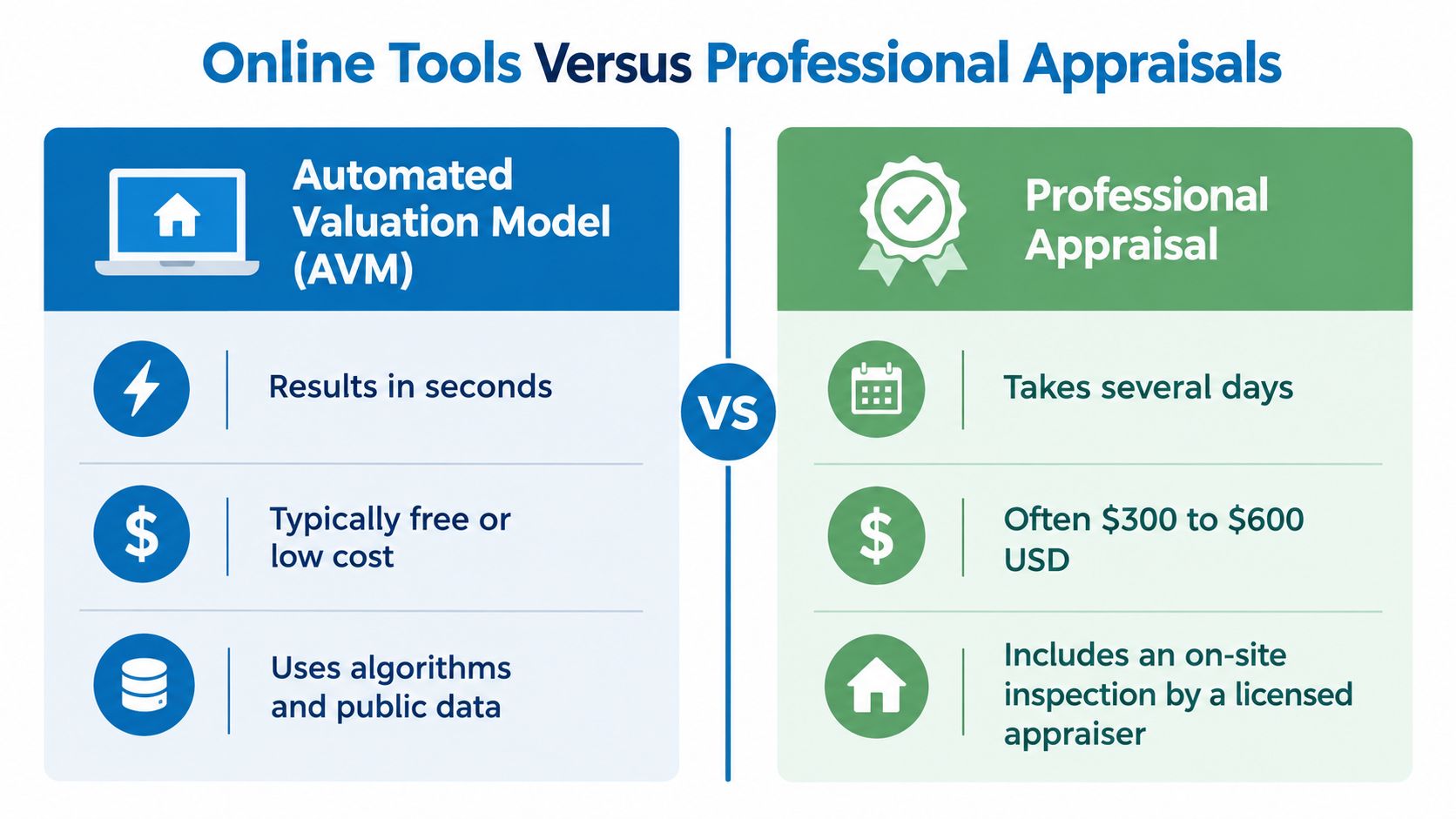
Online tools are fast, but speed is not the same thing as precision. The Government Accountability Office defined an automated valuation model, or AVM, as a computerized system that uses tax records, property characteristics, neighborhood sales trends, and similar data to estimate residential value. GAO also reported that AVMs can generate results in only a few seconds and generally cost about $5 to $25, while still being less reliable than appraisals for most first-lien mortgage originations (GAO AVM report).
What each tool is good for
An AVM is fine if you want a quick starting range. It's useful when you're curious, comparing neighborhoods, or checking whether the market has moved since your last look. It is not the right tool when you need a pricing strategy for a real listing.
A professional appraisal is different. It's slower, more formal, and designed to verify value with deeper scrutiny. In mortgage lending, appraisals have been the dominant valuation method because lenders need something more defensible than a fast estimate.
Where Marilynn Wolfe fits in
A homeowner doesn't always need a lender-grade appraisal, but they do need a pricing conversation that respects the home's actual condition and the current market. That's where a comparative market analysis, and in some cases a full valuation review, becomes more useful than a website number. Marilynn Wolfe, LLC offers that kind of local pricing guidance for Palm Coast, St. Augustine, and Flagler County sellers, alongside a broader selling strategy built around current buyer demand.
A quick estimate answers one question, “what might this home be worth?” A professional review answers the harder one, “what should I do with that number?”
Where Online Estimates Can Mislead
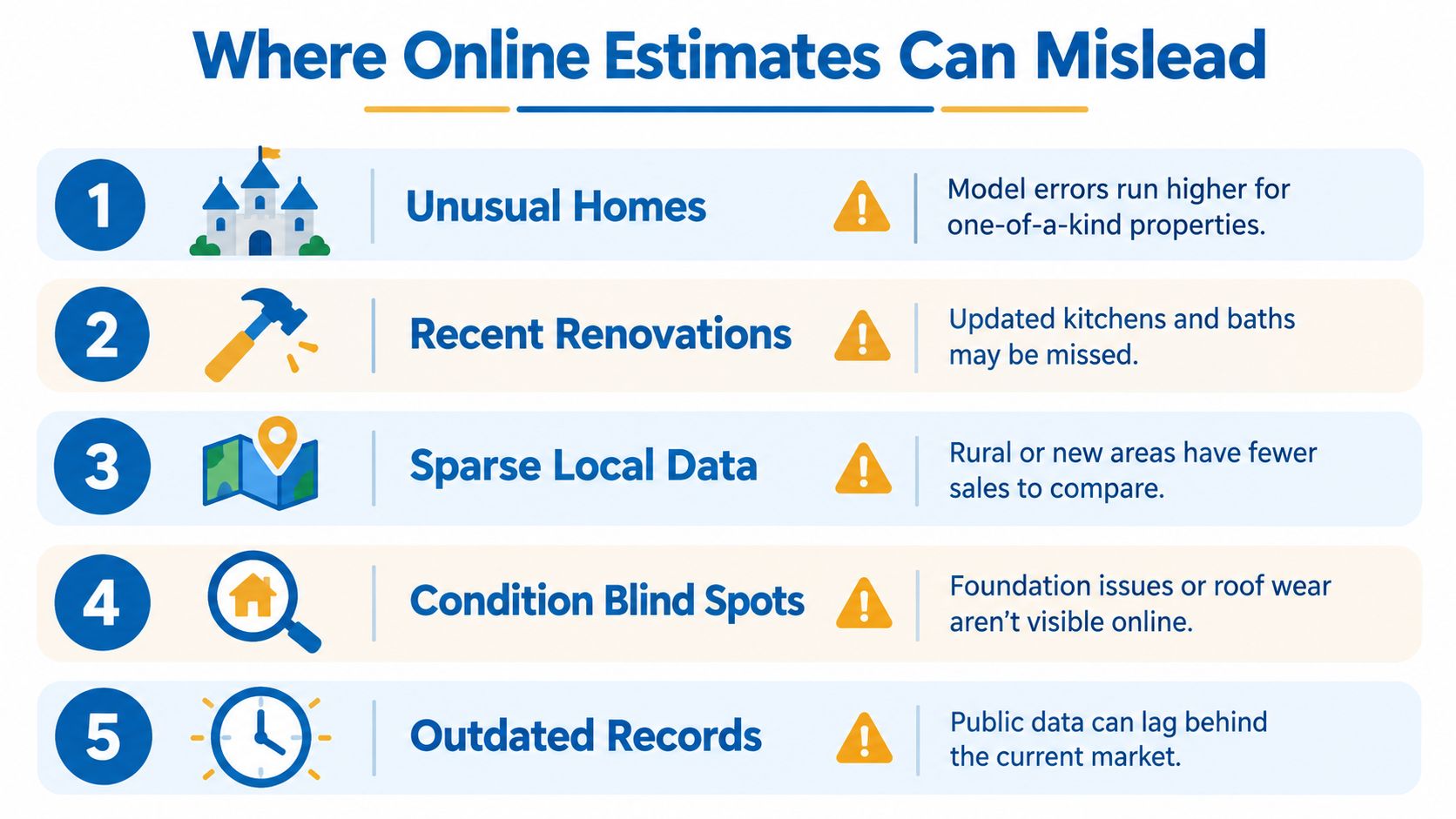
The biggest mistake sellers make is assuming an online estimate is objective just because it looks clean on screen. It isn't. It's only as good as the data feeding it, and some homes are harder to price than others.
The homes that trip models up
Automated models tend to struggle with unusual homes, recently renovated homes, rural properties, and areas with few recent transactions. They can miss condition, deferred maintenance, a better view, a worse layout, or a renovation that hasn't made it cleanly into the data yet. That matters in Northeast Florida, where a custom build, a flag lot, or a coastal property can defy a neat algorithm.
The risk isn't just inaccuracy, it's unequal accuracy. A 2025 Urban Institute analysis found that AVM errors were 3.4 percentage points higher for Black homeowners than for white homeowners in Atlanta and Memphis, with Black-owned properties undervalued by about 5% on average (Urban Institute analysis). That's a reminder to challenge the number, not worship it.
Questions to ask before you trust the figure
- How recent are the sales? Older comparables can drag the result away from today's market.
- Do the comparables match the home? Bedrooms, condition, and lot type matter.
- What did the model miss? Renovations, flooding concerns, or unusual layouts can change the true number.
- Was the property inspected? If not, the estimate is working without important context.
If an estimate doesn't explain its weak spots, it's incomplete. Homeowners should treat it as a rough signal, not a final pricing decision.
The Hidden Costs Behind the Headline Number
A home can show a strong estimate and still be harder to sell than the number suggests. That's because buyers don't just buy a house, they buy the monthly reality that comes with it. Insurance, flood exposure, and ownership costs change what the market will bear.
Recent U.S. data show that about 6.1% of homes, worth nearly $3.4 trillion, face severe or extreme flood risk, with FEMA's Risk Rating 2.0 pricing flood insurance based on individualized risk rather than home value alone (Realtor.com climate risk report). That means two homes with the same estimate can have very different buyer appeal once insurance and risk are part of the conversation.
For coastal and inland Northeast Florida, this matters a lot. Buyers often look at flood-zone status, elevation, storm resilience, and current insurance quotes before they decide how much to offer. A property that looks strong on paper can still feel expensive once the ongoing costs are added up.
Bottom line: the headline number is not the same thing as the marketable value.
Sellers should compare any estimate with actual insurance quotes and flood information before setting expectations. If the carrying costs are high, the market will usually discount that somewhere, even if the website number looks flattering.
How Local Market Conditions Change the Estimate
A number that feels high in one neighborhood can feel low in another. That's because Palm Coast real estate market trends and the St. Augustine housing market don't move in lockstep, even though they're both part of Northeast Florida.
Recent Redfin reporting showed a Palm Coast median sale price near $350,000 with about 78 days on market, while St. Augustine's median sat around $450,000 with roughly 91 days on market and homes selling about 2% below list price (Redfin Palm Coast housing market). Those numbers don't price your house for you, but they do show why the same estimate can feel different depending on where the home sits.
Palm Coast vs St. Augustine Market Snapshot
| Market Indicator | Palm Coast | St. Augustine |
|---|---|---|
| Median sale price | about $350,000 | about $450,000 |
| Days on market | about 78 | about 91 |
| Sale-to-list pattern | not stated in the verified data | about 2% below list price |
A home near the historic district in St. Augustine can face a different buyer pool than a Palm Coast home in a golf community or a property near Flagler Estates. That's why ZIP code averages can be lazy. Buyers respond to the actual micro-market they're shopping in, not to a general map pin.
A useful estimate always comes with a place and a date. Without both, it's just a floating number.
Getting a Real Estimate You Can Trust
If you're serious about selling, stop asking whether the online number is “right” and start asking whether it's usable. A usable estimate is tied to current comparable sales, the home's real condition, and the way buyers are behaving right now. That's where a comparative market analysis earns its keep.
A strong pricing conversation should include a walk-through, verified sales, a look at competing listings, and a clear explanation of the adjustments. You want to know what changed the value, whether it was a roof, a pool, a view, a repair issue, or a location factor that buyers care about. If the explanation is fuzzy, the number probably is too.
For some homeowners, a quick online estimate is enough to satisfy curiosity. For sellers, absentee owners, move-up buyers, and 55+ homeowners planning their next move, it usually isn't. A local real estate professional can help you test the estimate against the market instead of guessing in the dark.
If you're making a decision that affects equity, timing, or your next purchase, get a second opinion before you act.
Marilynn Wolfe, LLC works with homeowners across Palm Coast, St. Augustine, Flagler County, and surrounding Northeast Florida communities who want clear pricing guidance and a practical selling plan. If you want a more grounded read on your home's value, I'm always happy to help you compare the number on the screen with what the market is doing.
If you're curious what your home could sell for in today's market, Marilynn Wolfe, LLC can help you sort out the numbers, the neighborhood, and the timing. Visit Marilynn Wolfe, LLC to connect with Marilynn Wolfe for a personalized value conversation and local market insight.