
If you're searching for duplexes for sale in Palm Coast FL, you may start with a simple question: can the rental income make the property more affordable? The answer depends on far more than the listing price. Flood exposure, insurance terms, zoning, lot configuration, building-code compliance, and the condition of both units can determine whether a duplex becomes a dependable home and investment or an expensive project.
Palm Coast attracts buyers looking for income-producing property, house-hacking opportunities, relocation homes, and long-term real estate holdings. It also sits within a broader Flagler County market where affordability and housing supply remain closely connected. Whether you're buying, selling, downsizing, or relocating from St. Augustine, the right analysis begins with the property's operating details.
The Current Market for Duplexes in Palm Coast
A buyer searching for a duplex in Palm Coast can quickly find that the market is more specialized than the single-family market. One market aggregator showed 63 active duplex listings in late September 2026, with asking prices ranging from $269,900 to $589,000 and an average asking price of $476,190. The listed properties represented approximately 148,157 square feet and an estimated combined value of about $28.6 million, according to the Palm Coast duplex market listings.
Those figures provide useful orientation, but they shouldn't replace property-level analysis. A duplex with newer construction, stronger insurance terms, better parking, and two clearly functional units may justify a different price than an older property with deferred maintenance or uncertain rental utility. Buyers should compare the complete operating picture, not just the advertised price.
What available duplexes tend to look like
Several examples in the local listing data show duplexes measuring 2,800 square feet, with 1,400 square feet per side, commonly arranged as three-bedroom, two-bath units with garages. That configuration appeals to both owner-occupants and investors because one side can serve as a residence while the other produces rental income, or both units can be leased independently. The same source documents these layout characteristics in its Palm Coast duplex inventory, although each property still requires separate verification.
Palm Coast home values also need to be viewed in context. The broader market reported a median home sale price of $359,990, while homes took an average of 102 days to sell, compared with a national average of 55 days. That slower pace suggests that sellers need accurate positioning and strong presentation, while buyers may have more time to investigate inspections, insurance, and financing before making a decision.
Practical rule: A competitive duplex offer should reflect verified condition, achievable rent, insurance costs, and legal use. A low price isn't automatically a good deal if the property carries high operating risk.
For sellers, clean financial documentation and clear information about each unit can make a meaningful difference. For buyers relocating into Palm Coast, St. Augustine, or surrounding communities, the most useful shortlist is based on total ownership cost rather than search filters alone.
Navigating Local Zoning and Lot Split Rules
A duplex can look ready for rental income while its legal status remains unclear. In Palm Coast, zoning and land-development rules determine whether the property may be built, occupied, divided, or converted into separate ownership. Verify those details with the relevant city or county office before making an offer. A listing description alone does not establish permitted use.
The Flagler County zoning guidance covers permitted uses, setbacks, building height, and lot requirements. Properties within Palm Coast are subject to city rules, while parcels in unincorporated Flagler County may follow county regulations. Confirming that jurisdiction early can prevent problems with additions, redevelopment plans, or a proposed lot split.
The local rules that affect ownership
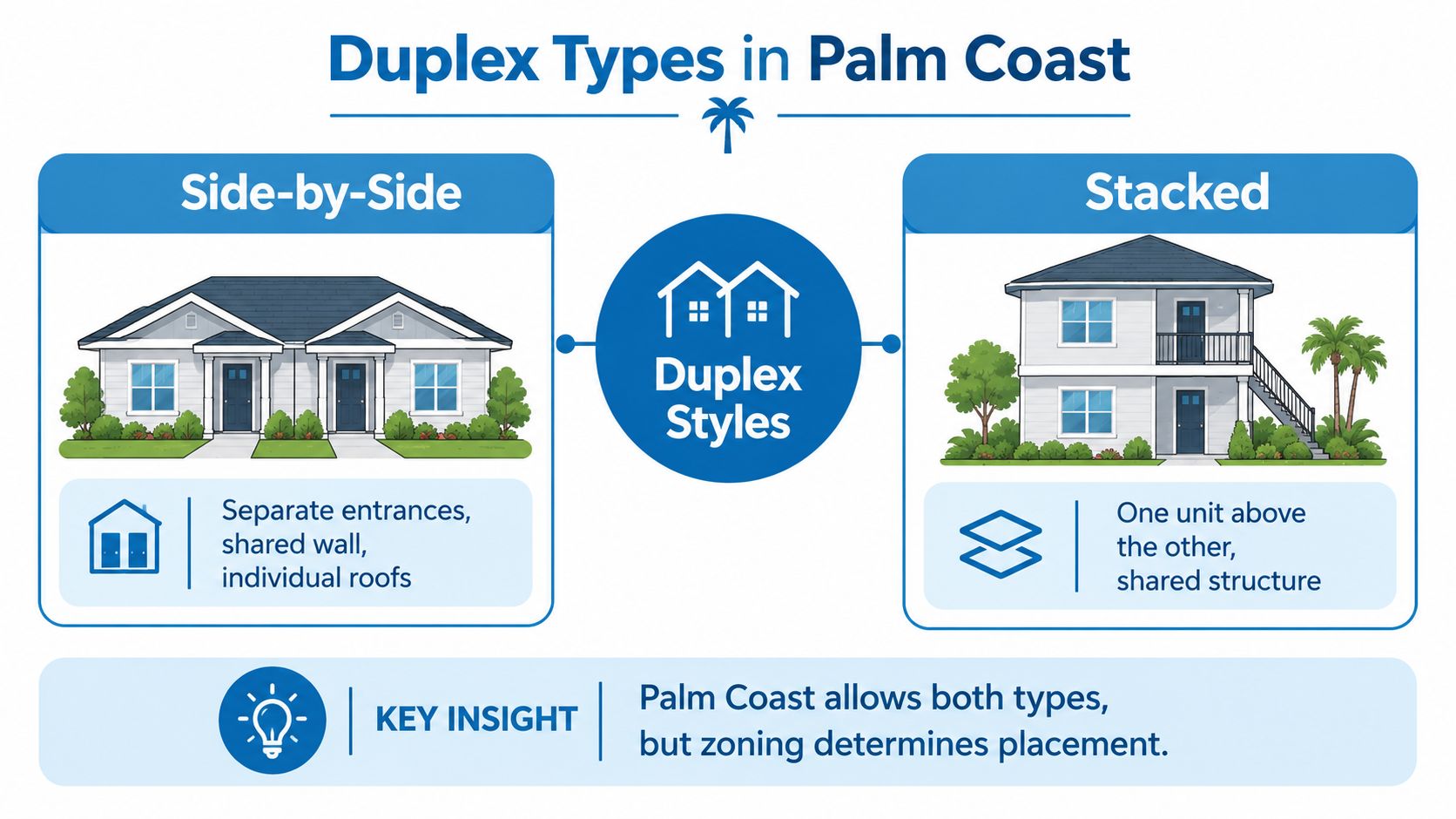
Palm Coast planning materials identify duplex land use at 8 units per acre. They also state that a legally divided duplex lot must contain at least 4,000 square feet per lot. Living-area requirements apply to each unit, not just to the combined structure. Review the city's future land use and comprehensive plan materials before treating a parcel as split-ready.
A duplex held under one ownership structure may later support separate ownership through a condominium conversion or formal lot split. Palm Coast workshop materials state that each divided side must be at least 4,000 square feet and 30 feet wide, subject to the required approval process. The Palm Coast planning workshop document provides the relevant city context.
Before assigning value to a future division, ask the planning department or a qualified local professional to verify:
- Parcel status: Is the property inside Palm Coast or in unincorporated Flagler County?
- Existing approval: Are both units legally recognized as a duplex?
- Lot dimensions: Does the proposed division meet applicable size and width requirements?
- Ownership structure: Is a condominium conversion or deeded lot split more suitable?
- Utility and access: Can each side retain compliant access, services, parking, and setbacks?
A split can create flexibility, yet it may also require approval fees, legal work, surveying, and construction changes. Underwrite those costs before assuming separate ownership will increase the property's value. Treat the split as a possibility requiring confirmation, not as an automatic benefit.
Flood Zones and the True Cost of Ownership
A duplex can look affordable at closing and still strain cash flow once insurance, lender conditions, and storm-related maintenance enter the budget. In Palm Coast and greater Flagler County, flood exposure can change the ownership equation even when two properties have similar layouts, rents, and finishes.
Flagler County states that a mortgaged home in a high-risk flood zone must carry flood insurance. Standard homeowners insurance does not cover flood damage, and National Flood Insurance Program coverage can take 30 days to become effective. Review the Flagler County flood-zone information before setting an offer price or financing timeline.
Underwrite the property before you fall in love with it
Order a flood-zone determination early, particularly for duplexes near canals, low-lying lots, or areas affected by coastal conditions. Ask an insurance professional for written indications covering available policies, exclusions, deductibles, replacement-cost assumptions, and conditions that could affect renewal.
Request more than a flood-zone label. Ask how the building's elevation, access, drainage, utilities, roof, and prior loss history may affect coverage and lender approval. These details can influence both the immediate cash needed to close and the recurring cost of holding the property.
A new build, builder warranty, or recent renovation may answer some underwriting questions, but it does not remove location-specific storm exposure. Older electrical, roofing, plumbing, or structural components can create additional concerns for insurers and lenders. Confirm who pays for routine storm preparation, emergency repairs, and tenant communication if you will not manage the property yourself.
The right question isn't “What is the monthly payment?” It is “What will this property cost to own under realistic insurance and flood conditions?”
Listing features such as no HOA fees, garages, and attractive finishes may support tenant appeal, yet they do not establish an acceptable insurance profile. The Palm Coast duplex listing example shows why buyers should examine financing and insurance considerations alongside visible features.
Absentee owners need a local response plan. Have the property manager, insurance agent, lender, and contractor review the risk before inspection and financing deadlines narrow your options. Their early feedback can expose operating costs that a short showing will not reveal.
Inspection Priorities and Florida Building Code
Fresh paint can make a duplex look ready for tenants, but cosmetic improvements don't answer the questions that affect safety, permits, insurance, and long-term maintenance. Florida duplexes must meet the Florida Building Code and Florida Fire Prevention and Lifesafety Codes as minimum construction standards. The Florida statute addressing building-code requirements also addresses duplexes alongside other residential forms for accessibility requirements.
One specific requirement is especially relevant during inspections and renovations. At least one private bathroom on habitable grade levels must have a 29-inch clear opening. That detail can affect whether an older layout is compliant, whether a renovation needs redesign, and whether a proposed repair can move through permitting without complications.
Inspect each side as its own operating unit
A duplex inspection should evaluate the shared structure and each unit independently. Use the inspection period to examine:
- Roof and exterior systems: Look for age, drainage concerns, water intrusion, storm damage, and signs of incomplete repairs.
- Electrical and plumbing: Confirm that panels, wiring, shutoffs, water heaters, and fixtures serve the units safely and appropriately.
- Heating and cooling: Determine whether each side has independent equipment and whether the systems are serviceable.
- Fire and life safety: Review smoke alarms, egress, separation between units, stairways, and access routes.
- Permits and additions: Compare the physical structure with city records and ask about enclosed patios, converted garages, extra bathrooms, and other modifications.
- Unit separation: Check meters, doors, utility access, sound separation, and maintenance responsibilities.
Older duplex stock can create more permitting friction than buyers expect. An unpermitted conversion may appear useful for rental income but create problems during insurance underwriting, refinancing, resale, or a future renovation. The inspection report is only one part of the review, so coordinate with the city, an insurance professional, and qualified contractors where questions remain.
Evaluating ROI and Financing Strategies
A duplex can support different ownership models, and the best choice depends on the buyer's lifestyle, financing position, management capacity, and tolerance for vacancies or repairs. An owner-occupant may value reduced housing expense and proximity to the rental unit. An absentee investor may prefer full rental income but must budget for property management, maintenance coordination, tenant turnover, and remote decision-making.
Rental income may support loan qualification in some circumstances, but lenders apply their own documentation and underwriting rules. Buyers should ask the lender how projected rent, existing leases, vacancy assumptions, insurance, taxes, and property condition will be treated. A spreadsheet that uses optimistic rent without accounting for repairs or operating costs won't produce a reliable return estimate.
Duplex buyer strategy comparison
| Strategy | Financing Advantage | Management Effort | Best For |
|---|---|---|---|
| Owner-occupied | May align the purchase with a primary-residence financing approach, subject to lender rules | Lives on-site and can respond quickly, but must manage the boundary between home and rental | Buyers who want to reduce their housing burden and stay close to the property |
| Rental only | Uses the full property as an income asset, with underwriting based on the lender's investment-property standards | Requires systems for leasing, repairs, tenant communication, and vacancy management | Experienced landlords and absentee owners with reliable local support |
| Value-add renovation | May create a path to improve usability or rental appeal, provided the work is legal and financially justified | Highest oversight burden during construction, permitting, and tenant preparation | Buyers with renovation experience and enough reserves for surprises |
The table doesn't replace a property-specific pro forma. Build one using verified insurance information, taxes, utilities, maintenance assumptions, management costs, expected vacancy, financing terms, and realistic rents. Keep projected income separate from guaranteed income, especially when the units are vacant or the existing leases aren't transferable.
A duplex works financially only when the income survives ordinary ownership problems, not just the initial purchase.
Palm Coast buyers should also compare the duplex with other Flagler County opportunities, including newer construction and single-family homes. A duplex may provide more income potential, but it also brings more systems, more occupants, and more opportunities for maintenance issues.
The Broader Flagler County Housing Context
The case for duplex ownership becomes clearer when viewed through the broader Flagler County housing supply. An AEI Housing Center Flagler County playbook estimated a shortage of 3,400 homes, or approximately 5.3% of the county's housing stock. The same analysis reported that only 1.5% of new homes built in residential subdivisions from 2000 to 2024 were townhomes.
That supply pattern helps explain why land-efficient housing types matter. The analysis reported a median price of $424,000 for a newly built single-family detached home in a subdivision, compared with a $365,000 median sale price for financed homes. Those figures point to an affordability gap that smaller, more flexible housing formats may help address.
Why duplexes fit the local discussion
The AEI analysis projected that allowing more flexible housing types, including duplexes, multiplexes, and accessory dwelling units on existing lots, could add 86 homes annually, an increase of about 9% over the current rate of single-family detached construction in Flagler County. That projection isn't a guarantee for any individual property, but it demonstrates why local housing policy increasingly considers forms beyond detached homes.
Palm Coast duplexes sit at the intersection of several needs. They can give an owner-occupant a second income stream, provide rental housing without requiring a large apartment development, and make more productive use of residential land. They can also serve households that aren't ready for or able to purchase a detached home at the prevailing price point.
The broader Palm Coast real estate market still requires selectivity. Realtor.com reported a $400,000 median listing price, approximately 2.4K homes for sale, a 75-day median time on market, a $219 median price per square foot, and a 98% sales-to-list ratio in Palm Coast. These figures from the Palm Coast market overview provide general context, but duplex buyers should still rely on comparable multifamily properties and verified operating expenses.
For sellers, this context supports careful positioning rather than automatic premium pricing. For buyers, it supports a long-term view of a property type tied to housing demand, land use, and affordability.
Partnering with a Local Real Estate Professional
A duplex purchase requires more coordination than a standard online search. The right professional should help you identify relevant properties, distinguish legal duplexes from informal conversions, review comparable sales, and keep zoning, insurance, inspections, and financing moving together.
For sellers, pricing strategy depends on how buyers will evaluate the property. An income-oriented buyer may focus on rent potential and operating expenses, while an owner-occupant may prioritize layout, privacy, parking, and the condition of the side they plan to occupy. Strong marketing should explain the property accurately without making unsupported assumptions about income or future development rights.
What local guidance should include
A practical process includes:
- Market positioning: Compare the duplex with relevant Palm Coast properties rather than relying only on single-family averages.
- Document review: Organize leases, utility information, permits, repair records, and ownership documents.
- Risk identification: Encourage early conversations with lenders, insurers, inspectors, contractors, and zoning staff.
- Negotiation strategy: Use verified findings to negotiate price, repairs, credits, timelines, or contingencies.
- Regional perspective: Consider how Palm Coast compares with St. Augustine real estate, Flagler Estates homes, and surrounding Flagler County communities.
Local knowledge also helps buyers relocating from another market avoid assumptions that don't fit Northeast Florida. A buyer familiar with the St. Augustine housing market may still need different guidance in Palm Coast because parcel rules, flood exposure, construction patterns, and neighborhood characteristics can vary from one community to the next.
Marilynn Wolfe serves Palm Coast, St. Augustine, Flagler County, and surrounding areas as a Strategic Listing Agent with LPT Realty. Her work includes pricing strategy, market insight, preparation, marketing, buyer guidance, relocation, new construction, and support for homeowners selling, downsizing, or managing property from outside the area.
Whether you're evaluating a duplex for rental income, preparing to sell an inherited property, or comparing Palm Coast with nearby communities, a thoughtful review can prevent expensive surprises. The strongest decisions come from matching the property's legal, physical, financial, and market profile with your actual goals.
Marilynn Wolfe, LLC offers practical guidance for evaluating duplexes, preparing properties for sale, and understanding Palm Coast home values, zoning, insurance, and buyer demand. Visit Marilynn Wolfe, LLC to request a local consultation or discuss your buying and selling plans in Palm Coast, St. Augustine, and Flagler County.