


If you owned a house years ago, do the first-time homebuyer rules still shut you out of help in Palm Coast or St. Augustine? Usually not. The standard test is a three-year look-back ending on the purchase date: hold no ownership interest in a principal residence during those three years and you generally qualify as a first-time buyer. Each program runs the test on its own.
That gap lands in the budget. A buyer can clear one program and miss the next over a spouse's old deed, a county income ceiling, or a cash-to-close figure beyond what they have saved. Palm Coast sits in Flagler County, St. Augustine sits mostly in St. Johns County, and Flagler Estates is unincorporated Flagler County, so two similar houses across a county line can carry different limits.
The checks below go program by program, since passing one test says nothing about the next. Each rule ends the same way: what it does to the payment and the cash due at closing.
First-Time Buyer Rules at a Glance
Say a Palm Coast renter owned a condo six years ago, sold it before the move, and has rented ever since. Under the common test, that buyer counts as first-time again. First-time-buyer status is generally a three-year look-back, not a lifetime ban on prior ownership. You generally qualify when you held no ownership interest in a principal residence during the three years ending on the purchase date, which is how HUD defines a first-time homebuyer.
Past ownership can stop mattering once that window closes. For married applicants, either spouse's ownership can count. Basic FHA insurance doesn't require first-time status, so a repeat buyer can still use an FHA loan. What changes is access to specialized help: a feature such as counting positive rental history can require at least one borrower to meet the first-time test.
What each program actually tests
Read the table as a set of separate gates. Each program applies its own first-time test, so the same buyer can clear one row and stall on the next. A zero-down loan can still demand a certificate or an eligible address. A low conventional down payment can still carry income or price caps. Assistance is one more gate on top of the mortgage.
| Program | First-time test | Minimum down payment | Credit guide | Key condition |
|---|---|---|---|---|
| FHA loan | Not required for FHA itself; the three-year look-back applies to first-time programs | 3.5% | 580 or higher for 3.5% down | Mortgage insurance applies |
| Conventional first-time buyer offerings | Three-year look-back in many first-time programs | As low as 3% | Often 620 or higher | Income or purchase limits may apply |
| VA loan | No first-time test; open to eligible veterans and service members | 0% | Set by lender | Certificate of Eligibility required |
| USDA loan | No first-time test; household income limits apply | 0% | Set by lender | Property must be in an eligible area |
| Florida Housing assistance | Program-specific first-time definition | A second loan can cover down payment and closing costs | 640 minimum | Education, county limits and primary residence |
| IRA first-home withdrawal | IRS first-home definition | Not a loan; withdrawal capped at up to $10,000 | Not applicable | The withdrawal avoids the 10% additional tax before age 59½ |
VA and USDA loans have no first-time test. An eligible veteran, or a buyer whose home sits in an eligible area and whose household income fits, can use them as a repeat buyer.
For the budget, the last column is the one to watch. Mortgage insurance, an education course, a county limit, or a second loan covering cash to close is what decides the actual payment on a Palm Coast or St. Augustine house.
Who Counts as a First-Time Buyer
One buyer can pass the first-time test for a state grant and fail it for a different program. Each program applies its own definition, and most start with the same question: have you owned a primary residence within the last three years? A "yes" under one program's rules is not automatically a "yes" under another's.
The unclear files are the ones that surface after a divorce, an inheritance, or a move. HUD guidance in the 2025 FHA annual report also identifies exceptions, including a single parent or displaced homemaker who owned only with a spouse, and ownership of a property that wasn't permanently affixed to a foundation.
Divorce or separation. A buyer who owned only with a former spouse may still qualify under some programs. The divorce decree and the old settlement statement show who was on title and when that interest ended.
Inherited property. Treat an inherited home as ownership until the program says otherwise. What matters is the date the ownership ended, not the date you decided you were "done with it." The deed and the later closing statement are the proof.
Manufactured homes. A home that wasn't permanently affixed to a foundation can be treated differently under those HUD exceptions. Keep the title and any foundation paperwork. A manufactured home is not automatically invisible to the test.
A sale from several years ago. The window runs back from the new purchase date, not from the day you sold. Sell in one year and buy several years later, and the window may already be closed.
A spouse's house. For married applicants, ownership by either spouse can affect eligibility. One partner's old primary home can block both of you on a program that uses the federal test.
A move from another state. A house you owned in Ohio or Georgia counts the same way. Shopping the Palm Coast real estate market doesn't reset the clock.
Practical rule: Ask the lender to confirm each situation in writing for that specific program. A blanket yes or no is how people lose help they could have used.
The "young renter" picture is outdated. In its 2025 Profile of Home Buyers and Sellers, the National Association of Realtors reported that first-time buyers made up 21% of purchasers, the lowest share the survey has recorded, and put the median first-time buyer's age at 40.
Financing Rules That Change Your Budget
The down payment is the number people memorize. Cash to close is the number that has to be sitting in the account on signing day.
Cash to close stacks the down payment with lender fees, title charges, prepaid taxes and insurance, and the earnest money you already wrote. On an illustrative $350,000 purchase, a 3.5% down payment is $12,250. Closing costs and prepaids sit on top, so the check at the table runs larger than the down payment alone. A credit score of 580 or higher can open that 3.5% FHA path, and mortgage insurance still adds to the monthly payment. The debt-to-income ratio then decides how much house that payment can support.
Gift funds can cover part of the gap when the gift letter and the bank records match what the lender requires. A seller credit can offset some closing costs when the seller agrees to one in the contract. It can't rescue a payment that's already too high.
Each loan program applies its own version of these rules, the same way each program applies its own first-time buyer test. FHA sets one down-payment floor, conventional financing sets another, and a buyer who clears the cash-to-close math on one loan type can fall short on the next. Run the numbers per program, not once.
The down payment is the part above the waterline. Closing costs, taxes, and earnest money sit underneath.
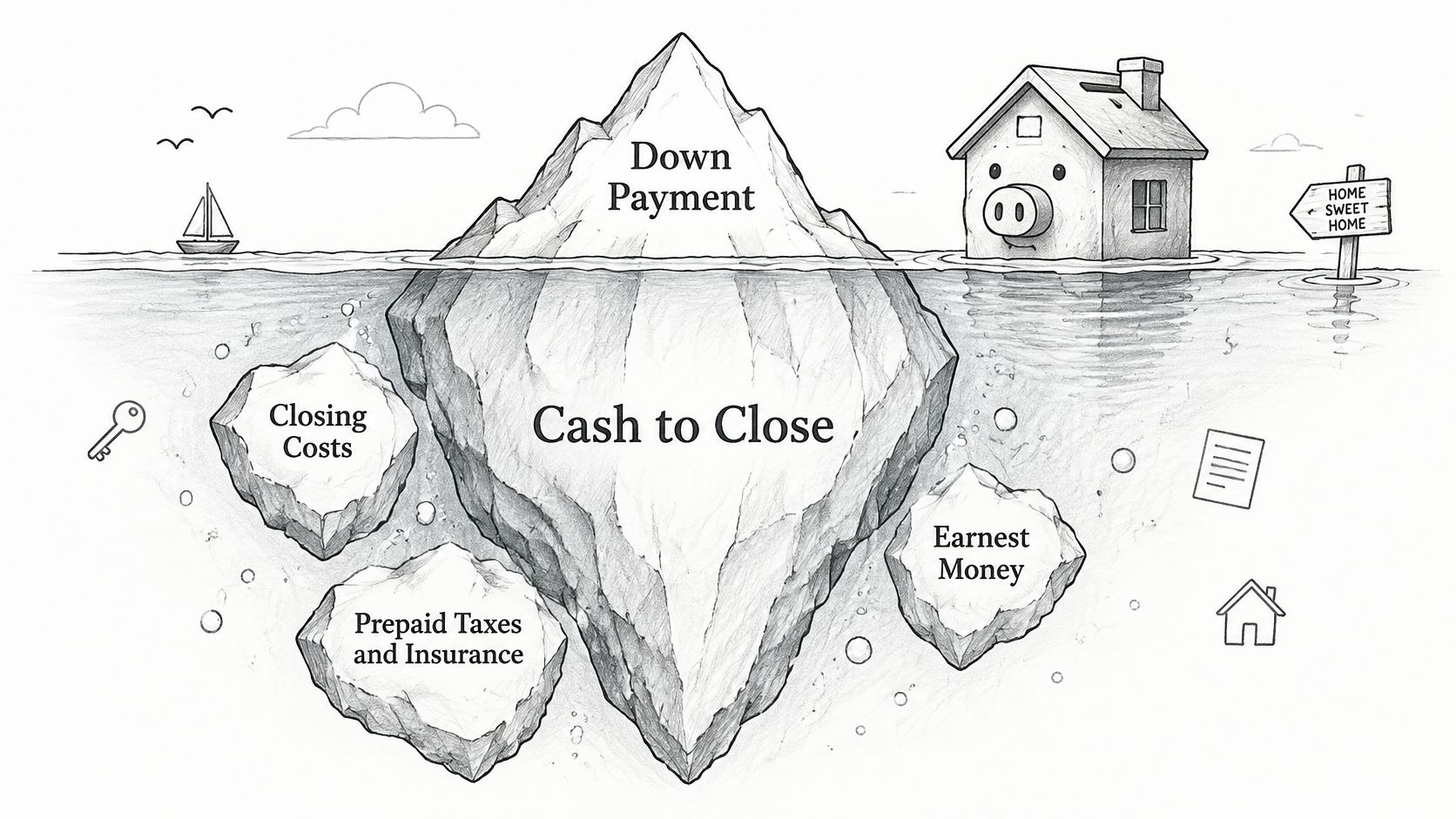
A Palm Coast buyer who can recite "3.5% down" but can't quote the closing figure is doing the math halfway. Knowing the percentage isn't the same as knowing the cost.
How assistance hits the monthly payment
Assistance works like a payment plan on the sticker price. A smaller check at signing can still land in the monthly budget.
| Assistance type | How it is repaid | Effect on monthly payment | What to check |
|---|---|---|---|
| Grant | Not repaid when conditions are met | None | Use rules and funding availability |
| Forgivable loan | Forgiven after a set period of occupancy | None while forgiveness period runs | Occupancy length and sale or refinance triggers |
| Deferred loan | Repaid at sale, refinance or loan maturity | Usually none monthly | Interest accrual and payoff triggers |
| Repayable second mortgage | Scheduled repayment over a set term | Adds to the monthly payment | Rate, term and combined debt-to-income ratio |
A grant doesn't raise the payment if you meet the rules. A repayable second mortgage does, and it has to fit inside the same debt ratio as the first loan.
Buyers clearly believe the numbers can work. TD Bank's survey found nearly 75% of Americans planning to buy their first home felt optimistic about the current housing market, per TD Bank's first-time buyer survey. Optimism doesn't change the arithmetic. Compare Palm Coast home values against the true monthly cost, including any repayable assistance, before you write an offer.
Florida and County Rules for Local Buyers
Florida Housing assistance is conjunctive. Clearing the first-time definition doesn't create an entitlement.
Florida Housing Finance Corporation lists the gates buyers have to clear, in the order you should check them:
- Credit score. A minimum of 640.
- Education. An approved homebuyer course, finished with a certificate.
- Lender. A participating program lender, not just any mortgage company.
- Income. The county ceiling for the household.
- Price. The county purchase-price limit on the contract.
- Occupancy. The home has to be a primary residence.
Miss one and the file fails, even if the other five are clean.
Why the county line changes the budget
Palm Coast is Flagler County. Most of St. Augustine is St. Johns County. Flagler Estates homes sit in unincorporated Flagler County, so the address, not the drive time, picks the limit.
Take a Palm Coast buyer whose income fits and whose credit clears 640. The contract price still sits above the Flagler County ceiling. That buyer is a first-time buyer and still doesn't qualify for that assistance. Shopping across the line in St. Johns County isn't an automatic yes either. Each county has its own income and price caps, and funding can run out while you're still touring.
Assistance can pair with FHA, VA, USDA, or conventional loans. The first mortgage still has its own debt-to-income, credit, documentation, and property rules. A search that crosses county lines can face two ceilings, which is why Flagler County real estate and a St. Augustine price band shouldn't share one budget.
Get the current county limits and the funding status in writing before you tour. A ceiling you heard last season can already be stale.
Line that cap up against the homes you can realistically afford in each county. That's the budget, not the highest preapproval number on the letter.
Retirement Savings and Tax Rules for a First Home
The IRA rule is a narrow exception to a penalty. It isn't an open door, and it isn't a promise that the withdrawal is tax-free.
Distributions before age 59½ generally face a 10% additional tax. Up to $10,000 may avoid that extra tax when the money is used to buy, build, or rebuild a first home, under the IRS rules in Publication 590-B. Ordinary income tax can still apply, depending on your bracket.
The withdrawal has to meet the first-home definition and go toward qualified acquisition costs. The $10,000 cap is generally a lifetime limit for one person. Spouses may each have a separate limit if each person qualifies on their own.
Florida doesn't tax wages at the state level, so for most local buyers the federal layers are the ones that matter. Take $10,000 out before 59½ for a qualified first home. You may skip the 10% additional tax and still owe income tax on that amount. That tax can shrink what reaches the down payment or the closing table.
Talk with a tax professional before you touch retirement funds. A lower amount due at closing isn't worth a surprise bill in April.
How the Buying Process Unfolds Step by Step
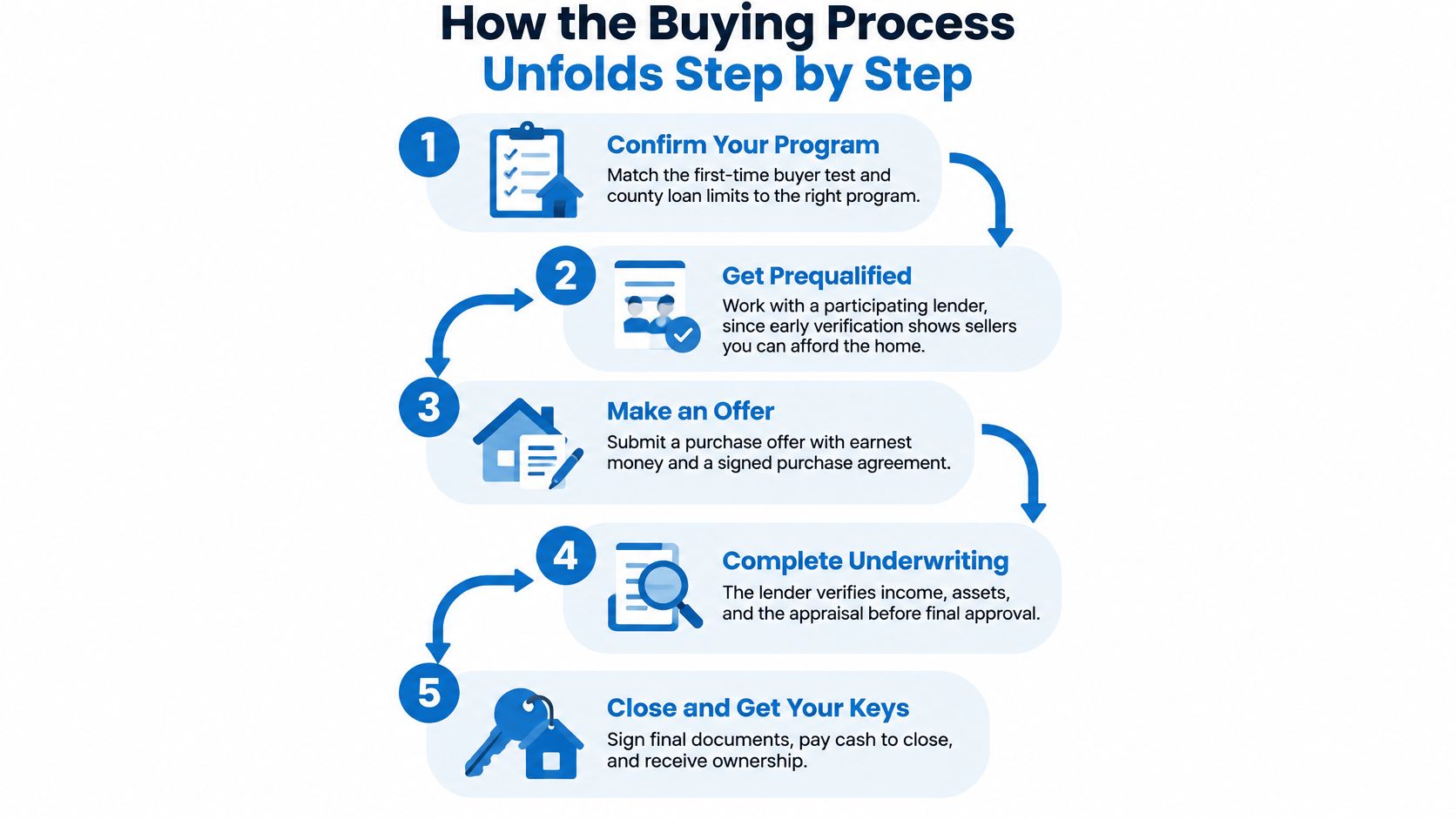
What stalls a first-time purchase more often than anything else? Assistance that gets lined up after the offer instead of before it. Order matters more than speed here, because each program runs its own first-time test at its own point in the process.
- Confirm the program. Match the first-time test and the county limits before you fall for a listing. Passing one program's test does not guarantee passing another's, and the wrong product wastes the weekend tours.
- Get prequalified with a participating lender. Florida Housing help has to run through an approved lender, and early verification tells a seller you can perform. Pull the papers described in the next section before that appointment.
- Finish homebuyer education early. The certificate has to exist before closing. A class booked in the last week becomes the delay.
- Build the budget from cash to close and the monthly payment. List price is a headline. Insurance, taxes, and any second-mortgage payment are the bill.
- Search inside the county ceiling. A home in Palm Coast sits under Flagler's limits, while a home in St. Augustine sits under St. Johns'. Tour with a buyer's agent who keeps the two columns separate.
- Write the offer with protection. Inspection, appraisal, and financing contingencies are the safety exits in the contract, alongside earnest money and any seller credit you need. A seller in Palm Coast still wants a buyer who can close, and a clean offer is how you show that.
- Let underwriting and the appraisal run. Keep pay stubs current. A new car loan in this window can break the debt ratio.
- Clear to close, walk the house, and sign. The final walk-through confirms the home still matches the contract.
A short video walks through the same sequence. Ten minutes with it now can save a surprise later.
How long each stage usually takes
Treat every duration below as a working estimate. Real timelines shift with the lender, the county, and the program in the file, so use these ranges for planning rather than scheduling.
| Stage | Typical time | What drives the timing |
|---|---|---|
| Document review and program check | 1-2 weeks | Divorce decrees, old settlement statements, ownership dates |
| Prequalification with a participating lender | 1-3 days | Credit, income and assets; the lender must participate in assistance |
| Homebuyer education | Schedule it early | Approved course certificate needed before closing |
| House hunting | 1-3 months | Inventory and the price ceiling set by county limits |
| Offer to signed contract | 1-7 days | Negotiation, earnest money and contingencies |
| Contract to closing | 30-45 days | Appraisal, underwriting and any assistance approval can extend it |
Long house-hunting stretches usually reflect thin inventory in your price range. Contract to closing can stretch when assistance approval or an FHA review sits in the file. Plan the lease end date around the longer number.
Gather These Documents Before You Make an Offer
A thin file is how underwriting finds a surprise in the last week of the contract. Gather this before you offer, not after the seller has accepted.
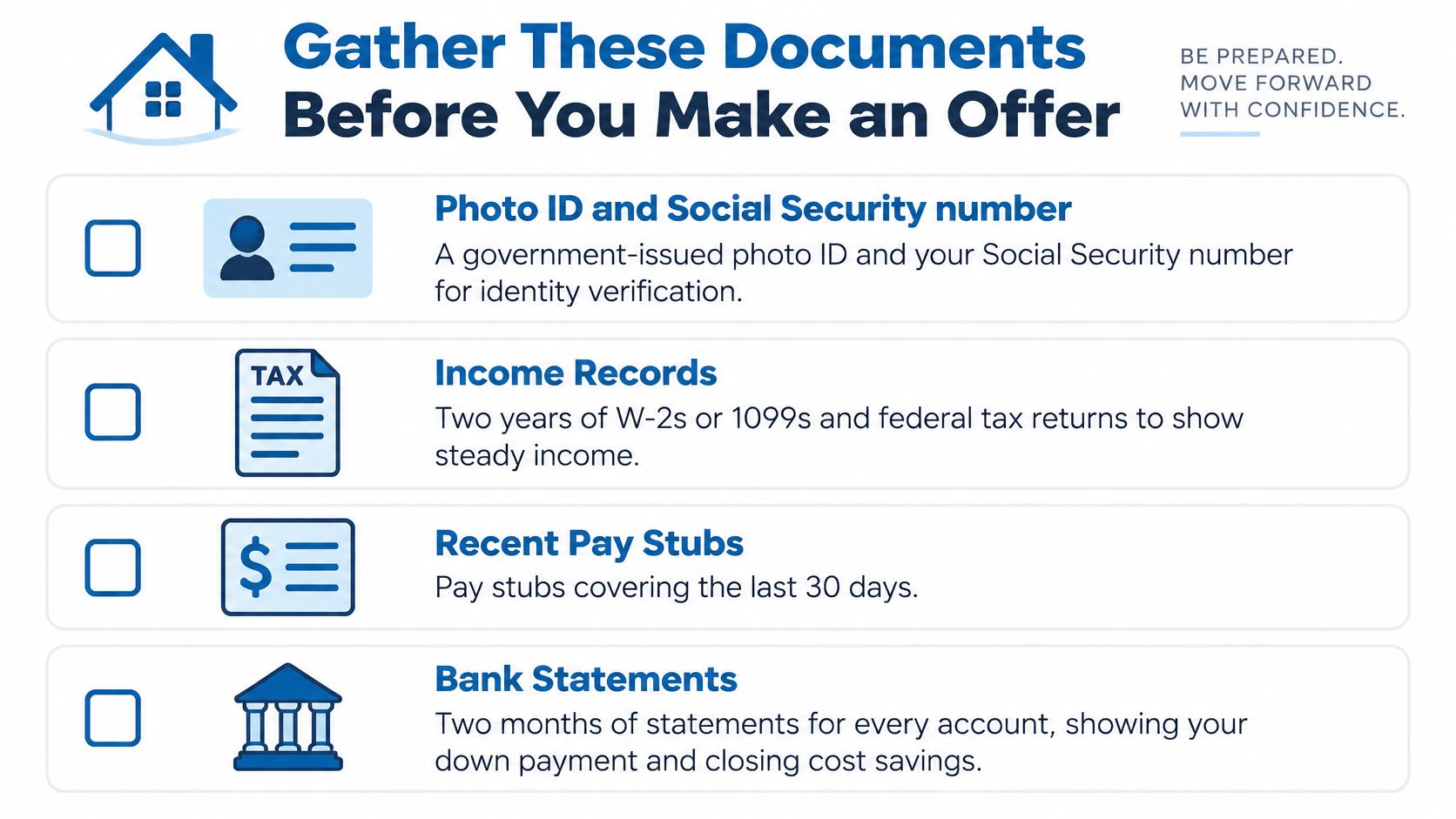
- Photo ID and Social Security number. The lender uses them to pull credit and confirm who is on the loan.
- Two years of W-2s or 1099s and federal returns. Income gaps need a short explanation, not a shrug.
- Recent pay stubs. Cover the last 30 days so the income matches what you already told the lender.
- Two months of bank and asset statements. Include every account that will fund cash to close. If family money is involved, add the gift letter.
- Ownership records. Bring the deed, the dates you held title, and the settlement statement from any prior principal residence.
- Divorce decree or separation papers. You'll need them when a former spouse was on that old title.
- Homebuyer education certificate. This applies when you're using assistance, and only if the provider is approved.
- Prequalification letter. It should come from a lender who participates in the program you want.
A complete file shortens underwriting because nobody is waiting on a decree you still have to order from another state. It also protects the earnest money you already put down. Fewer last-minute conditions means fewer reasons a seller turns to the next offer.
I'm Marilynn Wolfe with LPT Realty, and I work with buyers across Palm Coast, St. Augustine, and Flagler County. I'm glad to walk through county limits, timelines, and which neighborhoods fit a first-time budget, including newer construction. You can call 904-429-2829 or email marilynnwolfe.realtor@gmail.com if you want that conversation tied to your own file.
Marilynn Wolfe, LLC helps buyers in Palm Coast and St. Augustine sort first-time homebuyer rules, county assistance limits, and a real cash-to-close number before an offer goes out. If you want that walk-through for your own situation, visit Marilynn Wolfe, LLC. You'll get a straight read on neighborhoods, timing, and whether the assistance actually fits the payment.