
Are you asking whether it's a good time to sell, when the more useful question might be what kind of help your sale actually needs? A homeowner living in Palm Coast, an out-of-state owner managing a vacant property, and someone downsizing in St. Augustine can face very different decisions.
Home selling assistance should match your circumstances, not force you into a standard package. The right arrangement starts with your property, your next move, and how much work you want to manage yourself.
Why Home Selling Assistance Looks Different in Northeast Florida
Is now a good time to sell, and what kind of help do I need? Those questions belong together. Before recommending a launch date, a listing professional should understand whether you're staying locally, relocating, coordinating another purchase, or handling everything from another state.
For a St. Augustine condominium owner, preparation might begin with organizing property and association documents. A Palm Coast homeowner might need to decide whether to sell before purchasing a replacement home. Someone evaluating Flagler Estates homes may need a plan that accounts for the property's individual characteristics rather than borrowing comparisons from a subdivision.

Start with the seller's constraints
A useful consultation should clarify:
- Your availability: Can you handle appointments, contractor access, and documents during the workday?
- Your next destination: Does the sale need to align with a purchase, rental, or community move-in?
- Your decision-making needs: Would you prefer recommendations to approve, or limited assistance while you direct the process?
- Your property's readiness: Are you preparing an occupied home, a vacant property, or a home with unresolved maintenance?
Palm Coast real estate and St. Augustine real estate shouldn't be evaluated through a single regional average. Ask for comparisons that reflect your property's location, condition, and competing options.
The appropriate service model follows from those answers. Local full-time sellers may need execution support, while absentee owners need delegated coordination and downsizing homeowners may need a carefully sequenced transition.
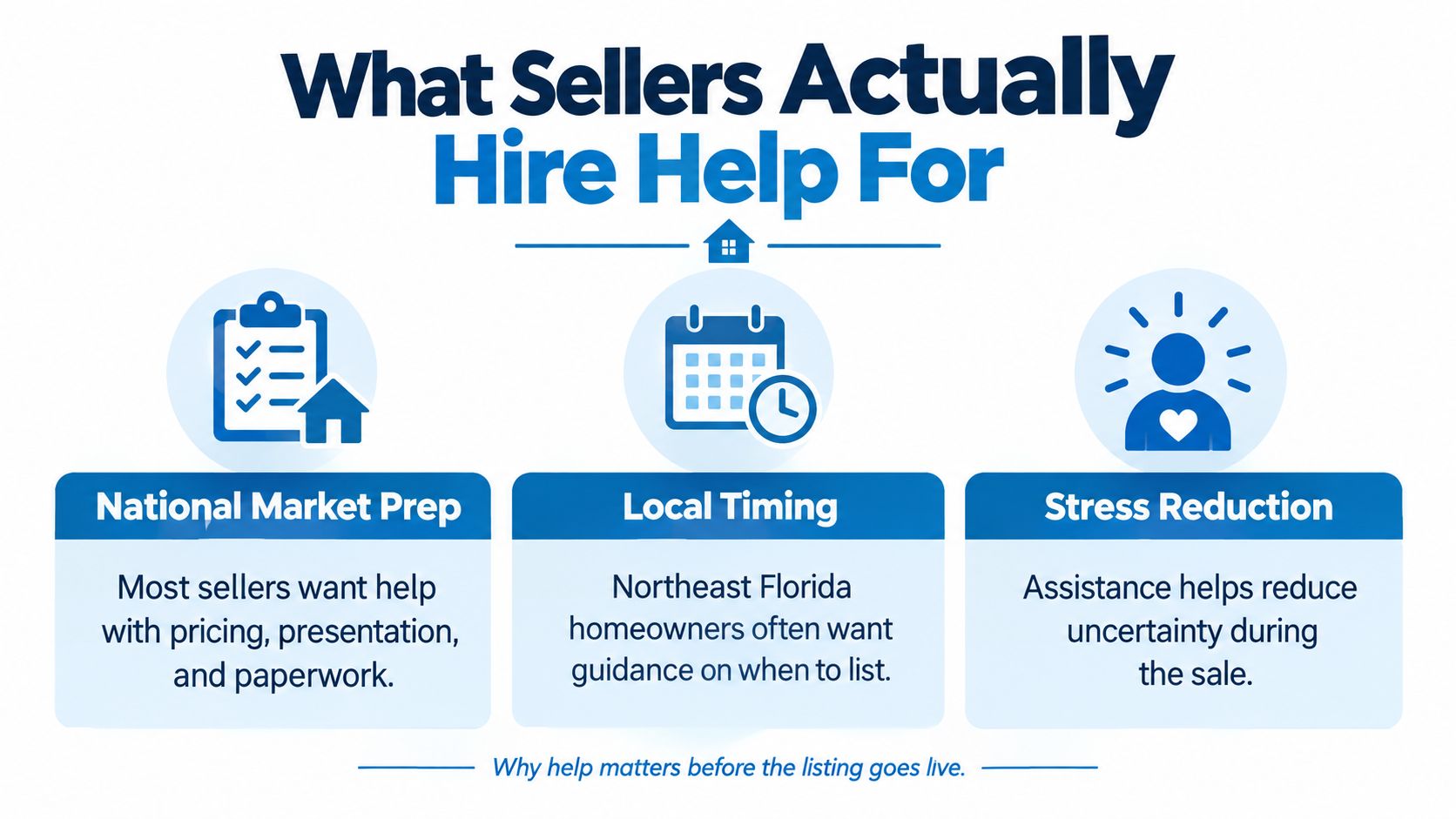
What Sellers Actually Hire Help For
Professional assistance remains the predominant choice. In its [2025 Profile of Home Buyers and Sellers, the National Association of REALTORS® reported that 91% of sellers used an agent or broker, compared with 90% previously, tying the highest recorded share, while 5% sold FSBO, an all-time low; sellers' primary reasons were marketing reach, competitive pricing, and selling within their desired time frame.
Those priorities provide a useful way to evaluate an engagement before signing anything.
Translate the priorities into deliverables
Exposure means agreeing on how the property will appear in the MLS, syndicated listings, photography, and other appropriate marketing channels. Ask who checks listing accuracy and how inquiries become showing opportunities.
Pricing support should produce an explanation you can follow, not merely a suggested asking price. Timing support should include a working calendar for preparation, launch, offer review, contractual deadlines, and closing coordination.
Practical rule: Ask what the agent will deliver, who will handle it, and which decisions remain yours.
Online valuation tools can help you begin asking questions. They don't decide whether a repair is worth completing, evaluate the practical consequences of an offer, or coordinate your move. The national participation figures don't prove every seller needs the same service, but they show that access to online information hasn't displaced professional representation.
For another perspective on listing assistance, the following video is available.
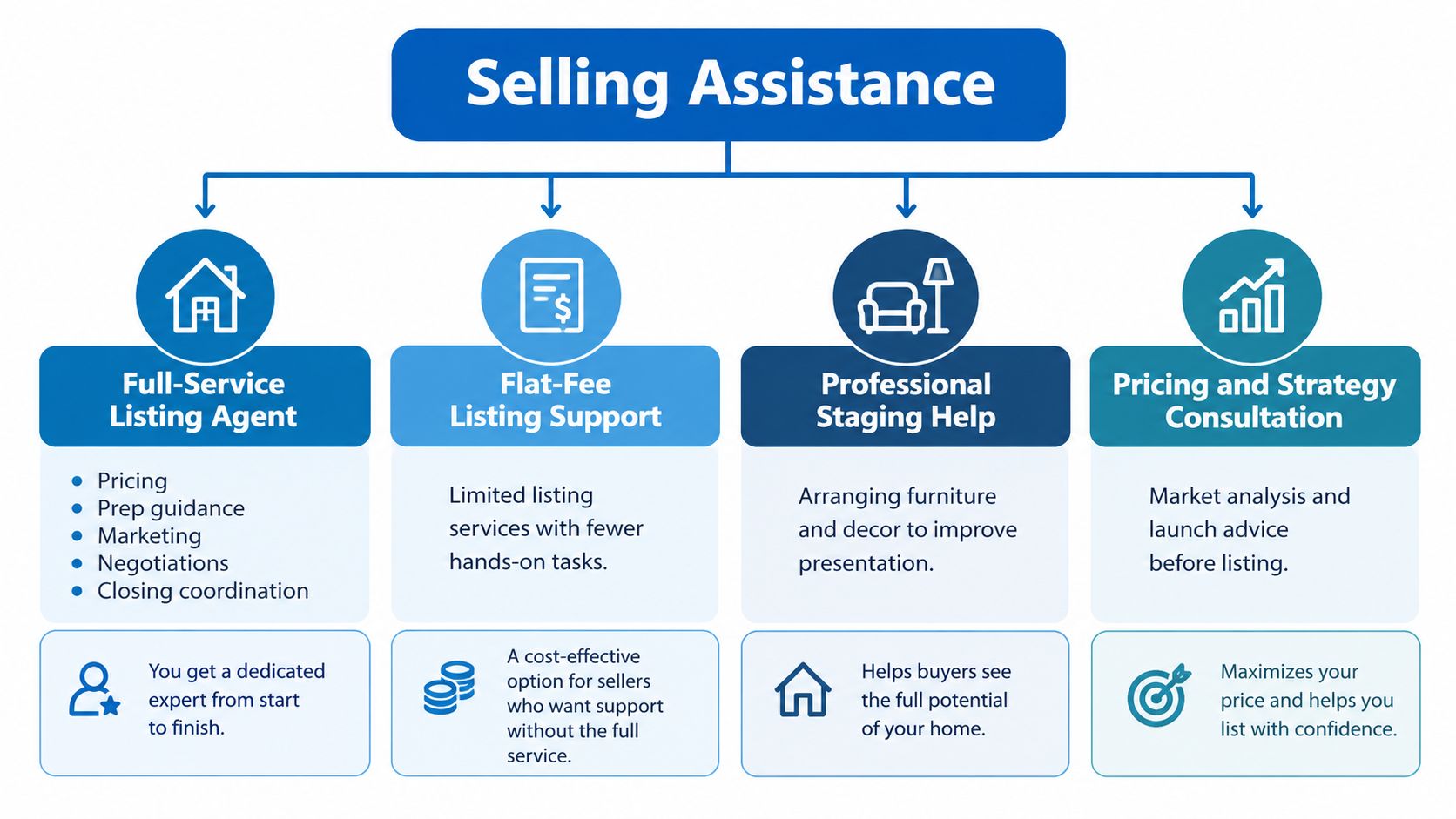
The Main Types of Selling Assistance Explained
Start by distinguishing transaction representation from specialized support. You can hire someone to manage the listing process, purchase a narrower service, or combine representation with preparation and transition help.
Representation and preparation
A full-service listing engagement can cover pricing, preparation guidance, marketing, showings, negotiation, and closing coordination. For a St. Augustine homeowner relocating out of state, the weekly work might involve approving photographs, reviewing showing feedback, and making decisions while the agent manages scheduled tasks.
Flat-fee listing support typically has a narrower scope defined by the agreement. Pricing consultations and professional staging can also be purchased separately, but someone still needs responsibility for inquiries, negotiations, and deadlines.
Some concierge preparation arrangements advance approved repair, painting, or staging expenses for repayment at closing. A Palm Coast move-up seller considering this option should review fees, repayment obligations, vendor selection, and what happens if the home doesn't sell. Deferred payment isn't the same as a free improvement.
Remote and transition support
For an absentee Flagler Estates owner, remote assistance should include documented vendor access, repair approvals, property updates, and secure document handling. A 2025 CertifID survey of 1,497 recent property buyers and sellers found 52% had limited or no prior wire-fraud awareness, roughly 1 in 20 experienced fraud, and more than one-quarter received suspicious communications.
Set callback procedures using previously verified numbers, written spending limits, and a closing-day escalation contact before activity begins.
Downsizing and transition support addresses a different burden. For a 55+ homeowner, it may involve sorting belongings, arranging movers, and coordinating the sale with the next residence. Ask which tasks the agent handles and which require separate providers.
Comparing Assistance Models Side by Side
The service description matters less than the division of responsibility. Before comparing proposals, identify which tasks you can realistically handle and which would become difficult if your work schedule, travel, or next purchase changed.
Selling Assistance Models Compared
| Assistance Model | Seller Effort Required | Control Over Pricing and Presentation | Cost Structure | Best Fit For |
|---|---|---|---|---|
| Full-service listing | Approvals, access decisions, and document responses | Seller approves decisions with agent guidance | Negotiated compensation and agreed expenses | Sellers wanting coordinated representation |
| Flat-fee listing support | Substantial hands-on management | Seller directs most execution | Defined fee with possible additional services | Available local owners comfortable managing tasks |
| Concierge preparation | Project approvals and scope decisions | Seller approves work within program terms | Advanced expenses and possible fees repaid under contract | Owners needing preparation without paying every expense upfront |
| Remote-sale coordination | Documented approvals and scheduled communication | Seller retains authority through written procedures | Included or separately negotiated, depending on scope | Absentee owners needing local oversight |
| Downsizing support | Personal sorting and transition decisions | Seller directs belongings and move priorities | Listing services plus any specialist charges | Homeowners managing a lifestyle transition |
| Pricing consultation or staging | Seller manages the remaining sale | Seller controls implementation | Consultation or project-based fee | Owners seeking targeted help rather than broad management |
Read the gaps, not just the inclusions
Ask who handles tasks that fall between providers. If a staging company needs furniture moved, a contractor needs access, or a buyer requests supporting documents, the agreement should identify who coordinates the response.
The most extensive package isn't automatically the right one. Choose the arrangement you can comfortably supervise.
A move-up seller may prefer broad coordination because the next purchase already demands attention. A local owner with time and relevant experience may reasonably choose limited support. Neither choice removes the need for clear written expectations.
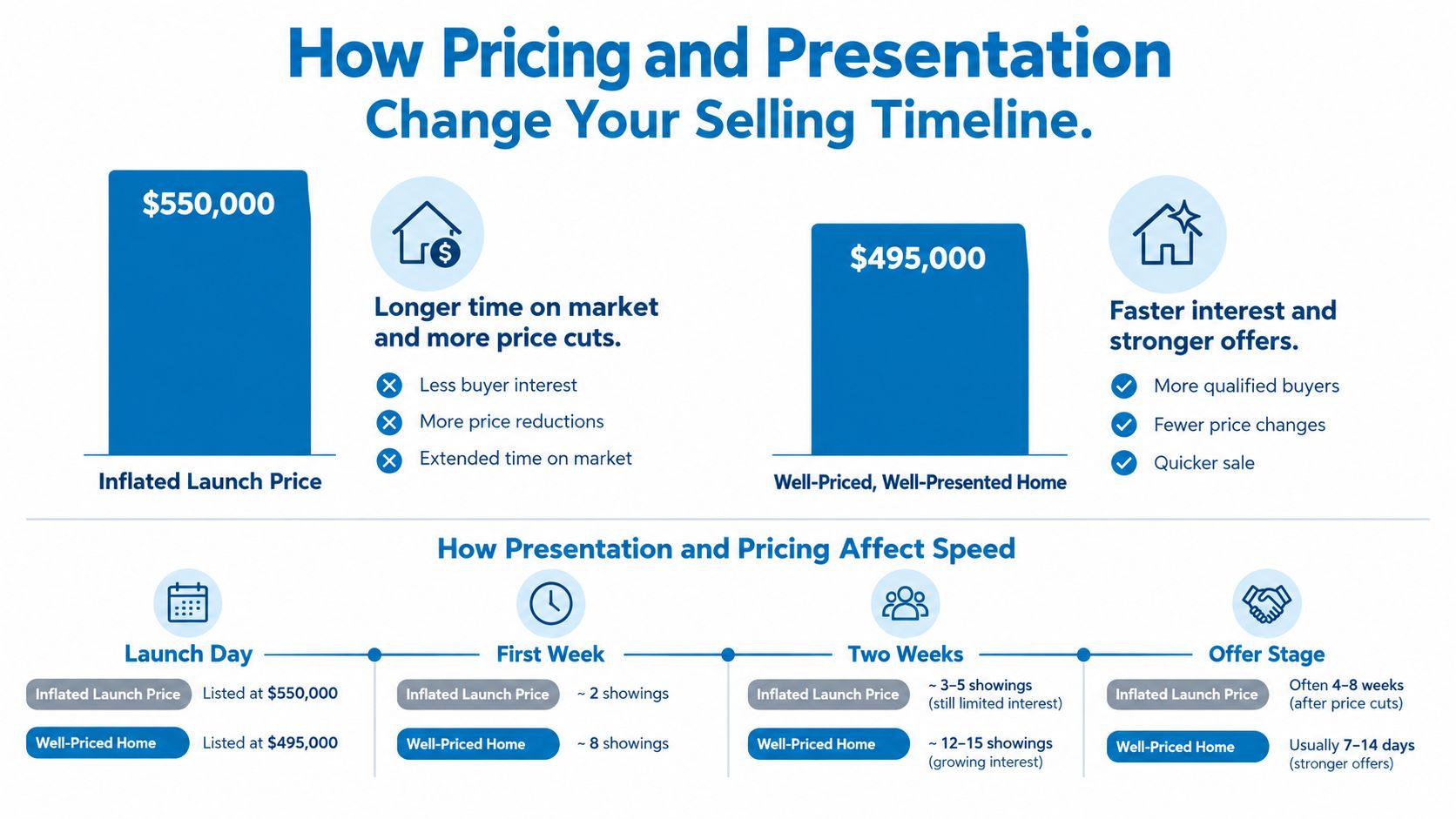
How Pricing and Presentation Change Your Selling Timeline
An ambitious asking price isn't harmless if it discourages buyers from considering the home. Zillow found that homes listed at least 12% above estimated market value were almost 50% less likely to sell within 60 days than homes priced closer to estimated value.
An inflated launch price can place a home outside buyers' search ranges, reduce showing activity, and leave the seller considering reductions after the initial introduction. That doesn't mean pricing low is always appropriate. It means the launch price needs a defensible relationship to competing choices.
Build the launch around evidence
When reviewing Palm Coast home values, request recent comparable sales, active competitors, available pending-sale signals, condition adjustments, and an explanation of the likely appraisal range. Apply the same discipline to the St. Augustine housing market rather than relying on broad area headlines.
Presentation deserves equal attention. Zillow's listing research found that homes with fewer than nine photographs were approximately 20% less likely to sell within 60 days than homes with 22–27 photographs, while listings exceeding 280 first-week views were three times more likely to sell within that period than those receiving fewer than 100 views.
These are associations, not promises. Adding photographs won't correct an unsuitable price or unresolved property problem.
- Prepare deliberately: Address material condition concerns before spending heavily on decorative changes.
- Photograph coherently: Show the layout, principal spaces, and relevant features without repetitive filler.
- Schedule a review: Establish an early checkpoint for showing feedback, online engagement, and offers.
The financial comparison should include mortgage interest, taxes, insurance, utilities, and maintenance. A higher proposed sale price can become less attractive when you account for the expense of waiting.
Local Factors That Shape Your Net Proceeds
Before choosing another cosmetic project, organize the information a buyer will need to evaluate ownership costs. For sellers in Flagler County and surrounding communities, a practical preparation folder should include:
- Roof and mitigation records: Available installation documents, permits, inspections, and wind-mitigation information.
- Flood information: Available elevation records, flood-zone information, and documentation of known flooding.
- Insurance history: Current policy details, deductibles, and available claims documentation.
- Repair evidence: Invoices and records that help explain completed work.
Florida's flood-disclosure statute states that standard homeowners insurance doesn't cover flood damage and encourages buyers to discuss separate flood coverage with an insurance agent. Don't promise that your coverage or premium will apply to a purchaser.
Connect the sale to the next home
A lower purchase price may not resolve affordability concerns if a buyer faces difficult insurance terms or substantial ongoing expenses. Relocation and new construction buyers should obtain property-specific guidance rather than assume neighboring homes have equivalent ownership costs.
For sellers purchasing another Florida homestead, Save Our Homes portability is a separate planning issue. The Florida Department of Revenue explains that the old homestead exemption doesn't transfer automatically; eligible owners must apply for the new exemption using Form DR-501 and request portability using Form DR-501T, with a stated March 1 filing deadline in the first year after moving.
Florida property-appraiser guidance describes the portability window as generally three tax years measured from January 1 of the last year the prior exemption applied, not simply three years after closing. Confirm your dates with the applicable property appraiser.
Finally, build an estimated seller's net sheet. Outside Miami-Dade, Florida documentary stamp tax is 70 cents per $100, or fraction thereof, of consideration, making a $400,000 taxable transfer $2,800 before other charges. Have licensed insurance, legal, and tax professionals resolve questions within their respective fields.
How to Choose the Right Listing Agent
Ask a prospective agent to explain the reasoning behind the recommendation, not just describe a marketing package. A strong answer should connect your property to specific evidence and identify what remains uncertain.
Useful interview questions include:
- How did you select the comparables? Look for an explanation of location, condition, property type, and meaningful differences.
- What preparation would you skip? An agent should help distinguish necessary work from spending that may not support your goals.
- Who coordinates vendors? Ask who schedules access, collects estimates, and seeks your approval.
- How will we communicate? Request a defined update process, especially if you live outside Northeast Florida.
- What would cause you to change the strategy? Look for decision criteria rather than a promise to keep advertising.
Listen for a process you can follow
A vague answer focuses on exposure without explaining who reviews results. A useful answer identifies the information you'll receive, the decisions you'll make, and how recommendations will be documented.
A useful interview test: Ask the agent to explain a recommendation in plain language without relying on a slogan.
Local fit also matters. Someone discussing Palm Coast real estate market trends should be able to narrow the conversation to your competing properties, not merely repeat countywide observations. The same applies when comparing St. Augustine neighborhoods, Flagler Estates, and surrounding Flagler County real estate.
Marilynn Wolfe, a Strategic Listing Agent with LPT Realty LLC, serves these communities with an approach centered on preparation, positioning, and market insight. Evaluate that approach alongside other proposals by asking for a clear path from consultation through closing.
Your Next Step Toward a Confident Sale
You don't need to commit to listing before understanding your options. Request a personalized home value, an estimated seller's net sheet, and a short assessment of conditions in your specific community.
Contact Marilynn Wolfe, LPT Realty LLC, at 904-429-2829 or marilynnwolfe.realtor@gmail.com. Whether you're considering selling a home in Palm Coast, relocating from St. Augustine, or managing a Flagler Estates property remotely, start with your priorities and questions. Selling is a significant decision, and a clearly defined plan can make it more manageable.
Marilynn Wolfe, LLC offers local pricing guidance, preparation recommendations, and selling coordination shaped to your circumstances. Visit Marilynn Wolfe, LLC to request a personalized home value and discuss which home selling assistance model fits your property, timeline, and next move.