
Selling above asking price isn't automatically a sign that a home was priced well, and it isn't a result every seller in Palm Coast, St. Augustine, or Flagler County should expect. The more useful question is whether the asking price was set against current local competition in a way that attracted qualified buyers and protected the seller's net proceeds.
National headlines can make bidding wars sound routine. But homes selling over asking price are an outcome, not a pricing strategy. To understand whether an offer is strong, look beyond the headline number to the original list price, any later price changes, and the terms that determine what the seller is likely to keep.
The Over Asking Price Conversation Needs a Local Reset
A home can sell above asking and still fall short of what it might have achieved with a different pricing strategy. If the original price was set below market-supported value, an offer above it may reflect buyers bringing the price closer to a realistic range. Conversely, an ambitious asking price can discourage qualified buyers, even when the property is well presented.
National results show why the headline can mislead. In spring 2025, 28.5% of U.S. homes sold above their original list price, down from 32% a year earlier, while the typical median sale price was below the median list price, according to Redfin's housing market update. Those figures provide context, not a forecast for Palm Coast real estate or the St. Augustine housing market.
For a local seller, three measures tell a more complete story:
- Sale price versus original list price: Did the final price exceed the number buyers first saw?
- Sale price versus final list price: Did the home sell above its price after any reductions?
- Net proceeds: What remains after agreed credits, repairs, concessions, and other transaction costs?
These measures answer different questions. A home that sells above a reduced price may not have succeeded at its original pricing. In February 2025, 64.2% of homes sold below their original asking price, compared with 53.6% below their final asking price, following price reductions, as reported in Redfin's analysis of original and final list prices.
Practical rule: Judge the sale by the pricing history and net result, not by whether the final number crossed the asking price.
That distinction matters for absentee owners who need clear reporting, move-up sellers coordinating a purchase, and homeowners considering a downsize. A strong result is one that fits the property's market position and the seller's priorities, whether that means a higher price, fewer uncertainties, or a closing that works with the next move.
Why Some Homes Sell Above Asking and Others Do Not
Three conditions decide whether a home draws offers above its asking price: how many comparable homes a buyer can choose from, how much demand exists for that specific property, and how the seller sets the opening number.
Local competition is the piece sellers most often misjudge. In Flagler County, the number of active comparable homes within a half mile is a better demand signal than the regional inventory headline. A Palm Coast seller with three similar homes listed on nearby streets faces a different negotiation than one offering the only updated three-bedroom in its price band. The same logic applies across community lines: a Flagler Estates three-bedroom should not be priced off a waterfront Hammock Dunes comp, because the buyer pool, lot type, and price per square foot differ enough to change the supported range.
Demand varies from one home to the next. Relocation buyers, retirees, second-home shoppers, and local move-up buyers all search across Northeast Florida, but their interest depends on the property itself: its condition, location, and fit with their budget. A sought-after ZIP code does not produce competing offers on its own.
The national picture adds context. The answers sit at street level. Morningstar reported that 25.8% of homes sold above original asking price nationally, while 55% sold below, and in several Florida metros fewer than one in ten sold above asking, according to Morningstar's report on competitive housing markets. Metro-level figures are no substitute for a neighborhood analysis in Palm Coast, St. Augustine, or Flagler County.
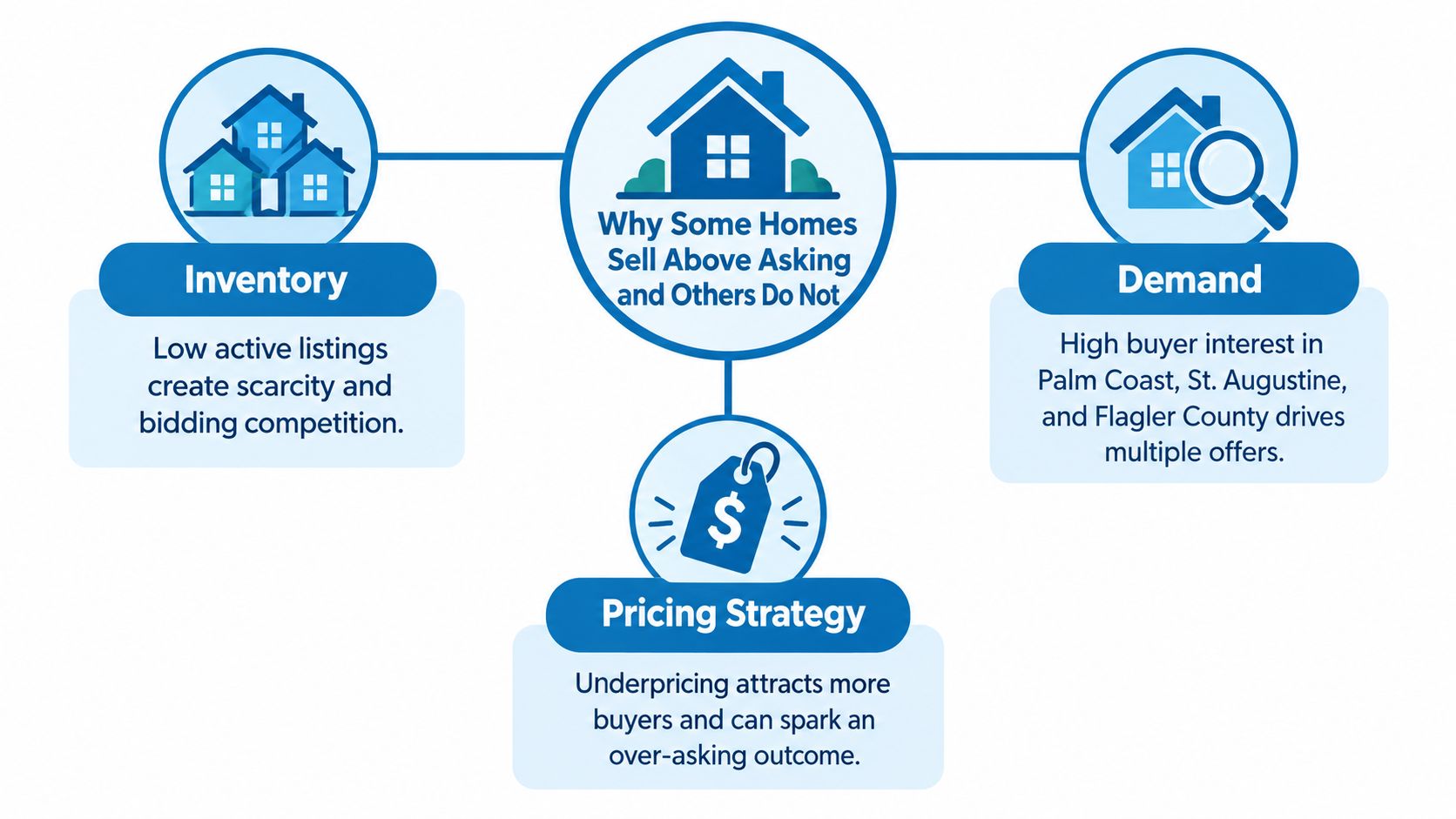
Pricing is where these conditions meet. A price grounded in recent comparable sales and current competition brings qualified buyers through the door. Set it too high, and buyers move on. Set it below market-supported value without a reasoned plan, and even a strong offer can leave money on the table.
The Fast Absorption Signal That Suggests an Over Asking Outcome
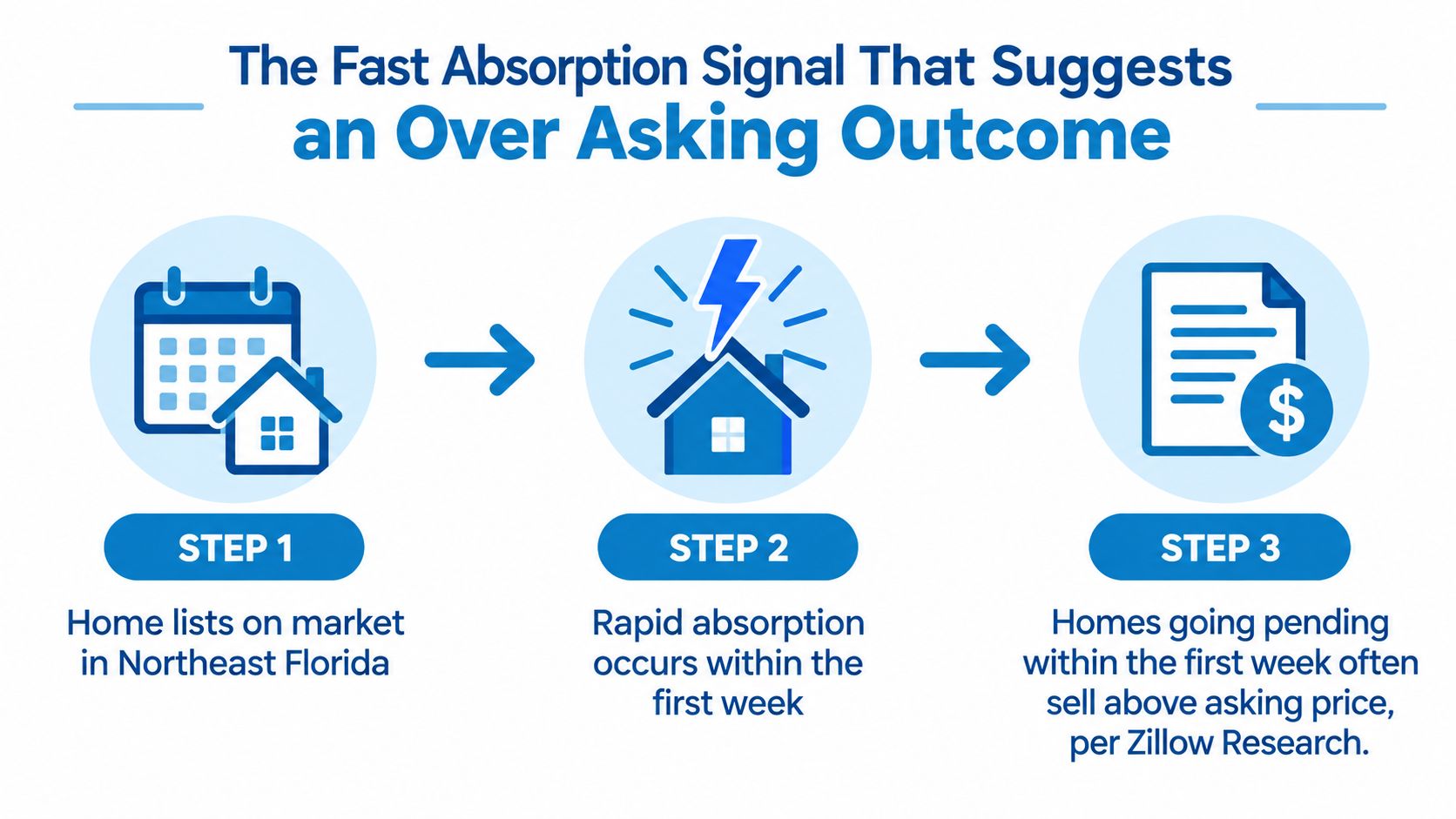
A quick move from listing to pending can be an encouraging sign, but it isn't a promise of an above-asking sale. Zillow Research found that homes going pending within seven days were 2.6 times more likely to sell above list than the typical listing. In February 2026, 44.3% of those fast-pending homes sold above asking, compared with 17.1% of all listings, according to Zillow Research's analysis of fast-selling homes.
For a seller in Palm Coast, St. Augustine, or Flagler Estates, the useful takeaway is to prepare before the listing goes live. Strong early activity is more likely when buyers see a home that is ready to show, accurately priced, and easy to assess online.
A practical launch plan includes:
- Finish visible repairs first. Fix the items buyers are likely to notice during a showing, and disclose known property issues clearly.
- Prepare accurate pricing and property information. Use relevant closed sales, current competing listings, and available pending activity to assess the opening price.
- Make the first impression count. Arrange professional photography and make sure the home is clean, accessible, and ready for appointments when marketing begins.
- Decide how offers will be reviewed. Consider price, financing, appraisal exposure, contingencies, and closing terms together.
Online engagement, showing requests, and buyer feedback help a seller assess whether the launch is connecting with the market. Limited early interest can be a cue to revisit price, condition, access, or marketing reach. It's better to evaluate those signals promptly than to treat the passage of time as proof that buyers will eventually accept the asking price.
The video below offers another look at the selling process.
Presentation Tactics That Attract Competitive Offers Locally
Presentation won't make every buyer offer more, but it can help a well-priced home earn a serious look. Buyers often form an impression online before arranging a showing, so cluttered rooms, dim photos, or unfinished repairs can weaken interest before they've seen the property in person.
Start with the basics: clear countertops, open up walkways, reduce personal items, and make each room's purpose easy to understand. For homes in Palm Coast and St. Augustine, exterior upkeep also matters. A tidy entry, maintained landscaping, and clean outdoor spaces help buyers understand how the property lives, not just how it looks from the street.
Photography and video should show the home accurately and in a way that makes the layout easy to follow. Marketing can then reach beyond the MLS through social channels, relocation networks, and direct communication with buyer agents. That broader reach is useful when it puts the listing in front of relevant buyers, but promotion can't compensate for a price that doesn't match the home or the competition.
Choose a presentation level that fits the property, its condition, and your timeline:
| Presentation Levels and Their Impact on Buyer Response | Time Investment | Best For | Typical Outcome |
|---|---|---|---|
| Light refresh, decluttering, cleaning, and minor touch-ups | Varies with the work needed | Homes already in sound, presentable condition | A clearer first impression without a major project |
| Full staging and coordinated photography | Requires advance planning and access | Vacant homes or rooms that need help showing their purpose | A more cohesive visual presentation for buyers |
| Pre-listing renovation | Depends on scope and contractor schedules | Homes with significant visible issues that affect buyer confidence | A chance to address concerns, though added work doesn't guarantee a higher sale price |
A large renovation isn't automatically the best choice. Before spending on upgrades, weigh the cost, the time required, and whether buyers in the home's segment are likely to value the change. For an absentee owner, coordinating a focused refresh may be more practical than managing a broad renovation from a distance.
Reading Competing Offers Beyond the Headline Price
When offers arrive, compare the buyer's ability to close along with the proposed price. Financing, appraisal, inspection terms, requested credits, and the closing date all affect how much certainty the seller has and how much of the headline amount may reach them.
Appraisal exposure deserves particular attention when a financed offer is above asking. A lender generally bases the loan on the appraised value, not the contract price. CoreLogic data cited by The Seattle Times in its report on appraisal gaps found that 19% of homes had appraised values below contract prices in one reported month, compared with 8% in the same month in each of the prior two years.
Consider a hypothetical offer that's above list but depends on financing. If the appraisal comes in below the contract price, the buyer may need additional cash, the parties may renegotiate, or the transaction may be at risk, depending on the contract. The offer's price alone doesn't tell you which outcome is likely.
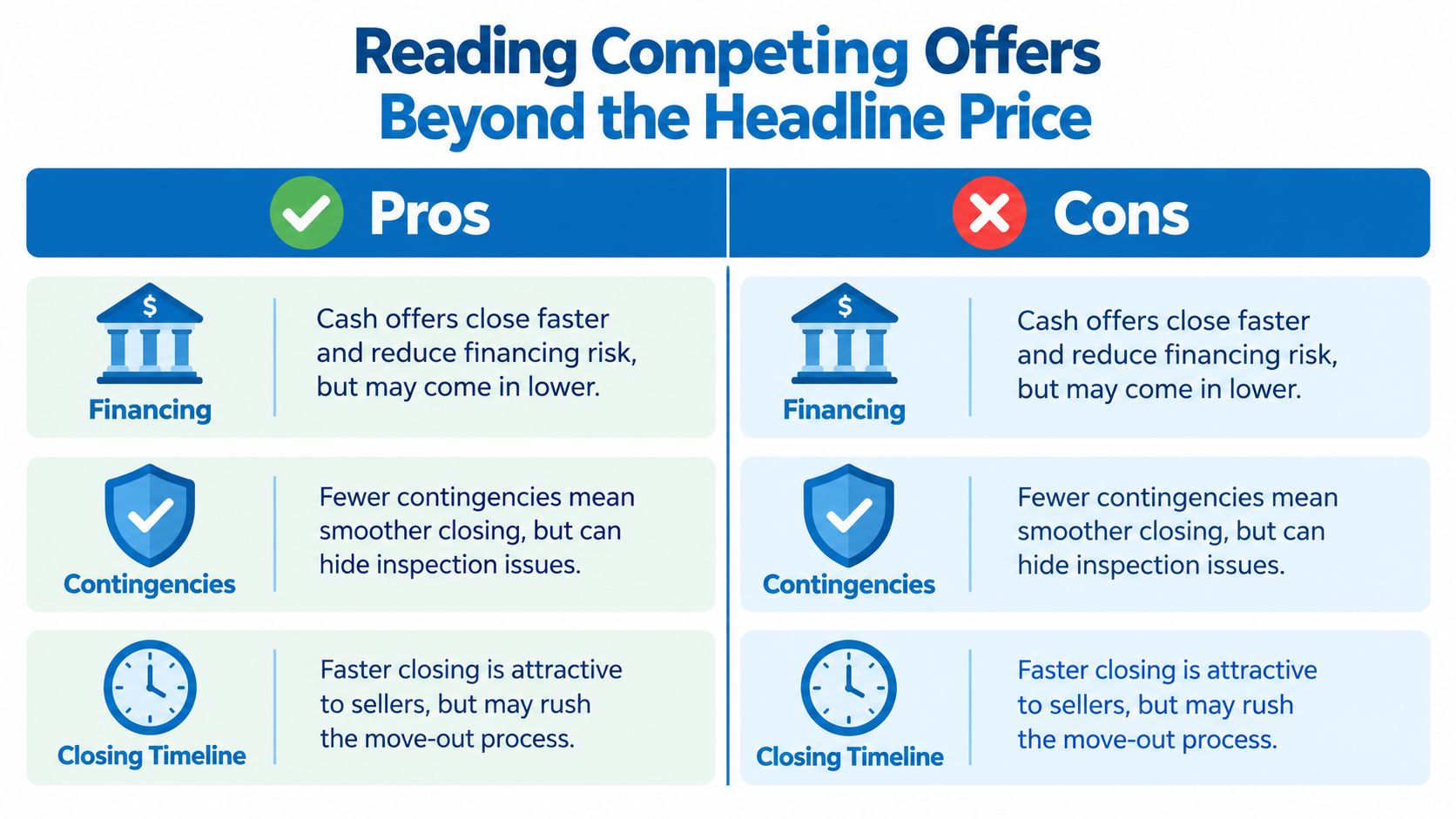
For each offer, ask:
- Financing strength: Has the buyer provided credible evidence of funds or financing readiness?
- Appraisal terms: Who bears the risk if the appraised value is below the contract price?
- Contingencies: Which protections apply, and how could they affect the transaction?
- Closing certainty: Does the proposed timing work for the buyer and seller, and what could delay it?
- Net proceeds: What do credits, repair requests, and other terms mean for the amount the seller keeps?
For a homeowner moving into another property, a clean timeline may be more valuable than a slightly higher offer with uncertain financing. A Strategic Listing Agent can help lay out offers side by side so the seller can compare price, risk, and timing rather than reacting to the largest number.
A Local Framework for Interpreting Your Own Market Signals
A seller can judge the listing more clearly by keeping the price history and buyer response together. In Palm Coast, St. Augustine, and Flagler County, start with the original asking price and compare it with recent closed homes that resemble the property. Then consider the current competition, showing activity, buyer feedback, and whether the home has undergone any price changes.
The distinction between original and final list price matters. The Redfin figures discussed earlier show why an offer above a reduced price isn't necessarily evidence that the original price was well positioned. A price adjustment may have brought the home closer to what buyers consider reasonable.

Use these questions during the listing:
- Is the asking price supported? Compare it with relevant closed sales and the active homes buyers can choose today.
- Are buyers responding? Review showing requests, online engagement, and the substance of feedback rather than relying on a single comment.
- What does the offer deliver? Compare net proceeds and terms, including financing, appraisal risk, credits, and closing timing.
- Has the market position changed? If activity is weak, consider whether price, presentation, access, or competing listings have shifted.
This approach helps distinguish strong demand from a successful correction. It also gives sellers a practical basis for deciding whether to hold firm, adjust the price, or negotiate terms. For homeowners exploring Palm Coast home values or selling a home in Palm Coast, local comparable sales and current buyer behavior are more useful than an assumption borrowed from national bidding-war stories.
What to Do Next If You Are Thinking About Selling
Before choosing a list price, gather information about comparable sales, current competition, the home's condition, and your timing. If you're an absentee owner, planning a move-up purchase, or downsizing, include the logistics of getting the property ready and coordinating the next step.
A personalized pricing discussion can help you understand how your home fits the Palm Coast real estate market trends or the current St. Augustine housing market. It should also cover presentation priorities and how offers will be evaluated, including terms that could affect your proceeds or closing plans.
Marilynn Wolfe is a Strategic Listing Agent with LPT Realty serving Palm Coast, St. Augustine, Flagler County, and surrounding Northeast Florida communities. For local guidance or a home value conversation, contact her at 904-429-2829 or marilynnwolfe.realtor@gmail.com.
Marilynn Wolfe, LLC offers local pricing insight, listing preparation, marketing, and guidance through offer review for homeowners across Palm Coast, St. Augustine, and Flagler County. If you're weighing an above-asking strategy or want to understand your likely net proceeds, visit Marilynn Wolfe, LLC to start a conversation.