

Could a home that looks affordable in Palm Coast or St. Augustine become expensive after insurance, taxes, CDD assessments, maintenance, and closing costs are added? That's the gap many first-time buyers discover too late. These first time home buyers tips and advice focus on the decisions that matter locally, from pre-approval and flood exposure to inspections, contracts, and neighborhood fit.
1. Get Pre-Approved Before You Start Touring Homes
A pre-approval gives you a verified starting point. The lender reviews your income, credit, debts, and assets, then states how much it may be willing to lend. Pre-qualification is usually a less formal estimate, so it shouldn't guide a serious search by itself.
A buyer looking in Palm Coast's Town Center may avoid falling for homes above their approved budget by completing this step first. A St. Augustine buyer may also uncover a credit-report error early enough to correct it before making an offer.
Gather tax returns, pay stubs, and bank statements before applying. Ask whether the lender offers Florida programs and how long the letter remains valid. Once approved, don't open new credit accounts or finance a vehicle during the search.
Practical rule: Shop from the payment you can comfortably sustain, not the maximum amount printed on the approval letter.
Share the letter with your agent so your search reflects your actual financing position.
2. Budget for the Full Cost of Buying
The down payment is only one part of the cash required. Closing costs can include appraisal charges, title insurance, government taxes, prepaid property taxes, homeowners insurance, and interest due before the first mortgage payment. The Consumer Financial Protection Bureau's closing-cost guidance reports median closing costs of $6,000 in 2022, though your amount will depend on the loan, property, location, and contract.
Florida transactions also involve documentary stamp taxes. The seller commonly pays the deed-related tax in much of Florida, while mortgage-related taxes may apply to the loan. Confirm the allocation in your contract rather than relying on custom.
Request the Loan Estimate early, then compare it with the Closing Disclosure. A “no-closing-cost” offer usually shifts the expense through a lender credit, a higher rate, or a larger loan balance.
After closing, apply for homestead exemption through the Flagler County or St. Johns County Property Appraiser. Florida's Save Our Homes protection limits annual assessed-value increases to 3% for qualifying homesteaded property, as explained by Florida's Department of Revenue.
3. Check Flood Zones and Insurance Costs Early
Insurance can change the affordability of a home more than its list price suggests. Buyers in Palm Coast, St. Augustine, Flagler Estates, and coastal areas should check flood exposure before making an offer, not after the inspection period begins.
Use the FEMA Flood Map Service Center to review the property's mapped designation. Ask for an elevation certificate when one exists, and request information about prior claims, roof age, HVAC age, and water-heater age. Lenders may require flood insurance based on the property's location, and homeowners coverage won't necessarily include flood damage.
A wind mitigation inspection can document features such as roof construction and opening protection. Ask at least two carriers for quotes, including Citizens Property Insurance when appropriate, and include both homeowners and flood coverage in your monthly ownership estimate.
A buyer comparing two similarly priced Palm Coast homes may find that the property with lower insurance exposure is the better long-term choice. That comparison matters more than a small difference in listing price.
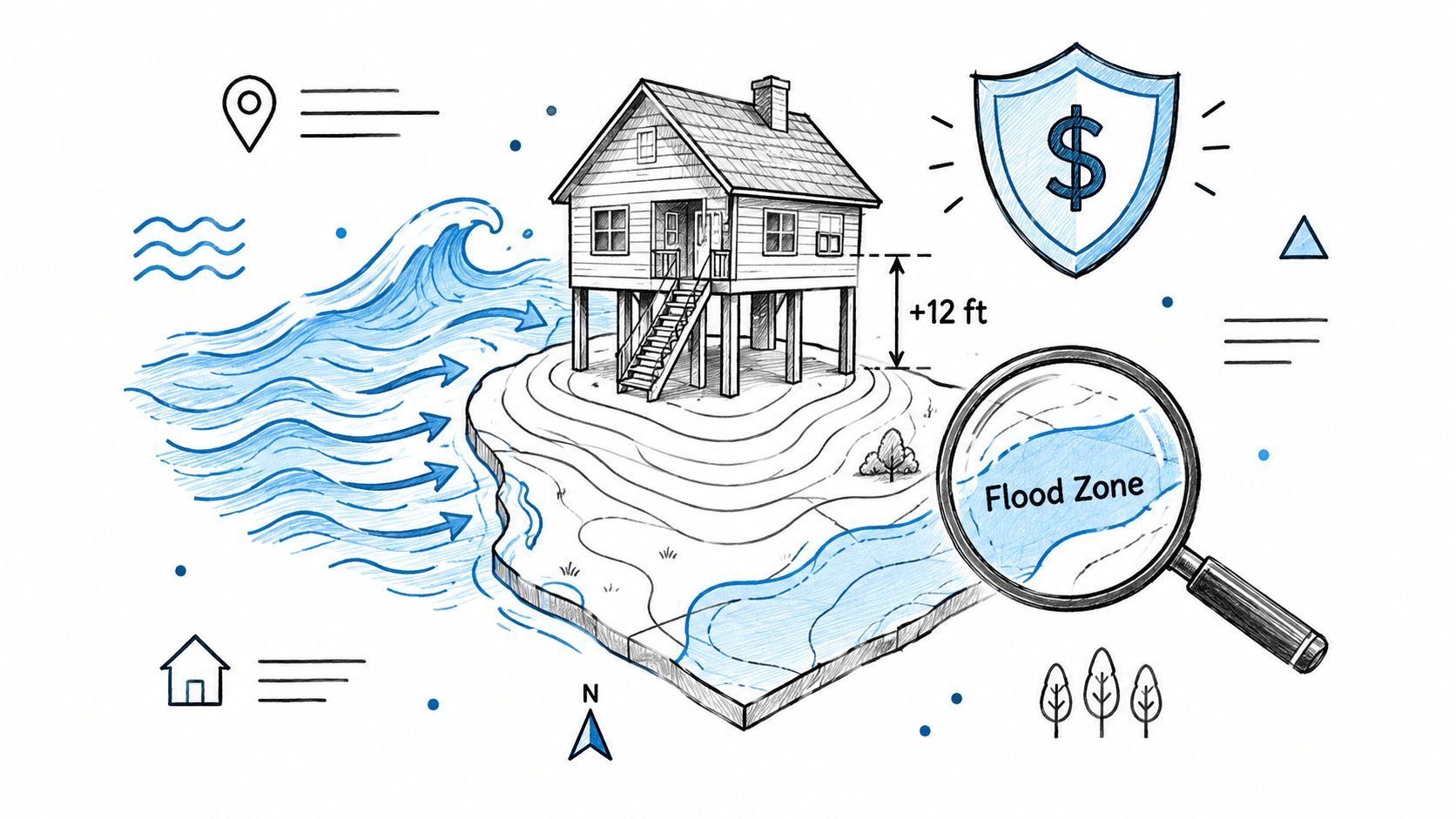
Flood-zone research is part of budgeting, not a task to leave for the closing stage.
For a broader explanation of how overlooked ownership expenses affect first-time buyers, review this homeownership cost analysis. The practical lesson is simple: calculate the full carrying cost before you fall in love with the house.
4. Explore First-Time Buyer Programs and Down Payment Assistance
A large down payment isn't the only path to ownership. Compare conventional, FHA, and state programs side by side, because mortgage insurance, education requirements, income limits, and repayment terms can change the best option for your situation.
Florida Housing Finance Corporation offers eligible first-time buyers 30-year fixed-rate first mortgages through participating lenders. Applicants generally need a minimum credit score of 640, approved homebuyer education, and compliance with county-specific income and purchase-price limits. Florida defines a first-time buyer as someone who hasn't owned and occupied a primary residence during the previous three years. Confirm current requirements through the Florida Housing Homebuyer Program.
Ask whether assistance is forgivable, deferred, or repayable. Complete required education early, and verify that the program serves Flagler County or St. Johns County before you make an offer.
Flagler County applicants may also need a first-time homebuyer class and credit counseling through Mid Florida Housing Partnership, followed by a Credit Readiness Confirmation Letter. Review the Flagler County home-buying assistance requirements before assuming you qualify.
5. Choose Your Neighborhood Based on Lifestyle and Long-Term Plans
Palm Coast real estate and St. Augustine real estate offer different daily experiences. Palm Coast includes planned neighborhoods, parks, golf communities, beach access, and connections to the Intracoastal Waterway. St. Augustine provides historic character and walkability in selected areas, while Flagler Estates homes may offer larger lots and more outdoor space.
Visit each location at different times. Drive the commute during your normal schedule, return after dark, and visit on a weekend. A relocation buyer may prefer Palm Coast after testing the route to work, while another buyer may accept a longer drive for the privacy of a Flagler Estates property.
St. Augustine's historic core also brings additional review requirements. Exterior changes may be subject to historic district rules, so ask the city about approvals before assuming you can add a fence, alter windows, change colors, or make other visible improvements.
Review zoning and future development plans through the relevant city or county planning office. A home that fits your life today should also make sense if your household, commute, or outdoor needs change.
6. Review HOA, CDD, and Special Assessment Obligations
The purchase price doesn't show every recurring obligation. An HOA may charge for common areas, amenities, landscaping, or enforcement of community rules. A Community Development District, or CDD, may fund roads, drainage, recreation, and other infrastructure through non-ad valorem assessments on the property tax bill.
Request the HOA resale package, current budget, financial statements, meeting minutes, and information about pending litigation or special assessments. Then review the property tax bill for CDD charges and other non-ad valorem items.
Compare total ownership, not just the contract price.
A buyer comparing two Palm Coast communities may find that the higher-priced home carries lower annual assessments. Another buyer may discover planned repairs to shared facilities and use that information when structuring the offer.
Read the rules before committing. If you want a pool, fence, boat, rental arrangement, or exterior renovation, confirm that the governing documents allow it.
7. Get a Thorough Inspection Tailored to Florida Homes
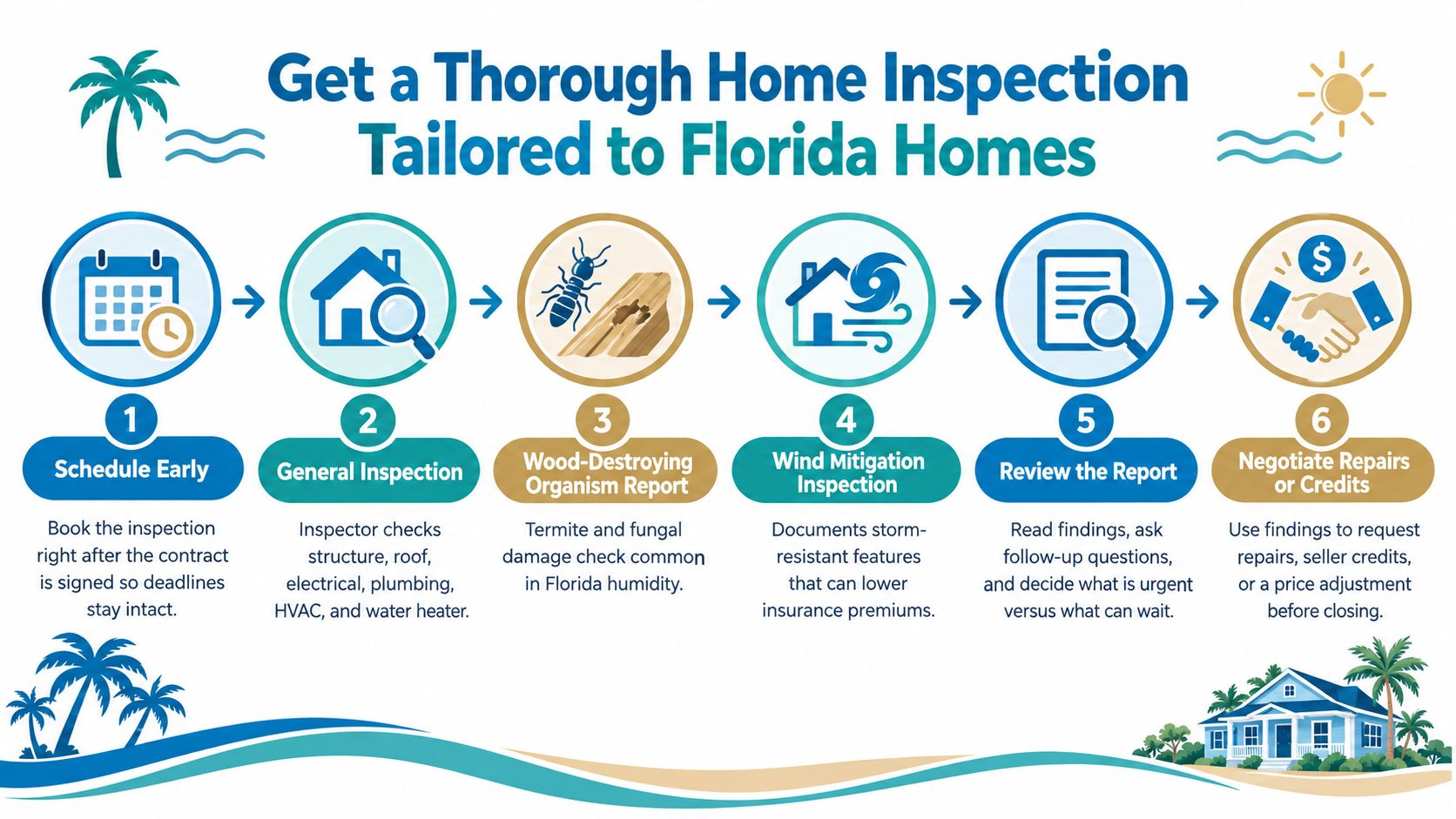
Florida homes face humidity, storms, termites, drainage concerns, and intense cooling demands. A general inspection should address the structure, roof, electrical system, plumbing, HVAC, drainage, and visible safety concerns. A wood-destroying organism inspection and wind mitigation inspection may also be appropriate.
Older St. Augustine housing can require extra attention to original plumbing, aging wiring, additions, and foundation conditions. In Palm Coast, ask about roof age, water intrusion, drainage, and prior storm repairs.
Attend the inspection if possible. Seeing a defect in person helps you distinguish an urgent repair from a cosmetic issue. Keep the inspection contingency in place while reviewing the report and obtaining repair estimates.
Hire an inspector licensed through the Florida Department of Business and Professional Regulation. The inspector should explain what needs immediate attention and what can be monitored.
A St. Augustine buyer may use an electrical finding to negotiate a credit, while a Palm Coast buyer may discover termite treatment records and plan the next step with the seller. The inspection doesn't guarantee a perfect home. It gives you information before ownership transfers.
8. Understand the Florida Purchase Contract and Your Deadlines
The contract controls your deposits, inspection rights, financing obligations, appraisal terms, and closing date. Earnest money is held in escrow, while a due diligence period gives you time to inspect the property, review documents, and confirm financing. Some contract costs may be nonrefundable even when credited toward the purchase price at closing.
Create a calendar as soon as the contract is signed. Include inspection, financing, appraisal, deposit, insurance, and closing deadlines. Missing one can put your deposit or contractual rights at risk.
Ask your agent to explain every section before you sign. Confirm who holds the earnest money, retain every amendment, and verify that the financing and appraisal protections match your circumstances.
A Palm Coast buyer might use the due diligence period to review HOA documents before requesting a repair credit. A St. Augustine buyer may need to coordinate additional historic-property or insurance research within the same timeline.
9. Compare New Construction and Resale Homes Carefully
New construction in Palm Coast, St. Augustine, and Flagler County can offer modern systems and fewer immediate repairs, but the advertised base price may not include the lot, upgrades, appliances, blinds, landscaping, or other choices. Request a written list of what is included before comparing it with a resale home.
Builder incentives may include closing-cost credits or rate buydowns. Ask what conditions apply, how long the incentive lasts, and whether it changes the loan terms. Get every credit and promise in writing.
Independent inspections are useful during construction. Where permitted, arrange a pre-drywall inspection, a final inspection before closing, and a written punch list. Review manufacturer warranties and the builder's warranty process.
A buyer may choose standard kitchen finishes to keep the total within budget, while another may spend on a structural option that would be difficult to add later. Focus on permanent value and livability before cosmetic upgrades.
A resale home deserves the same discipline. It may offer mature landscaping and an established neighborhood, but its roof, systems, insurance eligibility, and maintenance history require close review.
10. Work With a Local Buyer's Agent Who Knows the Market
A local buyer's agent can help compare Palm Coast neighborhoods, St. Augustine housing conditions, Flagler County real estate, and surrounding communities at the property level. The useful work isn't just opening doors. It includes reviewing comparable sales, evaluating pricing, writing an offer, tracking deadlines, and coordinating inspections and closing.
Buyer representation agreements and compensation arrangements should be discussed clearly before touring homes. Read the agreement carefully, including compensation and termination terms. Ask for recent comparable sales, not just the listing price.
Look for an agent who communicates clearly and explains trade-offs without pressure. Marilynn Wolfe is a local real estate professional with LPT Realty serving Palm Coast, St. Augustine, Flagler County, and nearby communities. She helps buyers evaluate property value, prepare competitive offers, and move through contracts, inspections, and closing.
A relocating buyer may use local insight to narrow a broad search to two communities that fit the commute and budget. A St. Augustine buyer may use comparable sales to compete without paying more than the home's realistic market value.
If you want to discuss what your budget could support, contact Marilynn Wolfe at 904-429-2829, marilynnwolfe.realtor@gmail.com, or visit Marilynn's local real estate website.
10-Point First-Time Homebuyer Comparison
| Item | Implementation complexity | Resource requirements | Expected outcomes | Ideal use cases | Key advantages |
|---|---|---|---|---|---|
| Get Pre-Approved Before You Start Touring Homes | Low–Moderate: paperwork and lender review | Income/credit documents, lender time, credit check | Specific loan amount, pre-approval letter (valid ~60–90 days) | Competitive markets; before touring homes | Clarifies budget; strengthens offers; speeds underwriting |
| Budget for the Full Cost of Buying, Not Just the Down Payment | Low: budgeting and confirmation of fees | Loan Estimate, Closing Disclosure, cash for closing, homestead filing | Accurate cash-to-close estimate; fewer surprises at closing | Any buyer needing clear cash planning | Prevents last-minute funding gaps; clarifies long-term tax impacts |
| Check Flood Zones and Insurance Costs Early | Moderate: research and additional inspections | FEMA maps, elevation certificate, insurance quotes, wind mitigation | True monthly cost estimate; flood and wind risk awareness | Coastal/low-lying properties or areas with storm risk | Avoids insurance shocks; potential premium reductions |
| Explore First-Time Buyer Programs and Down Payment Assistance | Moderate: eligibility checks and lender comparisons | Income docs, lender comparisons, possible buyer education | Lower down payment options; possible assistance funds | Low-cash buyers; income-qualified first-time buyers | Reduces upfront cost; access to forgivable or deferred aid |
| Choose Your Neighborhood Based on Lifestyle, Commute, and Long-Term Plans | Low–Moderate: time investment for visits and research | Time for site visits, commute checks, zoning/development research | Better lifestyle fit; improved long-term satisfaction | Buyers prioritizing lifestyle, schools, commute | Matches daily needs; helps protect resale value |
| Review HOA, CDD, and Special Assessment Obligations Before You Commit | Moderate: document review and questions to sellers/HOA | HOA packets, budgets, tax bills, meeting minutes | Clear ongoing cost picture; awareness of restrictions | Planned communities, amenity-heavy or CDD neighborhoods | Avoids unexpected fees; reveals rules affecting use and upgrades |
| Get a Thorough Home Inspection Tailored to Florida Homes | Moderate: schedule multiple specialized inspections | Licensed inspector, WDO report, wind mitigation, inspection fees | Identifies defects; negotiation leverage; insurance support | Older homes; storm-prone or termite-susceptible properties | Reduces repair surprises; informs insurance and repairs |
| Understand the Florida Purchase Contract and Your Deadlines | Moderate–High: contract review and deadline tracking | Agent or attorney review, calendar system, earnest money | Preserves contingencies; avoids deposit loss | All Florida buyers, especially first-timers | Clear legal protections; reduces transaction risk |
| Compare New Construction and Resale Homes Carefully | Moderate: contract and warranty comparisons | Builder contract review, phased inspections, warranty documents | Tradeoff between customization and immediate readiness | Buyers choosing customization or newer systems | Modern systems and warranties vs potential lower resale price |
| Work With a Local Buyer's Agent Who Knows the Market | Low: interview and engagement process | Agent interviews, buyer representation agreement review | Local market insight; negotiation and process guidance | Out-of-area relocations; first-time buyers | Local pricing knowledge; smoother transaction navigation |
Your Next Step Toward a Confident First Home
Buying a first home goes more smoothly when each decision happens in the right order. Start with pre-approval, then calculate the full monthly ownership cost, investigate insurance and flood exposure, compare assistance programs, and choose neighborhoods based on your actual routine.
Before making an offer, review HOA and CDD obligations, protect your inspection rights, understand every contract deadline, and compare new construction with resale homes using total cost rather than appearance alone. The right property isn't just the one with the lowest price or newest finishes. It's the one you can insure, maintain, and enjoy without stretching your finances beyond a comfortable limit.
If you want help mapping out your budget, comparing Palm Coast or St. Augustine communities, or tracking your contract timeline, Marilynn Wolfe is happy to talk it through. Reach her at 904-429-2829 or marilynnwolfe.realtor@gmail.com, or visit marilynnsellsfl.com for local market insight.
Marilynn Wolfe, LLC offers practical buyer guidance, including property-value analysis, competitive offer preparation, and contract support for first-time buyers in Palm Coast, St. Augustine, and Flagler County. Visit Marilynn Wolfe, LLC to start a conversation about your budget, neighborhood options, and next steps.