
If you're asking, “Can I sell my house without a Realtor in Palm Coast or St. Augustine and keep more money?”, the better question is this: Will the sale leave you with more net proceeds after pricing mistakes, marketing, buyer-agent compensation, legal review, repairs, concessions, and carrying costs? That distinction matters because selling by owner is possible, but it transfers the work and risk from a listing professional to you.
For Northeast Florida homeowners, the answer can change dramatically based on whether you already know the buyer, own a highly marketable property, live nearby, or need to coordinate an inspection, appraisal, title work, insurance documents, and closing from another state. A Flagler Estates owner, a Palm Coast downsizer, and a St. Augustine property owner facing historic-district or HOA considerations may all need different strategies.
Is Selling Without a Realtor the Right Move for You
Most FSBO sellers begin with commission savings. I recommend beginning with net proceeds instead.
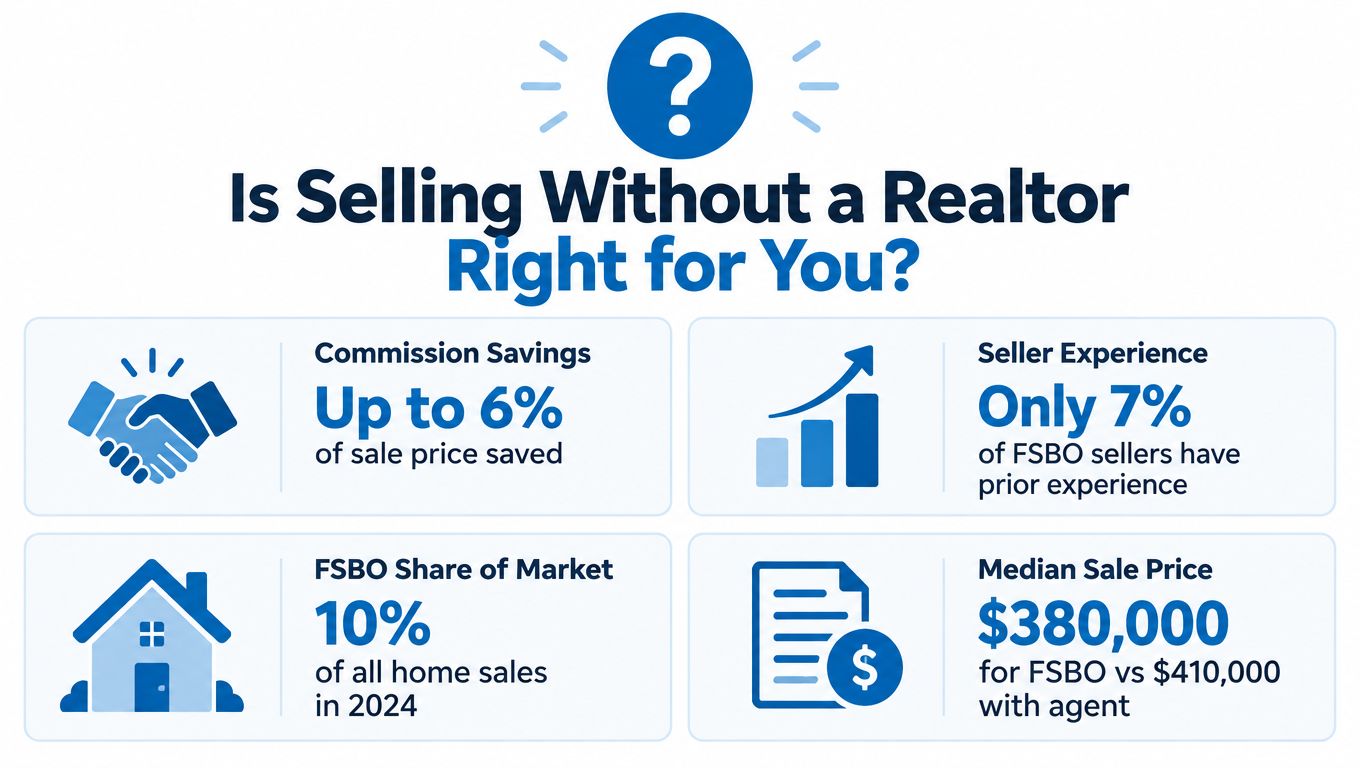
The National Association of Realtors' 2025 Profile of Home Buyers and Sellers found that only 5% of sellers sold without an agent, the lowest share recorded in that survey's history. By comparison, FSBO transactions represented 21% of transactions in 1985. The same survey reported that 91% of sellers used a real-estate agent, up from 90% the prior year.
The median figures deserve attention. The median FSBO sale price was $360,000, compared with $425,000 for agent-assisted sales, a $65,000 difference. That gap doesn't prove that every FSBO seller would have earned more with representation. It does show why saving a commission percentage isn't the same as maximizing your return.
The known-buyer exception
FSBO is more defensible when you already have a serious buyer. NAR reported that 60% of FSBO sellers knew the buyer of their home, which suggests many owner-managed sales are private transactions involving a friend, relative, neighbor, or existing contact rather than broadly marketed open-market listings.
That distinction matters in Palm Coast real estate and St. Augustine real estate. A private sale with a known buyer may require less exposure, but an open-market sale demands accurate pricing, professional presentation, buyer screening, negotiation, disclosure management, and closing coordination.
| Metric | FSBO | Agent-Assisted |
|---|---|---|
| Share of recent sales | 5% | 91% of sellers used an agent |
| Median sale price | $360,000 | $425,000 |
| FSBO sellers who knew the buyer | 60% | Not stated |
Practical rule: If your plan depends on finding an unknown buyer through online marketing, evaluate FSBO as a complete sales operation, not as a way to remove one fee.
You'll need to decide who will price the property, prepare disclosures, arrange photography, coordinate showings, verify financing, negotiate inspection findings, track deadlines, resolve title issues, and protect the closing. The rest of the decision comes down to four questions: can you price the home defensibly, create enough exposure, manage Florida compliance, and stay organized when the transaction becomes stressful?
Pricing Your Palm Coast or St. Augustine Home With Confidence
Pricing is where many FSBO plans fail before the first showing. An online estimate can be a starting point, but it isn't a pricing strategy for a specific home in Palm Coast, St. Augustine, Flagler Estates, or another Northeast Florida community.
Start with three to five comparable nearby sales. Compare homes with similar living area, lot size, age, condition, improvements, and market timing. Then adjust for the details that change buyer perception and ownership costs in this region.
Compare the features buyers actually notice
A home near the beach may compete differently from a similar home farther inland. Flood exposure, insurance costs, roof age, storm protection, HOA restrictions, pool condition, garage space, lot position, and updates can all influence what a buyer is willing to pay. A property in Flagler County may also be evaluated differently from a property in St. Johns County, even when the floor plans look similar.
New construction creates another pricing challenge. A resale home has to compete with builder incentives, available upgrades, warranties, and buyer preferences for a newer roof or modern systems. If your asking price ignores that competition, buyers may choose a new construction community instead.
Use a written adjustment sheet. For every comparable, record why your property deserves a higher or lower position. Don't choose the highest sale because it supports your preferred number.

Prepare before setting the price
A pre-listing inspection can identify roof, electrical, plumbing, moisture, structural, or system concerns before a buyer uses them to negotiate. Assemble property disclosures, permits, warranties, surveys, HOA or condominium information, and records for improvements before launching the listing.
Then establish a price-review trigger. After 10 to 14 days, assess:
- Showing volume: Are qualified buyers visiting?
- Online engagement: Are people saving, sharing, or asking questions?
- Offer quality: Are serious buyers responding with workable terms?
- Feedback patterns: Do multiple buyers identify the same concern?
If the listing receives little qualified activity, document the evidence and reconsider the price. NAR identifies pricing, preparation, and selling within the desired timeframe as leading seller difficulties, which is why a preplanned review is more useful than waiting indefinitely and hoping conditions change.
Marketing and Showings Without Losing Buyer Confidence
A FSBO listing can be visible without being persuasive. Buyers in Palm Coast and St. Augustine compare dozens of homes online, and weak photos, inaccurate measurements, or missing information can make a property look riskier before anyone schedules a showing.
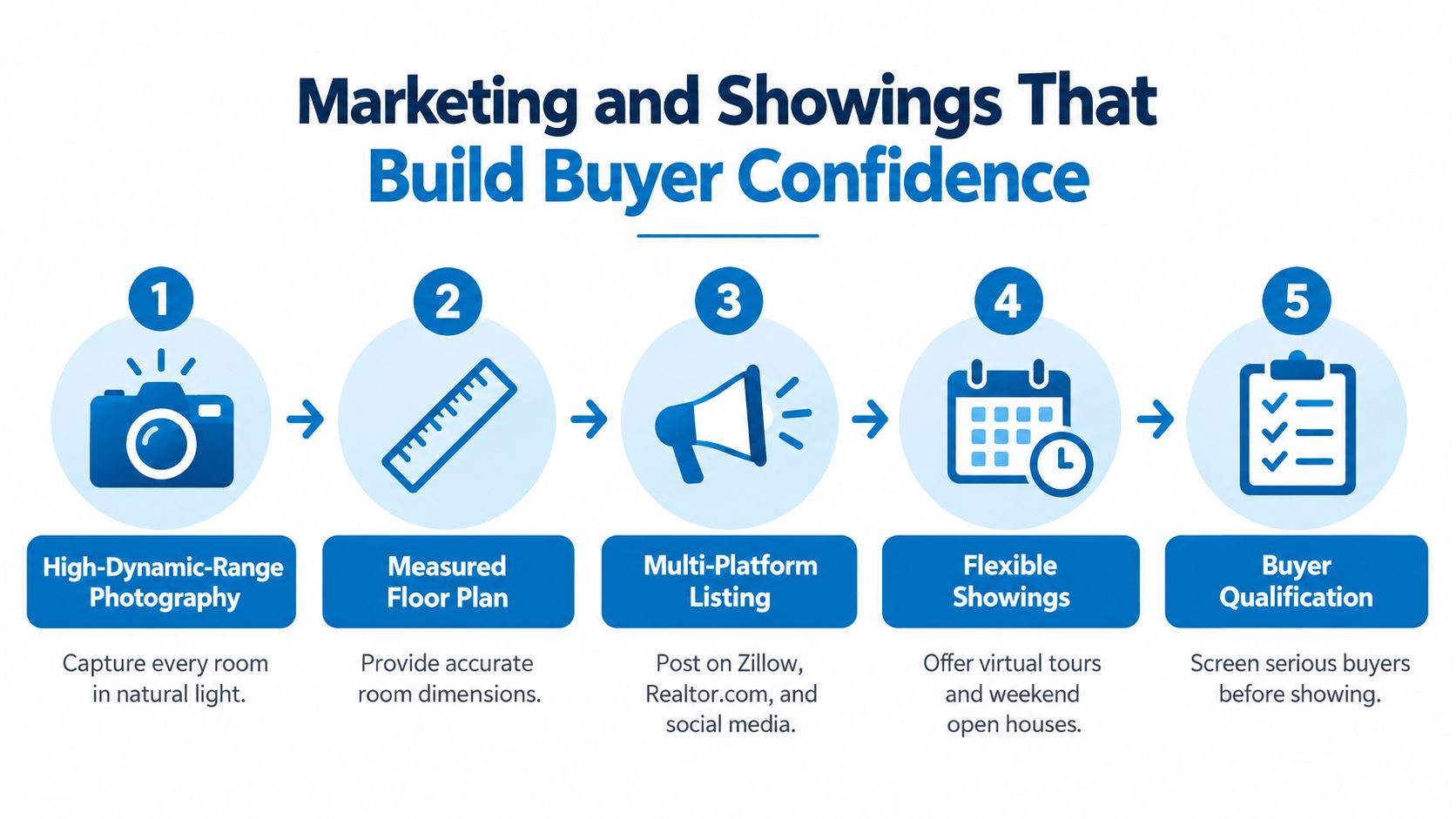
Professional presentation starts with high-dynamic-range photography, accurate room dimensions, a measured floor plan, exterior images, signage, and a written feature sheet. Describe improvements precisely. “Updated kitchen” is weaker than identifying the cabinets, counters, appliances, flooring, or work completed, provided those details are accurate.
Build reach beyond a yard sign
A flat-fee MLS service can distribute your listing through the MLS and consumer-facing channels, but it doesn't replace a full-service listing professional. You remain responsible for the description, accuracy, showing process, offer review, negotiations, disclosures, and contract deadlines.
Use the same standard buyers expect from a professionally marketed home:
- Photography: Show every important room in natural, balanced light.
- Floor plan: Provide measurements that match the listing and property records.
- Feature sheet: Explain improvements, utility details, HOA information, and exclusions.
- Showing system: Use scheduled appointments rather than uncontrolled access.
- Buyer screening: Request proof of funds or financing information before private showings.
- Follow-up: Respond promptly and record questions, feedback, and next steps.
Forty percent of FSBO sellers said they did not actively market their property, according to NAR's reporting on FSBO sales. That is a major warning for an owner hoping to reach buyers relocating to Northeast Florida or comparing Palm Coast home values with St. Augustine options.
Understand buyer-agent compensation
The industry-rule changes implemented after August 2024 changed how buyer-agent compensation is handled. Compensation is no longer automatically displayed through the MLS, and the subject may require separate negotiation. Buyers can still seek compensation from the seller, so the issue may appear in an agent-represented offer.
Decide in advance how you'll evaluate that request. Don't reject an offer based only on the compensation line. Compare the complete offer, including price, financing strength, inspection terms, appraisal risk, concessions, closing timing, and your expected net proceeds.
Showings also require personal safety and process discipline. Remove valuables, avoid sharing unnecessary personal information, confirm who will attend, and don't allow an unverified stranger to control the appointment.
Cost Math: Net Proceeds Behind Selling Without a Realtor
Would you keep more money by selling without a Realtor, or would a lower price and added costs erase the apparent commission savings? The useful comparison is expected net proceeds under different sale scenarios.
Start with a realistic probable market value, then create a net sheet that subtracts every cost you may pay or absorb. The NAR median comparison, $360,000 for FSBO versus $425,000 for agent-assisted sales, provides a benchmark, not a promise. The gap can reflect property type, seller circumstances, pricing, exposure, and the fact that some FSBO sellers already know their buyers.
Build three sale scenarios
Prepare conservative, likely, and strong sale-price scenarios. Let the worksheet test whether your savings survive a lower price, buyer concessions, additional carrying time, or an appraisal problem. A lower sale price can outweigh a visible commission saving quickly.
| Line Item | Description | Estimated Amount |
|---|---|---|
| Probable sale price | Supported by comparable nearby sales | $ |
| Buyer-agent compensation | Amount negotiated with a buyer or buyer's agent, if applicable | $ |
| Flat-fee MLS listing | Distribution and listing-entry cost | $ |
| Photography and floor plan | Professional visual presentation and measurements | $ |
| Repairs and preparation | Inspection work, maintenance, cleaning, or staging | $ |
| Attorney and title charges | Contract review, title work, deed, escrow, and closing coordination | $ |
| Buyer concessions | Credits, repairs, rate-related concessions, or other negotiated costs | $ |
| Carrying costs | Mortgage, taxes, insurance, utilities, and maintenance during additional marketing time | $ |
| Estimated net proceeds | Sale price minus the applicable costs above | $ |
Palm Coast sellers should account for insurance documentation and flood exposure. A St. Augustine property may involve HOA requirements, historic-area considerations, or older construction. Flagler County homes can vary sharply by neighborhood, condition, and intended use, so a countywide price assumption is not enough.
A nominal fee saving disappears quickly if the property is underpriced, poorly exposed, or tied up through a longer marketing period.
Ask one break-even question: How far below probable market value could the property sell before the savings disappear? Include buyer-agent compensation where applicable. Post-August 2024 rules do not guarantee that buyers will accept every transaction cost themselves, and an offer with a higher price may produce less money after concessions and negotiated compensation.
FSBO can work with a known buyer, a highly marketable home, or an owner who can manage the work and pay for professional support. It is a poor trade when avoiding a visible fee leads to weak exposure, inaccurate pricing, delayed decisions, or more carrying costs. Compare the final net proceeds, time commitment, and stress before choosing the selling method.
Florida Contracts, Disclosures, and the Brokerage Disclosure Rule
An internet purchase agreement is not a substitute for a Florida-compliant contract reviewed for your property and transaction. The contract should put the important business terms in writing, including earnest money, inspection rights, repair responses, financing and appraisal contingencies, title examination, closing date, possession, included items, and default remedies.
Track every deadline
A workable contract needs more than a purchase price. It needs a calendar.
- Earnest money: Identify the amount, holder, delivery deadline, and conditions for release.
- Inspection period: State when inspections must occur and how the buyer can respond.
- Repair negotiations: Define how requests, credits, or termination rights will be handled.
- Financing and appraisal: Address loan approval, appraisal results, and notice requirements.
- Title examination: Give the title company enough time to identify liens, ownership issues, permits, probate authority, or trust concerns.
- Closing: State the date, possession terms, document responsibilities, and closing location or remote process.
Florida's brokerage disclosure statute, Florida Statute 475.278, addresses residential sales involving improved residential property of four units or fewer, certain unimproved residential property, and agricultural property of 10 acres or fewer. When a Florida licensee acts as a single agent, the relationship and duties must be disclosed in writing before or at the time of a listing or representation agreement, or before the property is shown, whichever occurs first.
Know who represents whom
Marketing your home independently doesn't automatically create a seller-agent relationship. But a buyer may arrive with a licensed agent. Before you share sensitive information or negotiate, ask whom that agent represents, what duties apply, and how compensation is being addressed.
This distinction matters in Palm Coast, St. Augustine, and Flagler County, especially when a buyer's agent presents a form or proposes terms unfamiliar to you. Have the purchase agreement, disclosures, agency-related documents, and any unusual addenda reviewed by a Florida real-estate attorney or another qualified professional before signing.
Vacant land, probate sales, trust-owned property, inherited homes, and older properties deserve extra caution. Ownership authority, permits, liens, surveys, and payoff figures can create delays that a standard online form won't solve.
Handling Inspections, Appraisals, and Closing From a Distance
An absentee owner may believe the hardest part is finding a buyer. In practice, the remote coordination can be more demanding. A seller living outside Florida still needs to provide access, answer questions, gather records, negotiate repairs, respond to appraisal concerns, and sign documents on schedule.

Consider an older owner who moved away from Palm Coast but still owns a property near the coast. A buyer requests a showing, the inspector needs access, the lender orders an appraisal, and the title company asks for payoff and ownership documents. Each appointment requires a local person, a confirmed time, and a clear record of what happened.
Create a remote-sale file
Before accepting an offer, collect the documents most likely to affect underwriting and closing:
- Insurance records: Provide available wind mitigation, four-point inspection, flood-related, roof, and claim information.
- Water and waste records: Gather septic permits, well records, pump information, and service history when applicable.
- Association documents: Request HOA or condominium rules, fees, approval requirements, and estoppel information.
- Improvement records: Keep permits, invoices, warranties, and contractor information together.
- Ownership documents: Confirm the deed, mortgage payoff, trust or probate authority, and any power-of-attorney requirements.
A title company or attorney should coordinate escrow, title examination, deed preparation, lien resolution, payoff statements, and closing. The IRS guidance on the home-sale exclusion also makes clear that tax treatment depends on ownership and use requirements, not on whether a Realtor participated in the sale.
Give each professional a defined role:
- Licensed inspector: Evaluates physical conditions and systems.
- Insurance professional: Explains documentation and coverage questions.
- Title company or attorney: Handles title, escrow, deed, payoff, and closing documents.
- Signing service or closing provider: Coordinates execution when remote signing is available.
- Seller: Makes decisions, supplies accurate disclosures, and tracks contractual deadlines.
After the inspection, decide how you'll respond if the buyer requests repairs or a credit. If the appraisal is lower than the contract price, identify whether the buyer can bring additional funds, whether the price can be renegotiated, or whether the contract provides another remedy. If financing is denied or a deadline is missed, follow the contract instead of making informal promises.
Place the video walkthrough after the seller has organized the remote process, not as a substitute for professional coordination.
When FSBO Works, When It Doesn't, and How to Get Local Help
FSBO works best when the circumstances remove some of the burdens. You may have a strong candidate for owner-managed selling if:
- You already know the buyer: The sale doesn't depend entirely on open-market exposure.
- The property is easy to explain: Condition, improvements, access, and ownership are straightforward.
- You can coordinate locally: You or a trusted representative can handle showings, inspections, appraisal access, and urgent questions.
- You have time for the transaction: You can answer inquiries, compare offers, negotiate repairs, and monitor deadlines.
- You will hire professional help where needed: An attorney, title company, inspector, insurance professional, or tax adviser can handle work outside your expertise.
- You can stay emotionally detached: You can evaluate price and terms without allowing a buyer's criticism or personal relationship to control the decision.
FSBO is a poor fit for many open-market sellers. The risk rises when the property needs broad exposure, the owner lives out of state, the home has unresolved permits or liens, the seller is managing a move-up purchase, or the transaction involves probate, a trust, an HOA, a condominium, or complicated insurance questions.
Tax planning also belongs in the net-proceeds conversation. The IRS generally allows an eligible individual to exclude up to $250,000 of gain, or up to $500,000 when married filing jointly, if the principal-residence requirements are met. The general ownership and use test involves owning the home for at least 2 of the 5 years before sale and living in it as the main home for at least 2 of those 5 years. Those rules concern taxable gain, not gross sale price, and rental use, business use, a prior exclusion, or a second home can change the result.
Your actual outcome depends on basis, improvements, depreciation, selling expenses, price, concessions, and carrying costs. A tax professional should review your personal situation.
For homeowners comparing Palm Coast home values, the St. Augustine housing market, Flagler Estates homes, or another local opportunity, the decision should be practical. Ask whether FSBO improves your net result after the work is priced accurately. If it does, build a professional support team. If it doesn't, full-service representation may offer the stronger path to pricing, exposure, negotiation, and a controlled closing.
Marilynn Wolfe, LLC offers thoughtful pricing strategy, local market insight, professional marketing, and clear transaction guidance for homeowners in Palm Coast, St. Augustine, Flagler County, and surrounding Northeast Florida communities. If you're weighing FSBO against a full-service listing, visit Marilynn Wolfe, LLC for a personalized home-value conversation and candid guidance on the option that best fits your goals.