


What your home might sell for in Palm Coast right now is a fair question, and many homeowners ask it. Many homeowners start with a county tax record, see a much higher number online, then hear a different range from an agent, and they're left unsure which figure deserves their trust.
That's a normal reaction, and it doesn't mean one of those numbers is automatically wrong. Each one answers a different question. Understanding home assessment value starts with separating a tax figure from a pricing decision, then building your selling plan from current, property-specific evidence in the Palm Coast real estate and St. Augustine real estate markets.
Why Different Home Value Numbers Conflict
A Palm Coast homeowner preparing to sell might open the county record first because it's familiar and official. The taxable figure looks low. An online estimate on a phone suggests something much higher, and an agent talks about a range instead of a single price. It's easy to assume someone must be exaggerating.
Usually, no one is. They're measuring different things, on different dates, for different purposes.
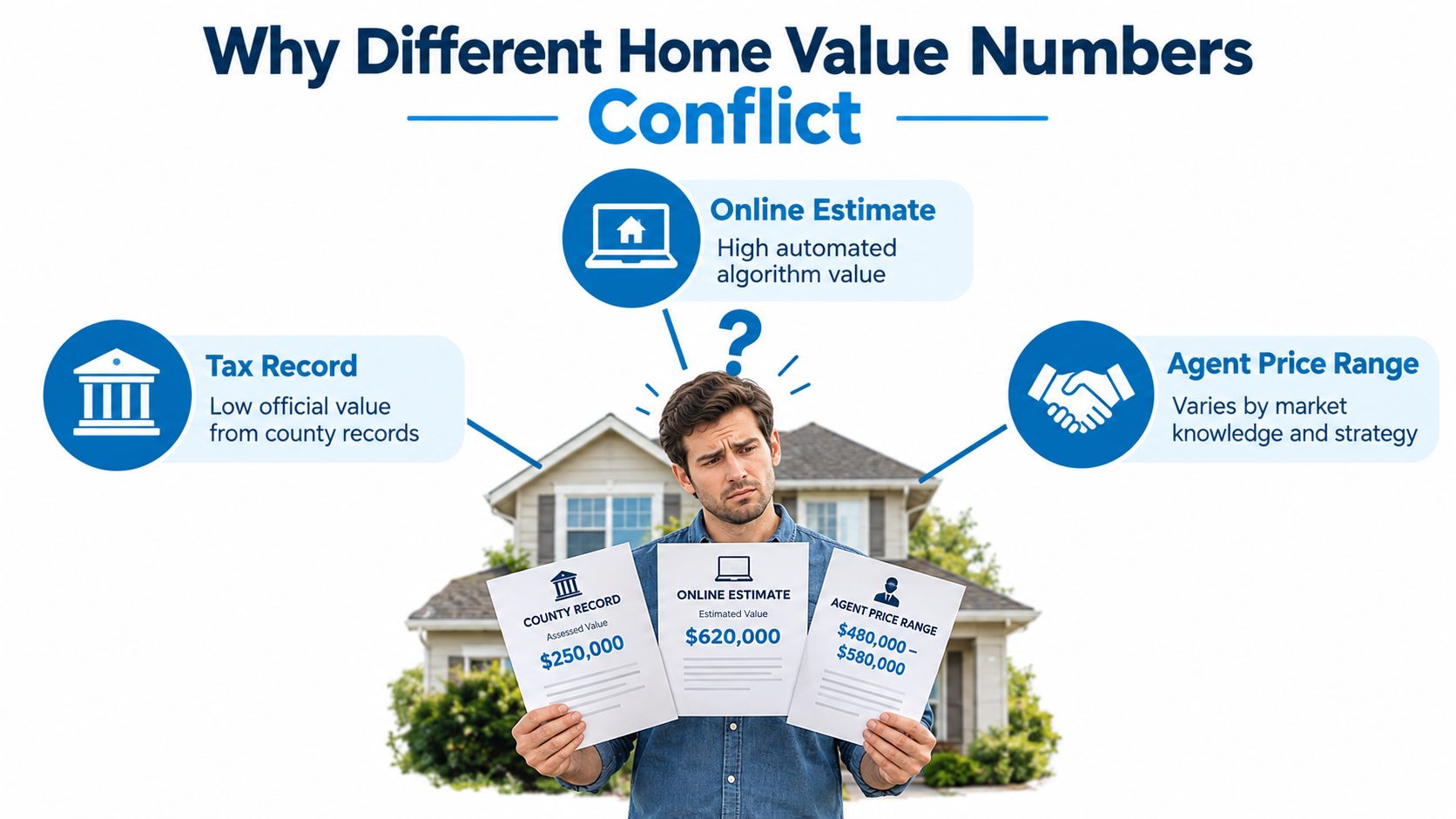
Different Numbers Answer Different Questions
A home assessment value is primarily a property-tax valuation, not necessarily the price a home would achieve in an open-market sale, as explained in the IAAO Standard on Ratio Studies. Assessment systems are usually designed for equitable taxation across large groups of properties. A market valuation for selling focuses on one specific home and current buyer demand.
Think of it this way. The county asks, "How should this property be treated fairly alongside thousands of others for taxes?" A buyer asks, "What will I pay for this house, on this lot, in this condition, compared with the other homes I can choose today?"
Those aren't the same question, so you shouldn't expect the same answer.
- Tax record: Useful for understanding taxes, exemptions, and county property data
- Online estimate: Useful as an early signal, but it can't see inside your home
- Agent price range: Built for a listing decision using comparable sales and current competition
- Formal appraisal: A written opinion developed for a defined purpose, such as lending or a legal matter
For homeowners selling a home in Palm Coast, in St. Augustine, or in Flagler Estates homes and other Flagler County communities, that distinction matters. A saltwater canal lot, a renovated kitchen, flood exposure, or an unusual floor plan can affect what a buyer pays. A mass appraisal system isn't designed to weigh those details the way a current comparative market analysis does for one property.
Practical rule: Don't ask which number is the winner. Ask what job each number was created to do, and whether that job matches the decision you're making.
Reading Florida Property Value Figures
Florida adds another layer of confusion because one property can show three different figures at the same time. Once you separate them, the tax record becomes much easier to read.
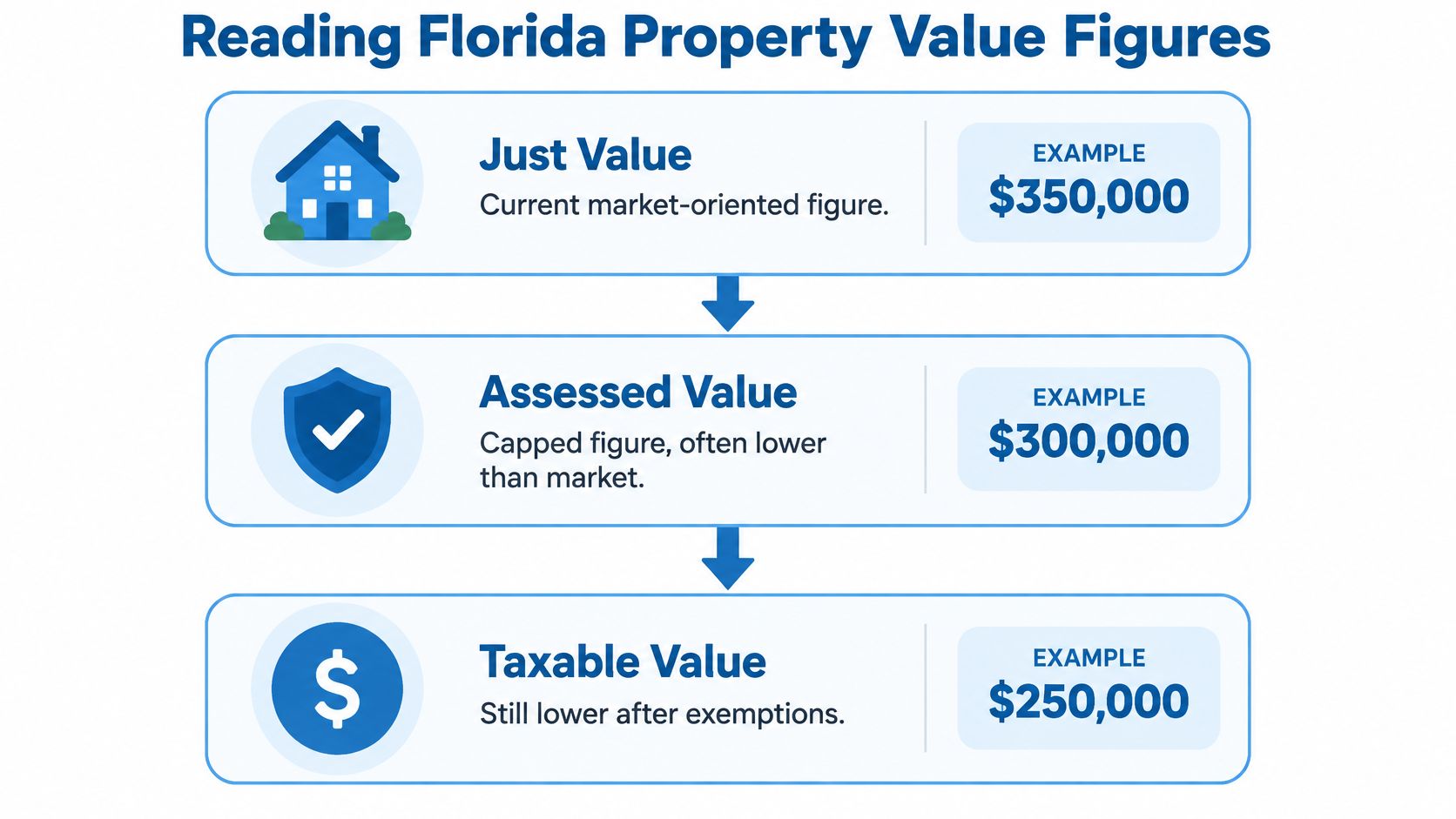
The Three Figures on a Florida Record
Just value is intended to represent market value for tax purposes. Assessed value reflects limitations such as Save Our Homes, so it can sit below just value. Taxable value is the amount used to calculate taxes after exemptions are applied, so it can be lower still.
That staircase explains a common surprise in Palm Coast home values conversations. A long-term homesteaded owner may see a modest taxable value and assume the home itself is worth about that amount. In reality, the low figure may show that caps and exemptions have done their job over many years.
Statewide context shows how wide that gap can become. In 2025, statewide median just value for homesteaded properties was $337,907, while assessed and taxable figures were substantially lower because of limitations and exemptions, according to the Florida property tax homestead distribution study. That doesn't tell you what your home would sell for. It tells you Florida's system intentionally separates the tax base from the market-oriented figure.
Why Long-Term Owners Often See the Lowest Numbers
For a qualifying Florida homestead, annual increases in assessed value are limited to 3% or the change in the Consumer Price Index, whichever is lower, as outlined in the Pinellas County Save Our Homes explanation. When the property is sold, the prior owner's assessment cap and exemption are removed at the end of the calendar year. The property is then assessed at its full just or market value for the new owner's first tax year.
So a low assessment can be good news and misleading at the same time. It's financially helpful while you own the home because it restrains your tax base. It's a poor guide to equity or sale proceeds because it was never built to track what today's buyer would pay.
The video below offers a helpful visual walkthrough of how these value concepts connect before you rely on any single figure.
Assessors also test their own accuracy at group level. The assessment-to-sale-price ratio divides assessed value by a verified sale price, so a property assessed at $270,000 that sells for $300,000 has a ratio of 0.90, or 90%. The IAAO recommends a median ratio generally between 0.90 and 1.10 for a property group. Even a system performing within accepted guidelines can produce an individual assessment that differs materially from your current market estimate.
For a St. Augustine seller, that means you should read the county record carefully, but you shouldn't price from it. Use it for tax context, property characteristics, and exemption history. Use comparable sales and current competition for pricing.
Turning Local Comparables Into Market Evidence
Once you've set the tax record in its proper place, the work shifts to evidence you can verify about your own home. That evidence is what a buyer, an agent preparing a CMA, and an appraiser will all look at, even if they weigh it differently.
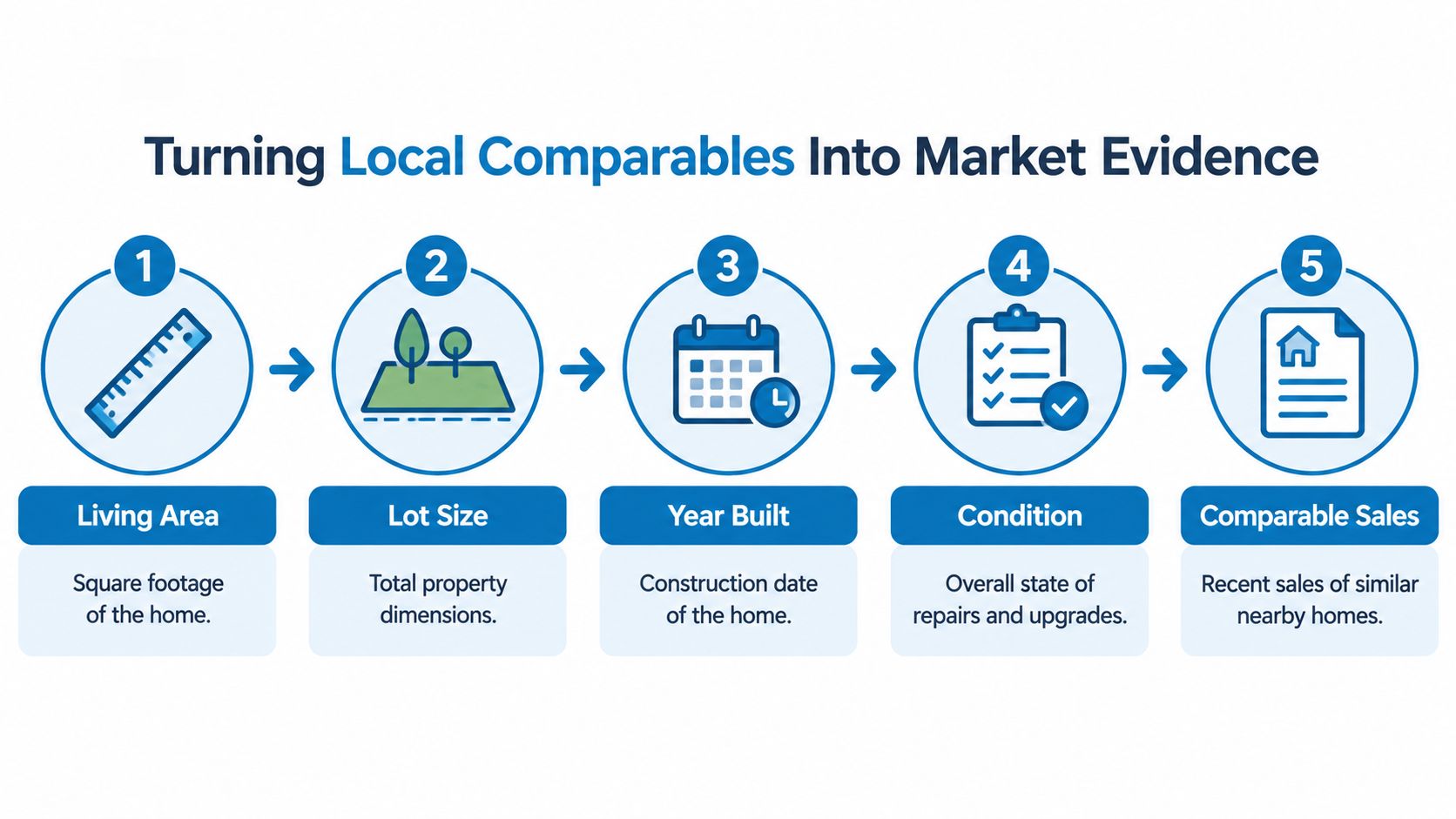
Start With Facts You Can Verify
Separate objectively verifiable property data from impressions before you look at prices. Impressions are hard to defend. Documented facts travel well from a CMA to an appraisal to a buyer negotiation.
- Living area and lot size: Confirm the county record matches the actual home and parcel
- Year built and condition: Note roof, HVAC, and major system ages if you know them
- Permits and renovation dates: Keep records for kitchen, bath, pool, or addition work
- Flood exposure and HOA costs: Buyers in Northeast Florida factor carrying costs into offers
- Location details: Canal frontage, preserve lot, busy road, or walkable historic setting all change the buyer pool
That last point matters locally. Two homes with similar living area can draw very different buyers if one sits on a freshwater canal in Palm Coast and the other sits on a standard interior lot, or if one is a newer Flagler County build and the other is an older St. Augustine home with a distinctive layout. A Flagler County real estate analysis that ignores lot and neighborhood differences will mislead you.
Use the Sales Comparison Approach
A defensible home assessment value should be developed primarily through a market-based sales comparison analysis, not by applying a fixed price-per-square-foot rule. Fannie Mae requires appraisers to analyze comparable closed sales, contract sales, and active listings, then adjust for measurable differences in location, physical characteristics, sale conditions, financing concessions, and market timing, per the Fannie Mae guidance on adjustments to comparable sales.
Price per square foot feels tidy, but it hides too much. It treats a renovated kitchen, an extra garage, a pool, and a superior waterfront position as if they were interchangeable square feet. Buyers don't shop that way, and appraisers aren't supposed to value that way either.
Adjust for Market Reaction Not Cost
Here's the part homeowners often miss. An adjustment should represent the market's reaction to a difference, not what that feature cost to build. A pool you installed for personal enjoyment may add meaningful appeal for one Palm Coast buyer and little for another who prefers a larger yard. A kitchen renovation may help your home compete, but buyers pay based on how the finished home compares with alternatives, not based on your contractor invoices.
Timing matters too. In a changing market, an older comparable may need a positive or negative time adjustment so the analysis reflects value as of the effective date. That's why date-checking your comps isn't clerical work. It's central to whether the conclusion fits today's St. Augustine housing market or last season's.
Closed sales show what buyers did. Pending contracts and active listings show what you're competing against right now. You need both views before you set a price.
A sound analysis tests the adjusted closed sales against current competition. If three similar homes are actively listed and sitting, your closed-sale range alone won't protect you from overpricing. If comparable homes are going under contract quickly, pending sales help confirm demand. The indicated value should fall within the range of the adjusted comparable sale prices, which keeps the conclusion anchored to evidence instead of hope.
Choosing a CMA Appraisal or AVM
Sellers often ask which method is best, as if one tool should win every time. A better question is which method fits the decision in front of you. The table below is the single comparison to use for that choice.
| Method | Primary Purpose | Evidence and Detail | Best Use |
|---|---|---|---|
| Comparative market analysis, or CMA | Support a listing price strategy | Recent closed sales, pending contracts, active competition, property condition, and local knowledge | Deciding how to price and position a home for sale |
| Formal appraisal | Provide a written opinion of value for a defined use | Standards-based inspection, comparable selection, and documented adjustments | Lending, estate, divorce, dispute, or unusual property situations |
| Automated valuation model, or AVM | Produce a fast data-driven estimate | Public records, prior sales, and algorithmic modeling without an interior visit | Early planning and tracking whether values are moving |
| Seller-selected comps | Supply supporting examples | Sales you or your agent identify, ideally with notes on condition and differences | Checking assumptions and preparing questions, not finishing the valuation alone |
When Each Method Is Enough
An AVM is fine when you're in the thinking stage. If you're a downsizer wondering whether a move is even plausible next year, an online estimate can help you decide whether to investigate further. It shouldn't set your list price, because it can't verify condition, unpermitted work, interior updates, or a lot premium that buyers in your neighborhood pay for.
A CMA is the right tool when the decision becomes real. It connects closed sales to the homes buyers can choose instead of yours today, and it lets you discuss strategy, not just a number. Do you price to encourage early competition, or do you need a tighter range because your next purchase depends on the proceeds? That's a CMA conversation.
Marilynn Wolfe, LLC offers an online home valuation and a personalized home value review that considers comparable sales, property characteristics, renovations, location, and current market conditions. That's one local option for moving from an instant estimate to a property-specific discussion.
A formal appraisal fits a different need. If the property is part of an estate, a divorce, a partnership dispute, or a transaction where a lender requires a standards-based opinion, the appraisal's defined intended use matters. The same applies to a highly unusual home where comparable sales are scarce and a documented, independent opinion carries weight beyond pricing.
Match the Method to the Decision
Seller-selected comps sit in a supporting role. They are useful when you know something the data misses, for example a nearby sale that had major deferred maintenance or a renovated interior that photos didn't show. Bring those sales to the conversation with dates and details. Don't present them as a finished valuation without adjustments and a check against active competition.
A useful test: If money, legal standing, or a contract depends on the answer, you need more than an algorithm.
For most Palm Coast and St. Augustine sellers, the practical sequence is simple. Start with an AVM only for orientation. Move to a CMA for a listing decision. Add a formal appraisal when the situation, not curiosity, calls for one.
Reconciling Four Value Indications
Consider a hypothetical long-held Palm Coast home. This is an illustration of method differences only, not a report of an actual local sale or price. The owner has lived there for years, updated the kitchen, and kept the homestead exemption in place.
Four indications arrive, and none match.
Why the Same Home Produces Four Answers
The tax record comes in lowest. That's expected here, because caps and exemptions have restrained the taxable side for years while just value followed a different logic. The record may also lag current conditions because assessment reflects a specific valuation date and mass appraisal methods, not a fresh walkthrough of the renovated kitchen.
The AVM lands higher, but it wobbles. It can see public record living area and nearby sales, yet it can't confirm whether the kitchen update was a light refresh or a full renovation, and it may struggle with a unique floor plan or a lot feature that doesn't repeat often nearby. Its speed is its strength. Its blindness to condition is its limit.
The CMA produces a range rather than a point. It weighs adjusted closed sales, then checks pending contracts and active listings that compete for the same buyer. Because it reflects seller timing and current competition, it may support a strategic list price slightly inside that range instead of treating the top as automatic.
The formal appraisal lands where its evidence and standards lead. It is developed for a specific intended use and effective date, with documented comparable selection and adjustments. It isn't trying to maximize showing traffic. It's trying to support a defensible opinion.
Reconcile Instead of Averaging
Don't average unlike numbers and call the result balanced. Averaging a taxable value with a market range produces a figure that serves neither purpose.
- Check the dates: An older indication may describe a different market
- Check the property data: Wrong living area, bed count, or lot details distort every method
- Check the comparable selection: Distant or dissimilar sales need stronger adjustments and more skepticism
- Check condition assumptions: A method that never saw the interior deserves less weight on finish quality
- Check current competition: Active listings test whether a closed-sale conclusion still fits today
Group statistics explain why some spread is normal. IAAO guidance identifies coefficient of dispersion ranges of 5 to 10 for newer or relatively uniform residential areas and 5 to 15 for older or more heterogeneous areas, as described in the IAAO Standard on Mass Appraisal. A more varied neighborhood naturally produces wider variation around the median, which is one reason two nearby St. Augustine homes with similar apparent market values can carry different assessment records. Construction date, exemptions, reassessment cycles, neighborhood boundaries, and local practices all contribute.
Reconciliation means giving each indication the weight its evidence earns. For a listing decision, the CMA usually earns the most weight because it's built for that decision. The appraisal earns more weight when a lender or legal process is the audience. The tax record keeps its weight where it belongs, in tax planning.
Matching the Analysis to Your Selling Situation
Your circumstances should shape how much analysis you need and in what order. A homeowner testing an idea doesn't need the same workup as a seller signing a listing agreement next month.
Start From Your Situation
Absentee owners often begin with stale information. If you live out of the area and haven't seen the property recently, don't rely on an old tax bill or a neighbor's sale anecdote. Start with an online estimate for orientation, then ask a local professional to verify condition, occupancy issues, and current competition in person. Photos, vendor records, and a property visit change the conversation fast.
Move-up sellers need a confident range because two transactions connect. Your sale proceeds affect your next down payment and your timing. A CMA that reconciles closed sales with active competition is essential, and you should discuss how pricing flexibility affects your purchase plans before you list.
Downsizing and 55-plus homeowners often value clarity and coordination over squeezing a theoretical top figure. Long ownership can also mean the widest gap between taxable value and market value, so a calm, document-based review helps. A CMA with plain language explanations, plus a plan for preparation and timing, usually serves better than a stack of automated estimates.
Account for the Buyer's Tax Reset
Florida property is assessed as of January 1 each year. After a change of ownership or termination of homestead, the property may be assessed at just value for the following January 1, so a buyer's future tax bill can differ sharply from the seller's current bill, according to Florida Department of Revenue taxpayer guidance.
That matters in negotiations. A relocating buyer comparing your St. Augustine home with a newer Flagler County property will think about total monthly cost, not price alone. You can't promise a buyer a specific future tax bill, and you shouldn't present your capped bill as if it transfers. You can be ready for the question and point buyers toward the county figures they should verify.
- Gather documents first: Survey, permits, renovation records, HOA information, and your TRIM notice
- Review competition second: Look at what a buyer can choose instead of your home today
- Choose the professional third: CMA for pricing, appraisal when the intended use requires it
- Verify before listing: Recheck property data, dates, and adjustments before you commit to a price
Timing complaints deserve their own track. Florida guidance says owners appealing a denial of an exemption, classification, portability, or tax deferral generally must petition the Value Adjustment Board within 30 days after the denial notice is mailed. Keep that tax process separate from your pricing analysis, and verify county-specific procedures rather than assuming Flagler and St. Johns counties handle every step identically.
Build a Seller-Ready Value Strategy
A seller-ready strategy uses each tool for the job it does well. Nothing in that approach requires you to guess, and nothing asks one number to do work it wasn't built for.
- Tax records: Tax context, exemption history, and property data to verify
- AVM: An early signal while you're deciding whether to explore a sale
- Comparable sales: The market evidence behind any serious value range
- CMA: Your pricing strategy, tested against pending sales and active competition
- Appraisal: A formal opinion when lending, legal, or unusual property circumstances warrant it
Your annual TRIM notice fits that checklist, but only in its lane. A TRIM notice provides assessed and market-value information and proposed tax data, but a formal assessment review does not replace a current comparative market analysis when estimating what a home could sell for, as the St. Johns County Value Adjustment Board process reflects. Read it every August for tax purposes. Don't convert it into a list price.
No single tool replaces judgment about condition, location, improvements, timing, and the buyer most likely to want your home. If you're curious what your home could sell for in the Palm Coast real estate market trends, Marilynn Wolfe with LPT Realty LLC works as a Strategic Listing Agent with Palm Coast, St. Augustine, Flagler County, and surrounding Northeast Florida sellers. You can reach her at 904-429-2829 or marilynnwolfe.realtor@gmail.com for a personalized home value discussion grounded in local evidence.
If you're weighing a sale in Palm Coast or St. Augustine and your tax record, an online estimate, and your pricing goals don't line up, a personalized review can reconcile those figures using comparable sales, property condition, and current competition. Connect with Marilynn Wolfe, LLC to talk through what your home assessment value means for taxes, what the market evidence supports for pricing, and which next step fits your timeline.