
Are you sure buying a relocation home should begin with a property search? For many out-of-state buyers moving to Northeast Florida, the more important first decision is whether to buy immediately, rent temporarily, or coordinate a sale and purchase across two markets. That choice affects financing, timing, inspections, and how confidently you can judge a neighborhood you've only seen online.
Relocation has become a major part of modern home shopping. In the 100 largest U.S. metros, out-of-market shoppers accounted for 61.9% of listing views in early 2026, and 87 of those metros were primarily driven by out-of-market interest, according to Scotsman Guide's report on relocation activity. Palm Coast, St. Augustine, Flagler County, and surrounding communities are increasingly considered by buyers arriving from other states, including people seeking coastal access, a different pace of life, retirement options, or new construction.
Buying a relocation home requires more than comparing online listings. You need a clear plan for researching local areas, evaluating homes remotely, preparing financing, and coordinating the move. The following approach is designed to help you make a practical decision in the Palm Coast and St. Augustine real estate markets.
Navigating the Relocation Home Buying Process
Moving from another state creates a knowledge gap that online listings can't completely solve. A property may appear ideal because of its photos, square footage, or proximity to the coast, yet the surrounding roads, flood exposure, insurance requirements, commute, and everyday amenities may change the decision. Buyers relocating to Palm Coast or St. Augustine need both remote research and local interpretation.
Nationally, only about 27.5% of interstate movers own a home within their first year after moving, meaning nearly three-quarters begin as renters after relocation, according to the National Association of REALTORS®. The share rose above 30% during 2020 and 2021, peaked near 33%, and returned to roughly its pre-pandemic level by 2024. That pattern doesn't mean renting is the right choice for everyone. It does show that buying immediately after a long-distance move isn't automatic, even for households that ultimately intend to own.

Start with a local decision framework
Before scheduling showings, define the factors that will determine whether a home works after the move:
- Daily routine: Map your likely commute, medical care, shopping, schools, recreation, and access to major roads.
- Property requirements: Separate essentials from preferences, especially for maintenance, accessibility, outdoor space, and new construction.
- Ownership readiness: Review your down payment, current-home equity, debt obligations, credit profile, and monthly comfort level with a lender.
- Neighborhood fit: Compare Palm Coast communities, St. Augustine neighborhoods, Flagler Estates homes, and nearby Flagler County areas rather than treating the region as one market.
Distance makes this preparation more important. A long-distance move reduces the probability that a household owns its next home by 3.2 percentage points for each standard-deviation increase in moving distance, according to research from the Centre for Economic Performance at the London School of Economics. Only 27.1% of movers in one large 2021 dataset moved to a new metro or left metro areas entirely in the way measured by that research. For a buyer, the practical response is to build a shortlist of neighborhoods, routes, financing contingencies, and property requirements before arriving.
Practical rule: Don't make a long-distance purchase based on a house alone. Evaluate the route, the block, the insurance questions, and the surrounding community.
Virtual and In-Person Home Tours
Out-of-state buyers often have to choose between convenience and certainty. A virtual tour lets you review Palm Coast real estate from your current home, while an in-person visit reveals details that cameras may miss. Neither option is automatically superior. The right approach depends on how well the property matches your criteria and how much local knowledge you already have.
What virtual tours do well
A live video walkthrough can be more useful than a polished listing video because you can direct the camera. Ask the agent to open closets, inspect garage corners, show ceiling areas, look beneath sinks, and walk from the front door through the main living spaces. Request views of the street, neighboring homes, drainage patterns, community entrances, and the exact relationship between the home and nearby roads.
Virtual tours work especially well during the early screening stage. They help eliminate homes with awkward layouts, excessive road noise, visible maintenance concerns, or features that don't match the listing description. They also reduce unnecessary travel when you're comparing St. Augustine real estate with Palm Coast homes or considering communities farther inland.
What in-person visits reveal
An in-person trip gives you the chance to experience the area rather than inspect the property. Drive the commute at the time you expect to travel, visit nearby shopping and medical services, and spend time in the neighborhood at different points in the day. If you're considering Flagler Estates homes, compare the setting and road conditions with more established Palm Coast communities before deciding what trade-offs matter to you.
Use a simple comparison:
| Virtual review | In-person visit |
|---|---|
| Efficient for screening multiple homes | Better for judging noise, traffic, and surroundings |
| Allows live questions from a distance | Shows scale, light, condition, and neighborhood feel |
| Useful before booking travel | More expensive and time-consuming |
| Can identify obvious mismatches | Helps confirm whether you can live comfortably in the area |
Make travel purposeful
Don't fill a short visit with every available listing. Give priority to homes that meet your financing range, location requirements, inspection expectations, and lifestyle needs. A local agent can group showings by area, add neighborhood drives, and help you compare communities instead of rushing from one property to the next.
If you can't travel before making an offer, use an inspection contingency, review documents carefully, and ask your agent to document the property thoroughly. Remote buying can work, but it requires stronger communication and more deliberate due diligence.
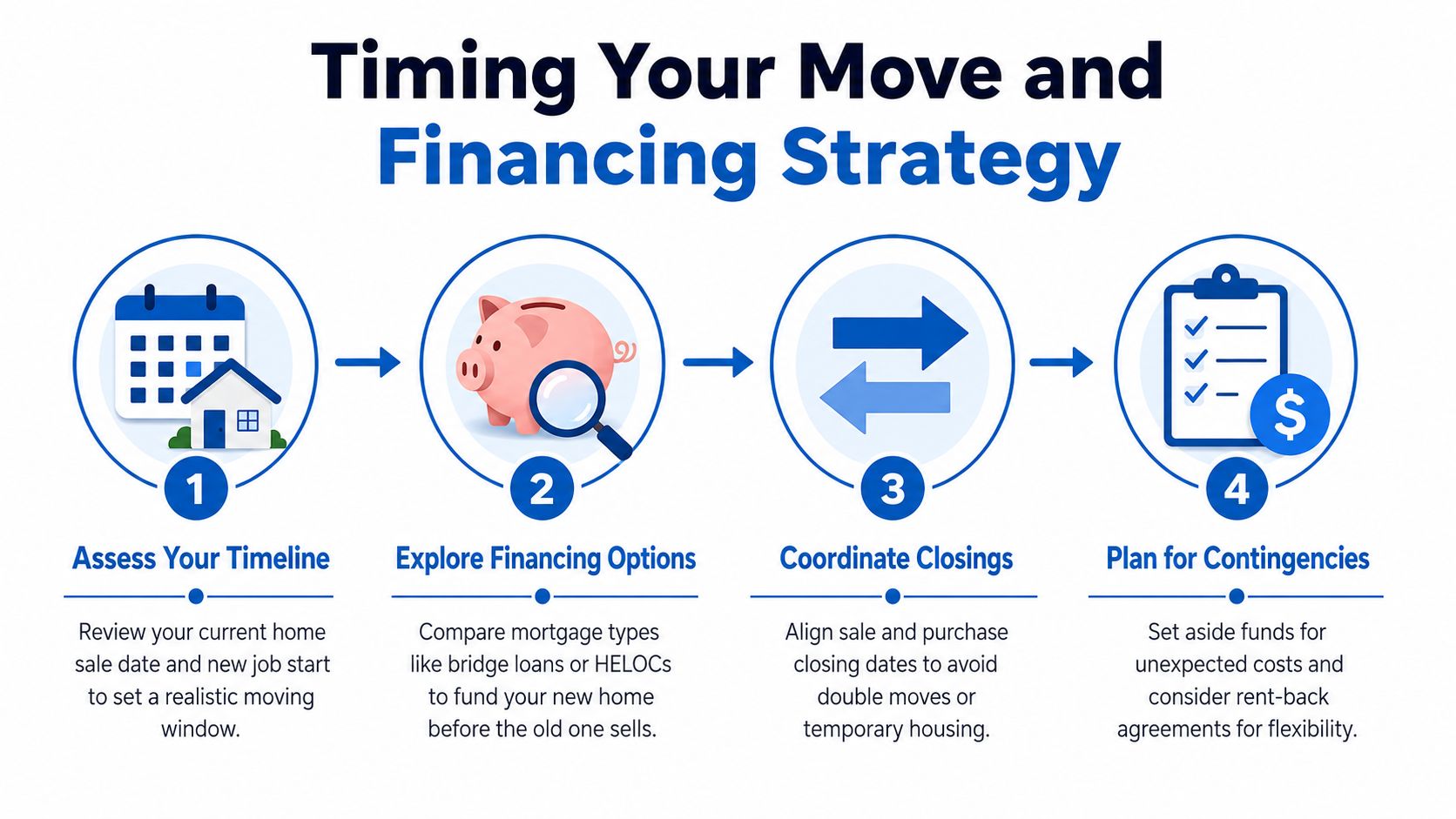
Timing Your Move and Financing Strategy
The question of whether to buy before selling deserves a careful risk review. Buying first can prevent temporary housing and make the transition easier, but it may require you to qualify while carrying your current mortgage. Selling first reduces the risk of owning two homes, yet it can create pressure to find a Florida property quickly or arrange temporary housing.
The choice becomes more important when borrowing costs make monthly payments less flexible. Mortgage rates around 6.76% were cited as a drag on relocation affordability in 2025, according to RISMedia's relocation buyer coverage. That figure is tied to the cited 2025 discussion, not a promise about today's rate. Your lender should calculate the payment using the actual rate, taxes, insurance, association costs, and loan structure available to you.
Compare the main funding paths
Sell first. This is often the cleanest option when you need sale proceeds for the next down payment or want to avoid overlapping housing costs. The drawback is that you may need a lease, storage, or short-term housing while searching in Palm Coast or St. Augustine.
Buy first with existing equity. A bridge loan or home equity line of credit may help fund the purchase before the current home sells. These options can carry eligibility requirements, fees, and additional payment obligations. Ask the lender to model the payment if the sale takes longer than expected.
Use a sale contingency. A purchase offer can be tied to the sale of your existing property, depending on the seller and local competition. This protects you from purchasing before selling, but it can make your offer less attractive than one without that condition.
Review mortgage portability carefully. Mortgage portability isn't automatic. Some mortgage agreements may allow a borrower to move an existing rate and terms to another property, but the contract and lender approval control the outcome, as explained by MoneySavingExpert's mortgage portability guidance. Confirm the terms before assuming portability will solve the financing problem.
Coordinate the calendar
Start with your job start date, current-home sale plan, lease expiration, lender timeline, and preferred possession date. Then build flexibility around inspection findings, appraisal, repairs, moving availability, and closing delays. A rent-back agreement after selling may provide additional time, but the terms must be negotiated and documented.
Federal tax assumptions also deserve attention. A qualifying homeowner may exclude up to $250,000 of gain, or up to $500,000 for married couples filing jointly, when selling a principal residence, provided the ownership-and-use requirements are met, including owning and living in the home as a main residence for at least 24 months during the five-year period before sale. The exclusion generally can't be used if another home-sale exclusion was claimed within the prior two years, according to IRS guidance on selling a home. Tax rules are personal, so discuss your circumstances with a qualified tax professional.
For most taxpayers, moving expenses generally aren't deductible for federal income tax purposes. IRS information about Form 3903 explains that the form is limited to qualifying moves related to starting work at a new principal place of work. Don't build a relocation budget around a broad moving-expense deduction.
Inspections and Move Coordination
Remote buyers sometimes focus so heavily on the offer and closing date that they underinvest in inspections. That's risky in any market, and it's especially uncomfortable when you won't be nearby to arrange repairs or revisit the property. A thorough inspection gives you information for negotiation and helps you decide whether the home still fits your plan.
Build a remote inspection process
Choose an independent, properly qualified local inspector and ask what the inspection includes before scheduling it. Depending on the property, you may also need separate specialists for areas such as roofing, pools, septic systems, wells, seawalls, or structural concerns. In Palm Coast, St. Augustine, and rural Flagler County settings, the right inspection questions can vary by construction type, age, lot, and location.
Ask for the complete report, photographs, and a live call with the inspector. During the call, have the inspector explain safety issues, active leaks, aging components, drainage concerns, and items that need monitoring rather than treating every line item as equally urgent. Your agent can help organize repair requests, but the inspector should explain technical findings.
Organize the move before closing
Create a shared relocation checklist that your agent, lender, title or closing professionals, movers, and household members can access. Include:
- Utilities: Schedule electric, water, internet, and other services for the possession date.
- Insurance: Obtain coverage information early, especially when property age, location, construction, or storm exposure affects underwriting.
- Movers: Confirm pickup, delivery, packing, storage, valuation coverage, and the possibility of a delayed closing.
- Documents: Keep identification, lender requests, insurance records, inspection reports, and signed disclosures in one secure location.
- Property access: Confirm keys, remotes, mailbox details, gate procedures, and any community orientation requirements.
New construction adds another layer. Builder timelines can change, and buyers should review contracts, upgrades, warranty procedures, and projected completion details before committing to a move date. A local professional can help you compare a new construction purchase with an existing home without assuming one option is automatically simpler.
Working with a Local Real Estate Agent
A local agent adds value when they turn unfamiliar information into a usable decision. For an out-of-state buyer, that means more than sending listing alerts. The agent should help you understand how Palm Coast, St. Augustine, Flagler County, Flagler Estates, and surrounding communities differ in layout, access, housing type, and lifestyle.
The right working relationship includes clear communication expectations. Decide how quickly you need responses, whether you prefer live video tours, which documents should be sent immediately, and how offers will be reviewed before signing. Ask the agent how they evaluate comparable properties, identify local concerns, and coordinate inspections when the buyer isn't present.
Make an offer based on evidence
Your offer should reflect the property's condition, comparable sales, competition, financing strength, closing needs, and contingencies. A low price without a clear rationale may not create an advantage, while an aggressive offer that ignores insurance, repairs, or monthly costs can create problems after acceptance.
A local agent can also help you distinguish between a home that photographs well and one that fits your intended routine. That distinction matters in the Palm Coast real estate market, the St. Augustine housing market, and smaller Flagler County areas where nearby properties may serve very different buyers.
Marilynn Wolfe, LLC offers guidance with current property value, competitive offers, contracts, inspections, and closing for buyers and homeowners navigating Northeast Florida real estate. Whether you're comparing a resale home with new construction or evaluating a sale-and-purchase sequence, local market insight can make the decision more disciplined.
A strong relocation offer is not simply the highest price. It's the offer whose timing, financing, terms, and property research you can actually support.
Next Steps for Your Florida Move
A buyer relocating from another state may begin with a broad goal, such as finding a Florida home near the coast, then narrow the search after comparing commute routes, maintenance needs, insurance questions, and neighborhood character. Someone considering Palm Coast may also evaluate St. Augustine, Flagler Estates, or another Flagler County community before choosing the right fit.
The practical next step is to create a relocation brief with your target move window, financing position, current-home plan, preferred communities, and nonnegotiable property features. That gives your agent a useful starting point and keeps the search focused when new listings appear.
Marilynn Wolfe is a local real estate professional with LPT Realty serving Palm Coast, St. Augustine, Flagler County, and surrounding Northeast Florida communities. She helps relocating buyers, move-up sellers, downsizing homeowners, absentee owners, and new construction clients make informed decisions from preparation through closing.
Marilynn Wolfe, LLC can help you compare Palm Coast and St. Augustine communities, evaluate relocation-home options, prepare a competitive offer, and coordinate the sale of your current property when needed. Visit Marilynn Wolfe, LLC or call 904-429-2829 to discuss your move, and email marilynnwolfe.realtor@gmail.com for local guidance.