
If you're wondering why national headlines suggest home values are still climbing while your Palm Coast or St. Augustine property may feel harder to price, you're noticing an important gap. Home value trends aren't uniform, and a national index can't tell you exactly what buyers will pay for a home in Palm Coast, St. Augustine, Flagler Estates, or another Flagler County community.
A home's current value depends on its location, condition, size, updates, insurance considerations, competing listings, and the buyers active in that specific neighborhood. Understanding the direction of the market helps sellers avoid pricing from outdated expectations and helps buyers recognize where they may have more negotiating room.
Why Home Value Trends Matter Right Now in Northeast Florida
A homeowner in Palm Coast might look at a national report showing rising prices and assume the same percentage applies to their property. Another homeowner in St. Augustine might see a recent sale at a higher price and expect to match it, even though that sale involved a different neighborhood, property type, condition, or buyer pool. Both assumptions can lead to an unrealistic pricing decision.
The more useful question is not, “Are home prices up or down?” It's, “What are buyers responding to in this location right now?”
That answer comes from combining several signals:
- Closed sales, which show what buyers previously paid.
- New listings, which reveal the competition sellers face today.
- Pending sales, which show what buyers are accepting before a transaction closes.
- Time to pending, which can indicate how quickly a well-positioned property attracts attention.
- Condition and presentation, because buyers have more reasons to compare homes when appreciation is modest.
Palm Coast home values and St. Augustine real estate can move differently even though the communities are relatively close. Coastal access, historic-district character, newer construction, lot sizes, community amenities, and buyer preferences all influence pricing. Flagler Estates homes may appeal to a different group than a condominium near downtown St. Augustine or a newer home in Palm Coast.
Practical rule: National trends provide context. Comparable homes in your immediate market provide the pricing evidence.
For homeowners considering selling, the risk of overpricing is especially meaningful in a slower-growth environment. A listing that starts above buyer expectations can sit while competing properties attract attention, creating the impression that the home has a problem. Sellers may then need to make a later adjustment after losing valuable early-market exposure.
Buyers benefit from the same information. Modest appreciation doesn't automatically mean prices will fall broadly, but additional inventory can create more opportunities to negotiate on price, repairs, or terms. Relocating buyers and new construction shoppers also need to compare resale homes with builder incentives, included features, and completion timelines.
Marilynn Wolfe brings a local Strategic Listing Agent's perspective to these decisions, helping homeowners in Palm Coast, St. Augustine, Flagler County, and surrounding communities connect broad market movement with the details that affect their property.
How Home Value Trends Are Measured and Why Numbers Differ
Why can two credible home value reports show different results for the same market? They may be measuring different parts of the market, much like thermometers placed in the shade, sunlight, or indoors. Each reading can be useful when you understand what it represents.
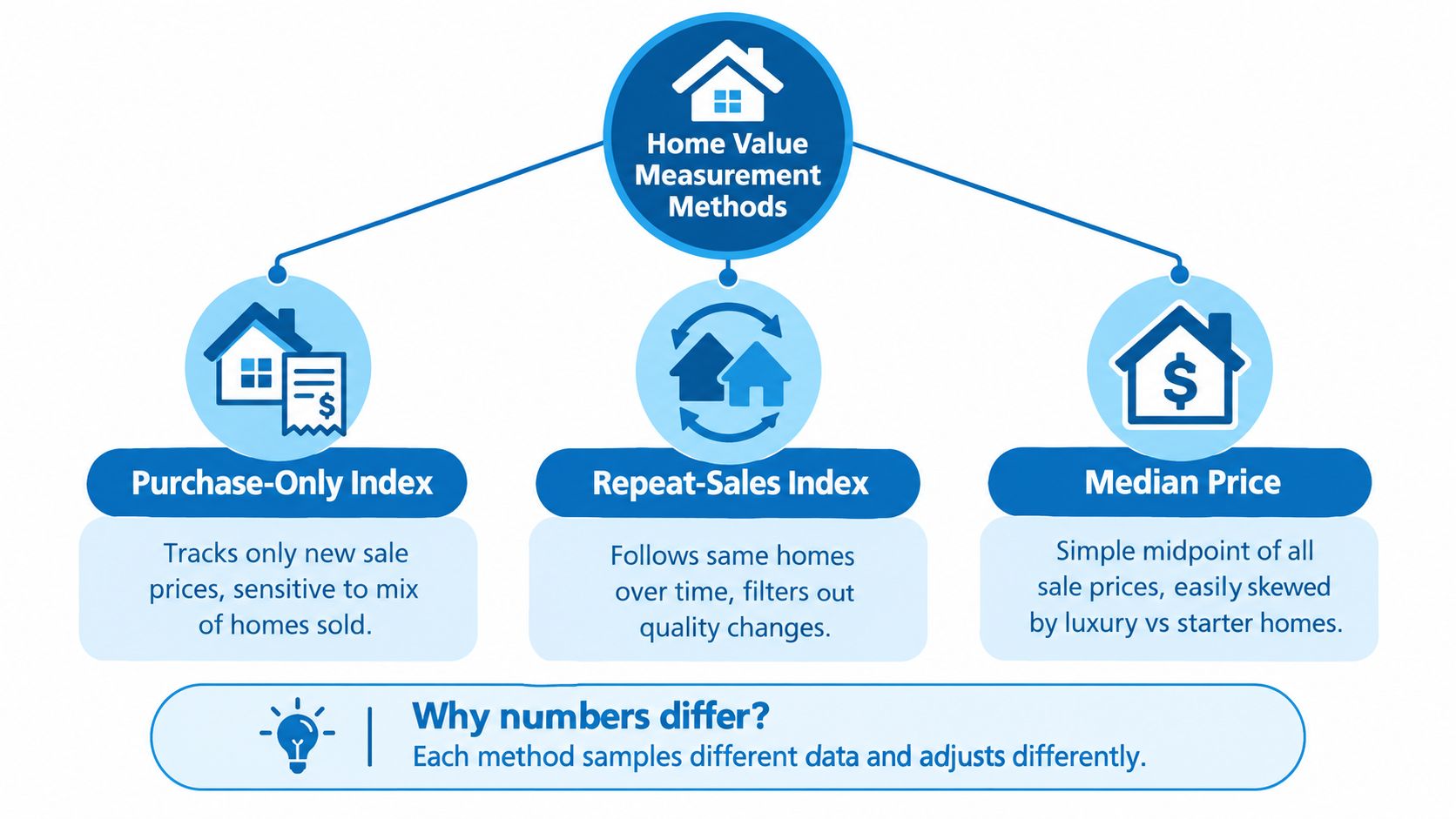
Three common ways to read the market
A purchase-only index tracks prices from selected home purchases. The types of homes sold can influence the result. If a period includes more expensive properties, the reported movement may look stronger than it would if more entry-level homes had sold.
A repeat-sales index follows price changes for the same homes over time. Comparing a property with itself helps limit the effect of differences in size, condition, or features, although the result still depends on the homes represented in the dataset.
A median sale price places all recorded sale prices in order and identifies the middle one. This measure is easy to follow, but it can shift when the sales mix changes. A month with more starter homes, luxury properties, condos, or new construction may produce a different median without every home changing value by the same amount.
A typical home value is a modeled estimate for a representative property in a market. It is not the midpoint of completed sales. That difference helps explain why a typical value for St. Augustine may not match its median sale price.
Why long-term indexes matter
The Federal Housing Finance Agency house price index is a long-running standardized measure of U.S. home value trends. Its coverage reaches back to the mid-1970s and includes all 50 states plus more than 400 American cities, allowing analysts to compare housing cycles over many years.
In its latest update, FHFA reported that the U.S. purchase-only index rose 2.1% between the second quarter of 2025 and the second quarter of 2026, while its expanded-data index rose 2.5% over that period. These figures help show the national direction. They do not replace a local comparative market analysis for a home in Palm Coast or St. Augustine, where neighborhood, property type, and buyer demand can produce a different result.
The S&P Cotality Case-Shiller U.S. National Home Price Index uses repeat sales and serves a different purpose. It reached 336.663 in June 2026, with January 2000 equaling 100, a new high for that series. Its long record illustrates how home values have changed through recessions and housing downturns.
For local pricing, start by asking three questions: What does the report measure? Which properties are included? Does it describe national values, a local median, or an estimated typical home? Those answers make national data more useful when interpreting modest appreciation nationally alongside slight softening in Palm Coast, St. Augustine, or Flagler County.
What Recent Data Shows About Home Value Trends Nationally and Locally
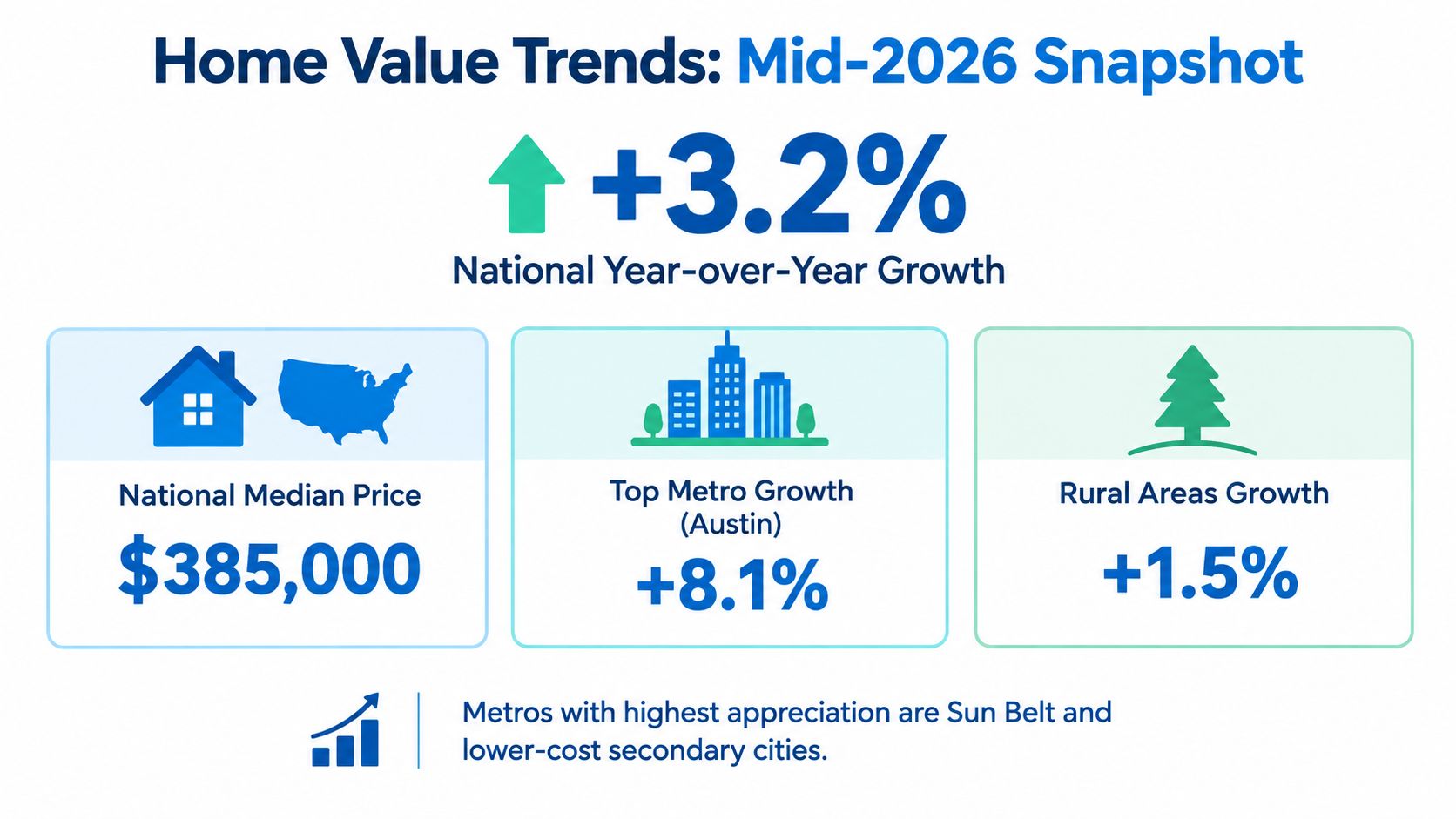
Is the national rise in home values translating into higher prices in Palm Coast and St. Augustine? The answer is more nuanced. National values are still increasing, while several Northeast Florida indicators show slight local softening.
The Case-Shiller national index reached 336.663 in June 2026, compared with 335.430 in May and 333.109 in April, according to the Federal Reserve's Case-Shiller data series. Year over year, it rose 2.1% in June, compared with 1.6% in May. Its long-run average since 2001 has been about 5.02%, so today's appreciation is comparatively restrained.
The FHFA national house price index update showed a similar pattern. Its purchase-only measure rose 2.1% year over year, and its expanded-data index increased 2.5%, with quarter-to-quarter gains of 0.3% and 0.4% in the latest quarter. A home value index can reach a new nominal high while its annual growth rate slows. That combination points to moderation, not automatically to a crash.
Local signals tell a more specific story
The Zillow June 2026 market report placed the typical U.S. home value at $372,057, up 1.1% year over year. Active inventory reached 1.39 million homes for sale, up 0.9% from a year earlier. More available homes can give buyers greater bargaining power without producing broad price declines.
Palm Coast is moving more softly. Zillow reported an average home value of $342,262 as of August 2026, down 0.9% year over year. Homes were going pending in about 44 days, with 1,113 homes for sale and 235 new listings in that snapshot, according to the Palm Coast home value data.
St. Augustine shows why the measurement matters. One St. Augustine market report reported a $453,314 median sale price, down 2.3% year over year, with homes going under contract in about 52 days and 678 homes on the market. A separate Zillow St. Augustine home value snapshot placed the median home value at $429,114 as of August 2026.
These figures measure different things, so they are not necessarily contradictory. One tracks completed sales, while the other estimates the value of a typical home. For sellers in Palm Coast, St. Augustine, and Flagler County, the practical message is clear: local pricing has softened slightly, and buyers are taking time to compare options. A national gain does not justify copying a national pricing strategy.
What Is Driving Home Value Trends Today
The current market is being shaped less by a sudden demand surge and more by limited supply, high borrowing costs, and low homeowner mobility. That combination helps explain why prices can remain high even when transactions take longer.
J.P. Morgan describes a high-price, low-mobility equilibrium. Its U.S. housing market outlook points to tight supply, chronic underbuilding since the 2008 crisis, and mortgage rates around 6.6% as forces making a move costly. Its outlook projects Case-Shiller home prices to remain flat in 2026 and rise 3% in 2027.
Why owners are staying put
Many existing homeowners may hesitate to sell if buying another home would mean taking on a substantially more expensive mortgage. That decision limits the number of resale homes available, even when potential buyers remain interested.
Builders also face practical limits. Land, labor, materials, permitting, and financing affect how quickly new homes can reach the market. In Palm Coast and surrounding Flagler County communities, new construction can add choices, but it doesn't instantly solve every supply constraint or provide the same product as an established neighborhood.
The result is a market where sellers may not face intense bidding on every property, but buyers still may not have enough choices to force widespread price declines.
What more inventory changes
Inventory affects negotiating power at the property level. When buyers can compare several similar homes, they're more likely to question an ambitious list price, request repairs, or wait for a better fit. A well-maintained home in a desirable location can still attract attention, but presentation and pricing need to align with current competition.
For sellers: Limited supply doesn't excuse an unrealistic price. Buyers can be selective about condition, location, and value when alternatives are available.
For buyers relocating to Palm Coast or St. Augustine, this environment rewards preparation. A clear budget, financing plan, and neighborhood criteria help buyers act when the right home appears without assuming every listing will create a bidding contest.
Palm Coast and St Augustine Home Value Trends Side by Side
Could Palm Coast and St. Augustine be moving in different directions, even though relocating buyers often compare them? Yes. The recent figures show a modest national appreciation trend alongside slight softening in both local markets, with St. Augustine showing the larger year-over-year decline.
| Market | Typical Value or Median Price | Year Over Year Change | Days to Pending or Contract | Homes for Sale |
|---|---|---|---|---|
| Palm Coast | $342,262 average home value | Down 0.9% | About 44 days to pending | 1,113 |
| St. Augustine | $453,314 median sale price | Down 2.3% | About 52 days to contract | 678 |
Palm Coast figures were cited in the recent data section. St. Augustine figures were also cited earlier. The price measures are different, so this table provides direction rather than an apples-to-apples appraisal. A national rise in home values does not guarantee that every Northeast Florida neighborhood will rise at the same pace.
What Palm Coast signals may mean
Palm Coast's 44-day pending timeline indicates continued buyer activity for homes that are positioned well. It does not mean every listing will attract immediate attention. Citywide figures combine established neighborhoods, newer construction, larger lots, and different renovation levels, much like averaging several different roads into one travel time.
That distinction matters for a Palm Coast seller. A dated property competing with newer construction may need a different price and marketing plan than a move-in-ready home with attractive outdoor space. Flagler Estates homes deserve comparisons with properties sharing similar land characteristics, access, improvements, and buyer appeal.
The local softening is slight, but it changes the pricing conversation. Sellers should use current comparable homes and buyer response, rather than assume national appreciation supports a higher asking price.
What St. Augustine signals may mean
St. Augustine's 52-day contract timeline and reported inventory suggest that sellers may need more patience. Historic areas, beach communities, suburban neighborhoods, condos, and new construction serve different buyers, so their pricing patterns can diverge within the same city.
The reported $453,314 median sale price should not be treated as interchangeable with the Zillow St. Augustine estimate of $429,114. Each figure answers a different question. A local pricing review should examine comparable properties, recent buyer behavior, condition, and current competition before setting a list price.
Seasonality Forecasts and What Trends Mean for Your Timing
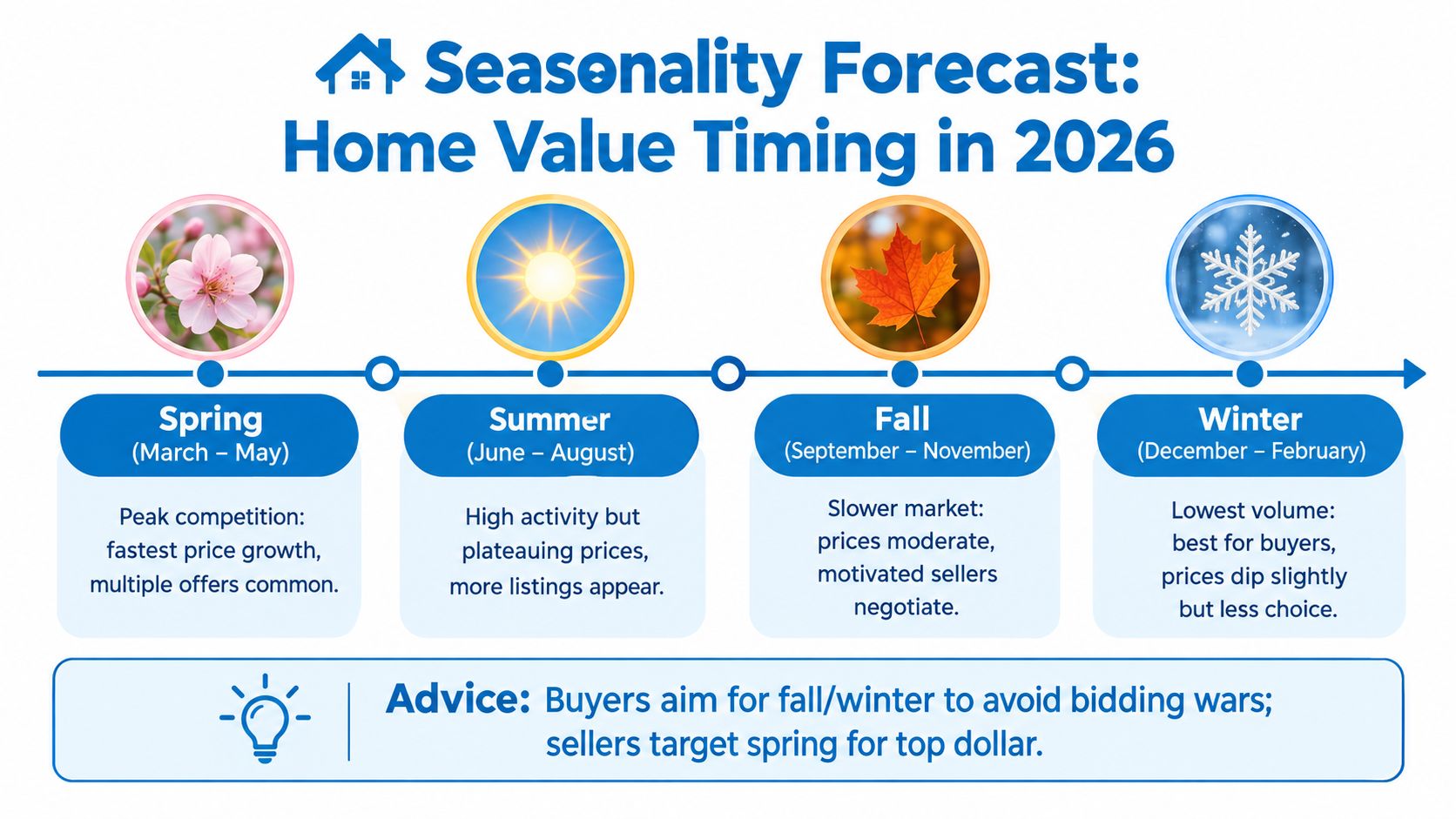
Could the season you list your home affect the response it receives? Seasonal patterns can change buyer activity, competing inventory, and the speed of early attention. They do not replace property-specific analysis, but they shape the conditions surrounding a Palm Coast or St. Augustine listing.
Your best timing also depends on the move itself. A homeowner downsizing may value certainty and convenience. Someone moving into a larger home may need to coordinate two transactions. An absentee owner may benefit more from a clear preparation schedule and local oversight than from waiting for a theoretically perfect week.
How to use timing without trying to predict perfectly
National conditions point to modest appreciation, not rapid price growth. The Zillow national market report also describes weak real growth alongside somewhat higher inventory. For sellers in Palm Coast, St. Augustine, and Flagler County, that contrast matters. National improvement does not guarantee stronger local pricing, especially when nearby homes are competing for the same buyers.
Waiting for a large jump may not serve a property that needs repairs or faces newer, better-presented listings. Preparation and positioning often matter more than choosing a particular week.
Sellers should check these points before selecting a launch date:
- Review the competition: Compare active listings as well as closed sales.
- Address visible distractions: Minor maintenance issues can give buyers reasons to negotiate.
- Set a defensible price: A competitive opening position may produce better early engagement than an inflated one.
- Plan around your next move: Coordinate selling, buying, renting, or relocating before listing.
- Track buyer response: Showings, inquiries, and feedback indicate whether buyers accept the current position.
Buyers may have more room to negotiate when homes remain available longer, though conditions differ by neighborhood and property type. Someone considering new construction should compare builder incentives and included features with resale homes instead of judging list price alone.
The practical forecast is neither a promise of a boom nor a warning of a crash. It is a reminder that pricing, preparation, and timing work together. In Flagler County, slight local softening means a seller should treat seasonality as context, then price for the specific competition in front of the home.
Making Smart Moves With Home Value Trends in Flagler County
Home value trends become useful when they change a decision. For a seller, that may mean replacing an old valuation with a current review of comparable homes, competing listings, condition, and buyer activity. For a buyer, it may mean comparing Palm Coast real estate with St. Augustine real estate based on lifestyle, commute, property type, insurance considerations, and total ownership costs.
A sound pricing strategy should answer practical questions:
- Which homes are the closest competitors?
- How does the property compare in condition and updates?
- Are buyers choosing newer construction instead?
- Does the location appeal to a specific group, such as retirees, relocating households, or move-up buyers?
- What would make the home feel like a clear value at its asking price?
Presentation matters because buyers have more time to compare when appreciation slows. Clean spaces, completed maintenance, accurate disclosures, strong photography, and straightforward property information can help a listing communicate its value clearly.
For absentee owners, local coordination is especially important. A property may need vendor access, preparation oversight, inspection support, and timely decisions from someone who understands Flagler County real estate. Homeowners considering downsizing or relocating may also benefit from planning the sale around their next housing step instead of treating the listing as an isolated transaction.
A personalized home valuation is more useful than relying on one automated estimate. Marilynn Wolfe, LLC offers a home valuation service that considers current market trends and local conditions when reviewing a property's value. As a Strategic Listing Agent with LPT Realty, Marilynn Wolfe helps homeowners in Palm Coast, St. Augustine, Flagler County, and surrounding communities make informed decisions about preparation, positioning, and timing.
Whether you own a home near the coast, a property in Palm Coast, or Flagler Estates homes outside the city's busiest areas, the right strategy starts with local evidence and a clear understanding of your goals.
If you're considering selling, relocating, downsizing, or want a current perspective on your property, Marilynn Wolfe can provide a personalized home value review and practical pricing guidance based on local conditions. Visit Marilynn Wolfe, LLC to connect, or call 904-429-2829 or email marilynnwolfe.realtor@gmail.com for a friendly conversation.