

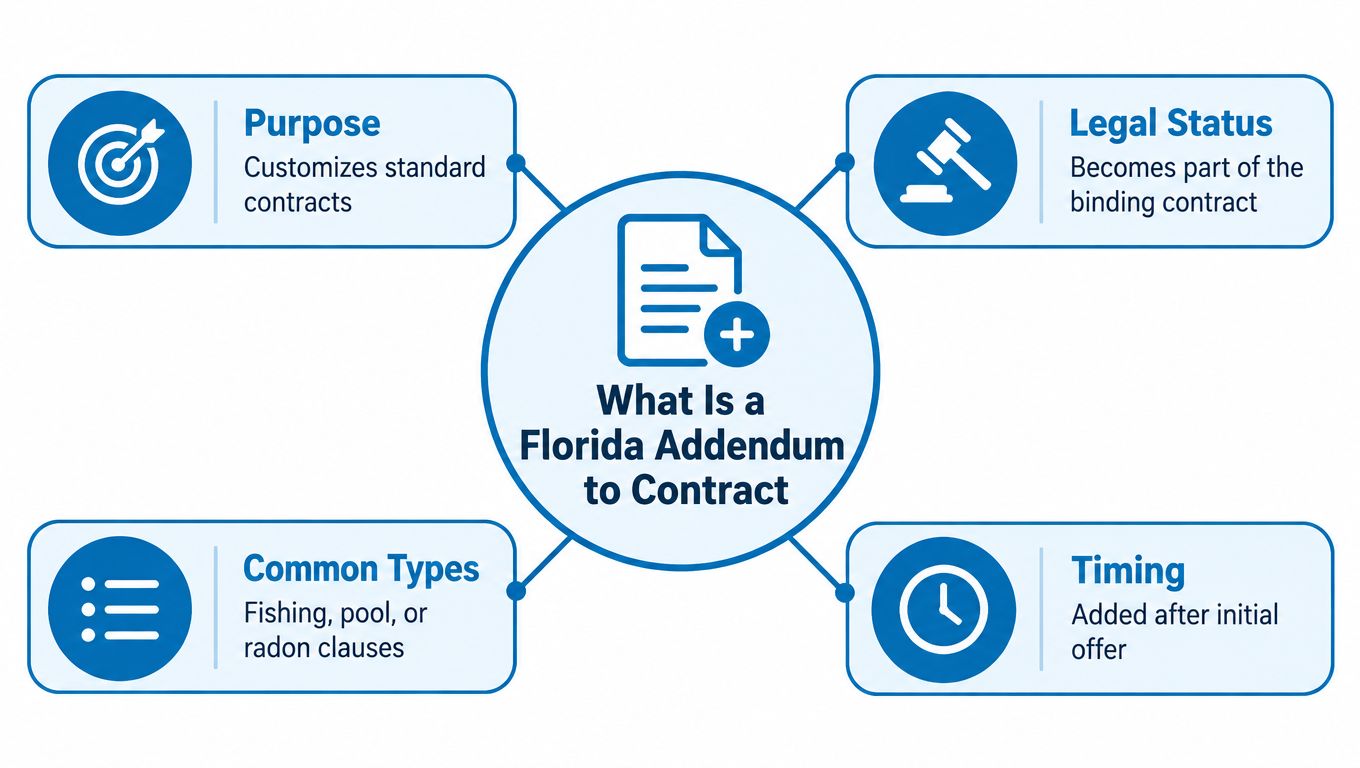
A Florida addendum to contract is a formal document added to the base purchase agreement to modify terms, extend deadlines, or add conditions, and it becomes legally binding once both parties sign it. Florida Realtors' 2019 forms description lists 29 additional addendums that buyers and sellers may use with the residential purchase contract.
That answer raises a more practical question for homeowners in Palm Coast and St. Augustine: if the standard contract already exists, why do so many transactions need additional documents? The reason is that every property and negotiation brings different concerns, from inspections and financing to association approval, repairs, concessions, and new construction requirements.
For sellers, the right addendum can clarify an offer without weakening the entire deal. For buyers, it can preserve important rights when financing, inspections, title work, or builder timelines change. The key is knowing which form fits the situation, how it connects to the main contract, and when a custom rider needs more careful legal review.
What Is a Florida Addendum to Contract
A buyer and seller may agree on the main purchase price, but that doesn't settle every practical detail. An addendum is a separate document that adds, modifies, or clarifies terms while keeping the original purchase agreement in place.
Florida Realtors describes addenda, riders, and optional clauses as the standard way to modify Florida residential contracts. Its forms library includes contracts, disclosure forms, and addenda that are continuously maintained for changing transaction needs. The organization's historical forms description identifies 29 additional addendums available for use with the Contract for Residential Sale and Purchase, including an addendum for adding further terms to that agreement. Florida Realtors' forms description illustrates how established this system is.
Standard forms and custom riders
A standard form addendum is designed for a recurring transaction issue, such as extending a deadline or addressing a particular financing arrangement. A custom rider is more specific. It may address unusual personal property, a special occupancy arrangement, a complex repair obligation, or a builder-specific term that doesn't fit neatly into a standard form.
The distinction matters in Palm Coast real estate and St. Augustine real estate because local transactions can involve planned communities, condominium associations, vacant land, new construction, and properties with different inspection or disclosure concerns. A standard form usually offers clearer structure. A custom rider may offer a better fit, but it also creates more room for ambiguity.
How the addendum becomes part of the deal
Signing a document isn't enough if nobody can tell which contract provision it changes. Florida Realtors' preparation guidance says an addendum should be numbered, referenced in Paragraph 20, and tied to the exact contract clause it modifies. The guidance gives the practical example of identifying that a sentence modifies a particular paragraph. Florida Realtors' preparation manual explains why that cross-reference matters.
Practical rule: If an addendum changes a deadline, obligation, or right to cancel, identify the affected paragraph and preserve a complete signed copy with the contract package.
A properly incorporated addendum can control over conflicting pre-printed language when it specifically addresses the same subject. An unsigned attachment, vague rider, or document that conflicts with another provision can create an avoidable dispute. In a Flagler County transaction, the safest approach is to make the document understandable to the buyer, seller, closing agent, and, when necessary, the attorneys involved.
Common Addendum Types in Palm Coast and St. Augustine Sales
The most useful way to evaluate an addendum is to ask what risk it manages. A buyer relocating to St. Augustine may focus on inspections and financing, while a seller in Palm Coast may be more concerned with concessions, repairs, or keeping a closing timeline intact.
Inspection and repair terms
An inspection addendum can establish how the parties handle property conditions discovered during the buyer's inspection period. It may support negotiations over repairs, credits, or other agreed remedies. A separate repair addendum can then identify the work, responsibility, timing, and documentation expected before closing.
The practical trade-off is straightforward. Detailed repair language reduces uncertainty, but it can also create a new disagreement if the parties don't define acceptable completion. “Repair as needed” is less useful than a clear description of the obligation.
Financing and appraisal provisions
A financing addendum addresses the buyer's loan process, including the period available to obtain approval or a commitment. An appraisal addendum can address what happens if the valuation doesn't support the agreed purchase price.
These provisions matter when buyers are comparing homes in the Palm Coast real estate market or competing for a property in the St. Augustine housing market. Sellers may prefer fewer contingencies, but a buyer who has no workable financing protection could face serious financial exposure. The negotiated terms should reflect the buyer's actual loan status rather than an optimistic assumption.
Association and title addenda
An HOA or condominium addendum can address association approval, required documents, fees, restrictions, or other community-specific conditions. This deserves attention in Palm Coast communities and in neighborhoods around St. Augustine where association rules may affect occupancy, leasing, improvements, or approvals.
A title addendum can address the time needed to review title and resolve defects. Sellers should understand that an ownership issue, lien, estate matter, or missing document may require cooperation before closing. Buyers should avoid treating a clean-looking property as proof that title work is complete.
Closing, concession, and construction documents
A closing date addendum can adjust the timing when financing, repairs, title work, or another transaction dependency takes longer than expected. Seller concession terms can make an offer more workable for a buyer, but the concession should be documented clearly and coordinated with the buyer's lender.
New construction buyers face another layer of paperwork. Builder contracts and riders may address construction timelines, upgrades, change orders, deposits, warranties, and closing conditions. Those documents deserve careful review because the builder's form may not resemble the standard residential contract used for an existing home.
For owners of Flagler Estates homes or absentee owners managing a property from outside the area, the right addendum can reduce confusion. It won't replace clear communication or professional review, but it can put the negotiated obligation in a form everyone can follow.
When and How to Use Addenda During a Transaction
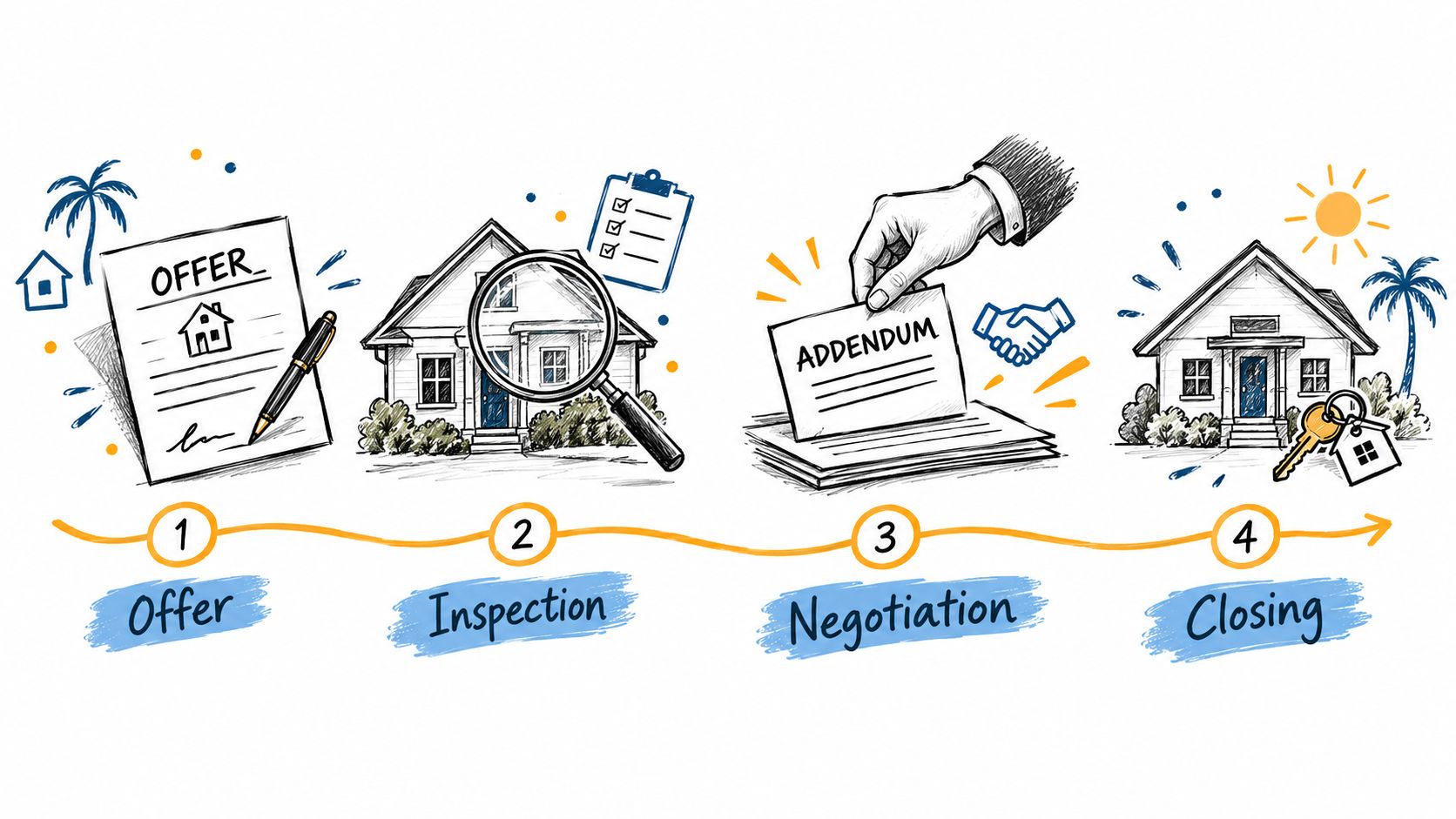
An addendum may appear with the initial offer, during negotiations, after an inspection, or shortly before closing. The timing depends on the issue. A financing provision belongs with the offer or contract package, while a repair agreement may arise only after the buyer receives inspection results.
Start with the base contract
First, identify the exact contract being used, the parties, the property, and the issue that needs to be addressed. Then choose a standard form if one exists. A standard form usually makes the relationship between the original agreement and the new provision easier to understand.
Second, read the base contract before drafting additional language. An addendum shouldn't create a conflict with a financing deadline, inspection right, title provision, or closing requirement that already appears elsewhere.
Connect the documents precisely
Florida Realtors' guidance calls for the addendum to be numbered, incorporated by reference, and linked to the paragraph it modifies. That means the final package should make it easy to answer three questions:
- What contract does this document belong to? Identify the parties, property, and agreement.
- What provision changes? Name the paragraph or subject with enough precision to prevent guesswork.
- What remains unchanged? State that other non-conflicting terms continue unless the document says otherwise.
Both parties must execute the addendum for the change to become effective. An agent may circulate the document, but a draft or unsigned attachment isn't a substitute for mutual agreement.
A final review should compare dates, defined terms, signatures, initials, and attached exhibits. A buyer and seller can also ask a Florida real estate attorney to review a custom rider, unusual liability language, or a provision that could affect termination rights or deposit risk.
The transaction timeline can become complicated when several documents are added. A clean, dated contract package helps the parties and closing professionals work from the same version.
For a visual overview of the process, this Florida Realtors contract guidance explains how optional clauses, riders, and addenda function in Florida sales contracts.
Florida-Specific Rules and Recent Form Updates
Florida's contract system relies heavily on standardized forms, but standardized doesn't mean static. Florida Realtors has updated addenda to respond to legal language, association matters, compensation questions, and changing transaction structures.
A technical point deserves special attention: the addendum should be explicitly incorporated into the base contract. The preparation guidance discussed above recommends numbering it, referencing it in Paragraph 20, and identifying the clause being modified. If the custom language directly conflicts with pre-printed language, Florida practice generally gives the specific executed provision significant weight, but the parties shouldn't rely on a court to resolve careless drafting.
Why current forms matter
In January 2025, Florida Realtors announced a renamed and expanded Qualifying Improvement Addendum to Contract, formerly called the PACE Addendum to Contract. The change reflected the legally required term “Qualifying Improvements,” and the disclosure expanded to residential and commercial transactions. Florida Realtors' 2025 forms update also described an updated Vacant Land Contract released in March 2025 that accounted for a revised HOA rider.
The same update cycle followed the post-settlement compensation shift in late 2024. Florida Realtors released a Compensation/Concession Addendum Related to Buyer's Broker for residential, vacant land, and commercial contracts. The form gives parties a way to document concessions or contingencies connected to buyer-broker compensation rather than leaving the arrangement in informal messages.
Florida Realtors also released updated riders and addenda tied to the Financing Enforcement Network rule effective March 1, 2026, along with a revised Qualifying Improvements Rider. These developments show why an old saved form may not be suitable for a current Palm Coast, St. Augustine, or Flagler County transaction.
A form that worked for a prior sale may not address the language required for today's deal.
The question is not just whether an addendum exists. It's whether the current version fits the contract, the property, and the legal conditions surrounding the transaction. A custom rider that changes a party's rights should receive appropriate legal review rather than being copied from an old file.
Key Deadlines and Extension Strategies
Deadlines often create more pressure than the purchase price because a missed date can affect financing, inspections, title work, association approval, or the buyer's ability to cancel. Florida's standard extension addendum is designed to modify specific time controls without reopening the entire purchase agreement.
| Deadline Type | Typical Duration | Common Extension Reason |
|---|---|---|
| Financing or commitment period | As stated in the signed contract | Loan approval, underwriting, or lender documentation is still pending |
| Inspection period | As stated in the signed contract | Additional inspections, specialist reports, or repair negotiations |
| Title cure period | As stated in the signed contract | A title defect, lien, estate issue, or document must be resolved |
| Feasibility or due-diligence period | As stated in the signed contract | Further property, zoning, land, or document review |
| HOA or condominium approval date | As stated in the signed contract | Association documents or approval remain outstanding |
| Closing date | As stated in the signed contract | Financing, repairs, title, appraisal, or another closing dependency |
The table uses “as stated in the signed contract” because there is no universal duration that applies to every Palm Coast or St. Augustine sale. The negotiated period depends on the contract form, property, financing, and agreement between the parties.
Extending one deadline carefully
An extension request should identify the exact period being changed and the new date. It shouldn't casually rewrite unrelated terms. Florida Realtors states that the extension addendum is intended for existing Florida sales contracts and becomes effective only when both parties execute it. Florida Realtors' extension addendum guidance explains that the form can address financing, inspection, title cure, feasibility, due diligence, and HOA or condominium approval periods.
A seller may agree to extra time when the buyer has a credible lender update or when a short delay protects a likely closing. A buyer may request an extension while waiting for appraisal results, association documents, or agreed repairs. Neither party should assume an email or verbal understanding changes the contract.
Deadline discipline: Never let a requested extension remain informal when the original deadline affects cancellation rights, deposit risk, or closing obligations.
Working with a Local Expert on Contract Negotiations
Addenda work best when contract language and local property knowledge support each other. A local professional can help identify whether a concern relates to an HOA, new construction process, inspection issue, title matter, or pricing strategy, then direct the parties toward the appropriate form or legal resource.
That context matters across Palm Coast, St. Augustine, Flagler County, and surrounding communities. A seller preparing a home for market may need a different negotiation strategy from an absentee owner who can't attend repairs in person. A move-up seller may need dates coordinated between a sale and a purchase. A 55+ homeowner downsizing may place more value on a predictable closing and clear possession terms than on a complicated concession structure.
Local judgment changes the conversation
The Palm Coast real estate market and nearby communities don't present identical transaction conditions. A buyer considering Flagler Estates homes may have different due-diligence questions from a buyer purchasing a condominium near St. Augustine. New construction buyers also need to read builder documents alongside the purchase contract, especially when timelines or upgrades are involved.
For sellers, a concession addendum may help address buyer financing concerns, but it should be weighed against net proceeds, lender requirements, and competing offer terms. For buyers, an inspection or financing provision may protect an important interest, but an overly broad request can make an offer less appealing. The right balance depends on the property and the current negotiation.

Marilynn Wolfe, LLC helps clients with contract writing and negotiation as part of its real estate services. That support can be useful when a homeowner needs to understand how a proposed addendum fits a listing plan, a relocation, a new construction purchase, or a local closing timeline. An agent can explain transaction practice, while a Florida attorney remains the appropriate resource for legal advice about unusual or disputed language.
Next Steps for Palm Coast and St. Augustine Buyers and Sellers
Before signing an addendum, slow down enough to connect it to the full contract. A short document can change a deadline, a concession, an inspection obligation, or a party's available options.
If you're selling
Start by gathering the current purchase agreement, disclosures, association information, repair records, and any lender or closing instructions already received. Ask your agent which standard form matches the issue and whether the proposed language changes your timing, proceeds, possession, or responsibility for repairs.
Sellers in Palm Coast, St. Augustine, Flagler County, and surrounding communities should also consider how the addendum affects positioning. A concession may help address a buyer's concern, but the terms should be clear and consistent with the offer. A deadline extension may preserve a transaction, but it should name the affected date and the new obligation.
If you're buying
Read each addendum with the base contract beside it. Confirm the inspection, financing, appraisal, title, association, and closing provisions that matter to your purchase. Buyers relocating to the area should allow time to understand community rules, property condition, and any documents tied to a condominium, HOA, vacant parcel, or new construction home.
Ask for clarification before signing if a term is vague or appears inconsistent. If the document includes custom legal language, unusual risk allocation, or a dispute over what controls, consult a Florida real estate attorney. An agent can help organize the transaction and explain practical consequences, but legal counsel should address legal interpretation and advice.
Keep a complete copy of every signed document, including exhibits and later extensions. Confirm that all parties have signed the same version, and don't assume a draft, text message, or verbal promise changes the agreement.
Marilynn Wolfe, LLC offers local guidance on preparing and negotiating real estate contracts for buyers and sellers in Palm Coast, St. Augustine, and Flagler County. If you're considering a sale, relocation, downsizing move, or new construction purchase, visit Marilynn Wolfe, LLC to discuss how the right addendum strategy can support a clearer transaction.