
If you're standing in a pastel front parlor on Cordova Street, ready to write an offer, the listing photos may make the decision feel simple. Across town, a seller may be wondering why a cash buyer hasn't appeared yet. In St. Augustine's historic core, both sides are dealing with more than price and charm.
St. Augustine historic district homes for sale are regulated, flood-exposed, condition-sensitive assets. What you can renovate, what you'll pay to insure, how long approvals may take, and how many buyers can realistically purchase the property all affect the true value. That's true whether you're relocating from Palm Coast, selling an inherited property, downsizing in Flagler County, or comparing St. Augustine real estate with newer communities nearby.
Why a Historic Home Is Not a Normal Purchase
A historic home doesn't behave like a typical suburban property. You can't evaluate it only by comparing bedrooms, bathrooms, finishes, and square footage. The structure's age, contributing status, alteration history, flood exposure, and approval requirements can change the transaction before the inspection period even begins.
Three friction points matter most.
First, preservation review controls exterior change. A buyer who wants new windows, a porch alteration, an addition, a fence, or a raised foundation may need more than a contractor's estimate. The project could require review under local architectural guidelines, and the applicable rules depend on the property's exact district and designation.
Second, flood exposure affects monthly ownership cost. A home may look dry today and still require careful review of its flood zone, elevation, drainage, foundation, insurance availability, wind coverage, and prior water intrusion. The Florida Department of Environmental Protection reports that current nuisance-flood exposure in the city's historic districts differs from projected exposure under sea-level rise scenarios, which makes parcel-level investigation essential. Read the Florida coastal-vulnerability assessment for St. Augustine.
Third, the buyer pool is narrower. Historic homes appeal strongly to buyers who value walkability, architecture, and place. They don't appeal equally to buyers who want easy maintenance, predictable renovations, large garages, or modern layouts. A beautifully staged kitchen won't compensate for unclear permits, deferred structural work, or an expensive insurance quote.
Practical rule: Price the property that exists, not the property you hope a buyer will create.
The right lens is cost, risk, and process. That applies to buyers considering a historic address and sellers preparing a home for market. It also applies to homeowners comparing St. Augustine housing market conditions with Palm Coast real estate market trends, where newer construction can offer a very different renovation and insurance equation.
What Defines the St Augustine Historic District Market
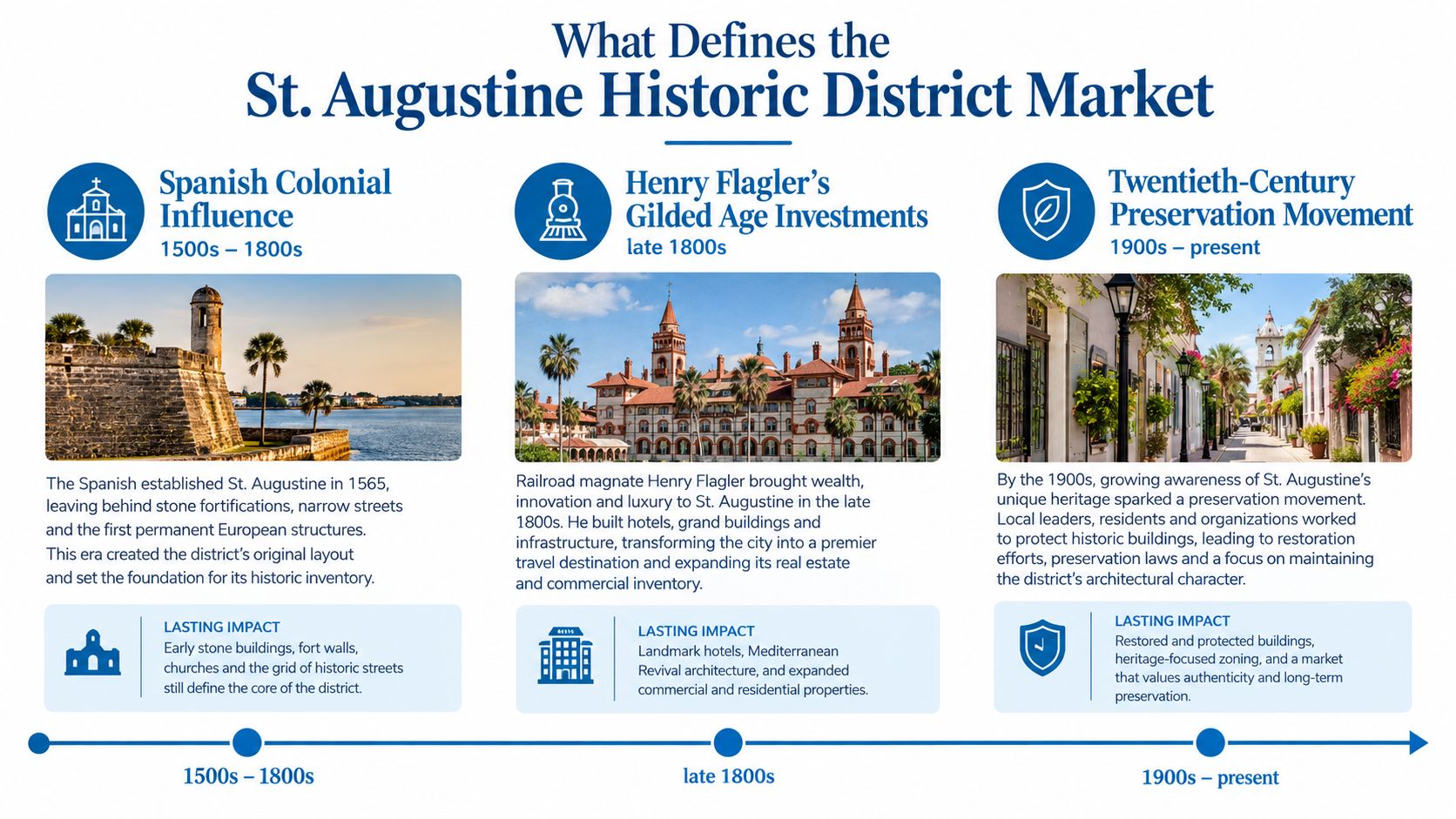
St. Augustine's historic market was built in layers. Spanish colonial planning established the compact street network and urban form. Later British and early American periods added different construction traditions, materials, and residential patterns. Tourism-era investment, including Henry Flagler's influence on the city's architecture and civic identity, added another layer, while twentieth-century preservation work protected portions of what remained.
That history explains why the inventory doesn't resemble a modern subdivision. The St. Augustine Town Plan Historic District preserves the street network of a sixteenth-century Spanish colonial town, and its surviving architectural heritage spans nearly 300 years, according to the Advisory Council on Historic Preservation's St. Augustine profile. St. Augustine was founded in 1565 and is recognized as the oldest continuously occupied European settlement in the continental United States.
The result is a market containing rare colonial-era survivors, wood-frame houses, Victorian-era properties, Craftsman-influenced homes, Mediterranean Revival buildings, and later infill. Those categories shouldn't be treated as interchangeable. A restored masonry structure near the oldest streets carries different maintenance concerns and buyer expectations than a wood-frame cottage in another district.
Geography matters more than the label
“Historic district” isn't one uniform boundary. Municipal boundary descriptions include portions of Palm Row, St. George Street, Cadiz Street, Aviles Street, Bridge Street, and the Matanzas River or Bay. Other descriptions reference Hypolita, Charlotte, Cuna, Cordova, Valencia, and Granada Streets. Review the municipal preservation-district boundaries before assuming that a nearby property follows the same rules.
The preservation picture is substantial. Local and state records identify more than 3,700 individual historic properties, along with seven National Register historic districts and five locally designated historic districts. The Town Plan National Historic Landmark District includes 212 buildings representing development from 1672 through 1935, according to the city's historic preservation data and analysis.
That's why average price-per-square-foot figures can mislead. Two homes a block apart may have different boundaries, construction periods, contributing status, flood conditions, and renovation pathways.
The historical timeline is easier to understand visually. This video provides additional context on St. Augustine's historic environment:
Preservation Rules That Shape Every Renovation Decision
Before pricing a historic home, find out what the city believes the property is. Before making an offer, find out what the city may allow you to change.
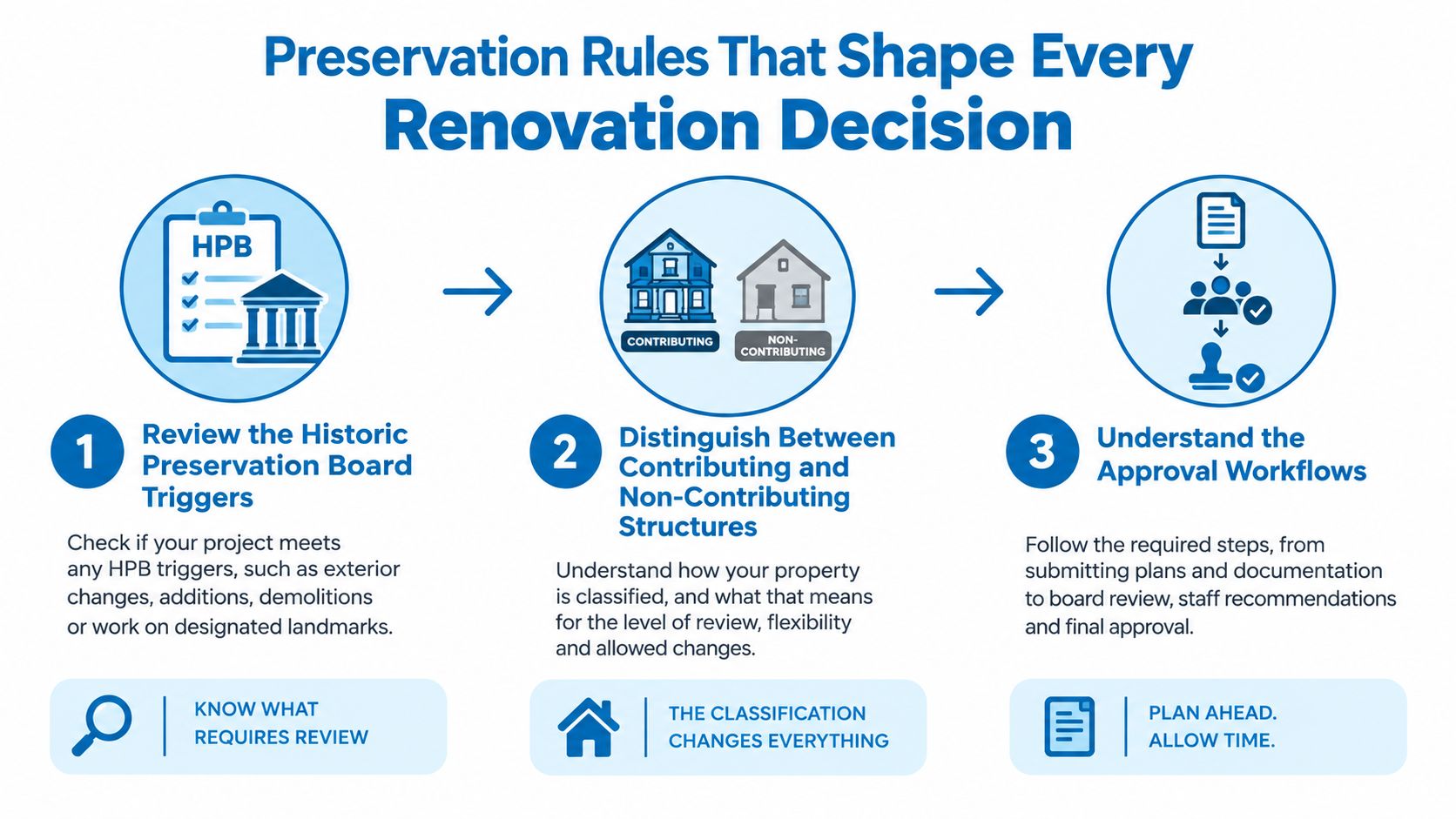
St. Augustine's locally designated preservation districts are identified as HP-1 through HP-5. Exterior alterations in those districts are reviewed under the city's Architectural Guidelines for Historic Preservation. A Certificate of Appropriateness from the Historic Architectural Review Board is generally required before a building permit can be issued for regulated construction. The guidelines cover more than paint and windows. They can apply to additions, adaptive reuse, signs, fences, outdoor features, relocations, and demolitions.
Start with the property file
Ask for the property's contributing or non-contributing status. A contributing structure helps define the district's historic character, while a non-contributing structure may face a different preservation discussion. That distinction doesn't mean a buyer has unlimited freedom, but it can change how staff and the board evaluate proposed work.
Then request the full preservation file, including prior applications, approvals, staff comments, and board minutes where available. A house with a clean record and documented improvements is easier to price than one with uncertain alterations.
Confirm the exact zoning boundary, too. A property can be close to a preservation district without being governed by precisely the same local overlay. Never rely on the neighborhood name in the listing.
Demolition and archaeology require separate attention
The city states that full demolitions proposed for any building 50 years or older, or for buildings located in HP-1 through HP-5, require Historic Architectural Review Board approval through an application and public hearing. Soil disturbance deeper than 3 inches and larger than 100 square feet may require archaeological review when the property lies within an archaeological zone. Those requirements can affect additions, foundations, pools, drainage work, and site changes, not only demolition.
Review the city's property-owner guidance on preservation requirements before assuming ordinary permitting is enough.
For sellers, gather prior Certificate of Appropriateness records and disclose known unpermitted work. For buyers, make the offer contingent on document review and feasibility confirmation for major exterior plans.
The least expensive house can become the most expensive purchase when a buyer misreads the approval pathway.
Flood, Insurance, and Resilience at the Parcel Level
The useful question isn't just, “Is this historic home in a flood zone?” The useful question is, “What will this specific parcel cost to own, insure, improve, and resell?”
FEMA flood maps classify properties according to mapped flood hazards, but a map designation is only one part of the analysis. Review the current flood-zone determination, elevation information, finished-floor position, foundation configuration, drainage, prior water intrusion, and lender insurance requirements. Get an insurance quote for the exact address before the inspection period ends.
Future exposure deserves separate treatment. The Florida assessment projects that 20% to 50% of structures across several St. Augustine historic districts could become vulnerable under approximately 1 to 1.5 feet of sea-level rise. That projection doesn't mean every property will experience the same outcome, and it doesn't replace a current FEMA determination. It does mean today's classification shouldn't be treated as permanent.
Flood Zone and Cost Snapshot for the Historic Core
| Street Profile | FEMA Zone | Elevation Cert | Relative Premium Impact |
|---|---|---|---|
| Higher-ground historic-core parcel | Verify for the exact address | Request existing certificate or order one if needed | May differ from nearby low-lying parcels, but obtain a written quote |
| Low-lying residential block | Verify for the exact address | Review finished-floor and foundation information | May increase insurance and mitigation costs depending on carrier requirements |
| Waterfront or river-adjacent parcel | Verify for the exact address | Particularly important for elevation and flood underwriting | Exposure may affect premiums, deductibles, coverage availability, and resale |
| Historic home with planned elevation or hardening | Verify current and post-project conditions | Coordinate with engineer, insurer, and preservation staff | Construction cost and approval friction may alter the ownership calculation |
A home on Aviles Street shouldn't be assigned the same insurance assumption as one on Marine Street just because both are associated with the historic core. Street-level impressions are not underwriting evidence.
Resilience work also has a preservation dimension. Elevated mechanicals, flood-resistant materials, flood vents, impact windows, and foundation changes may improve durability, but exterior changes can require historic review. The right improvement is the one that protects the property without creating an approval problem or an unrealistic resale expectation.
A Practical Roadmap for Buyers and Sellers
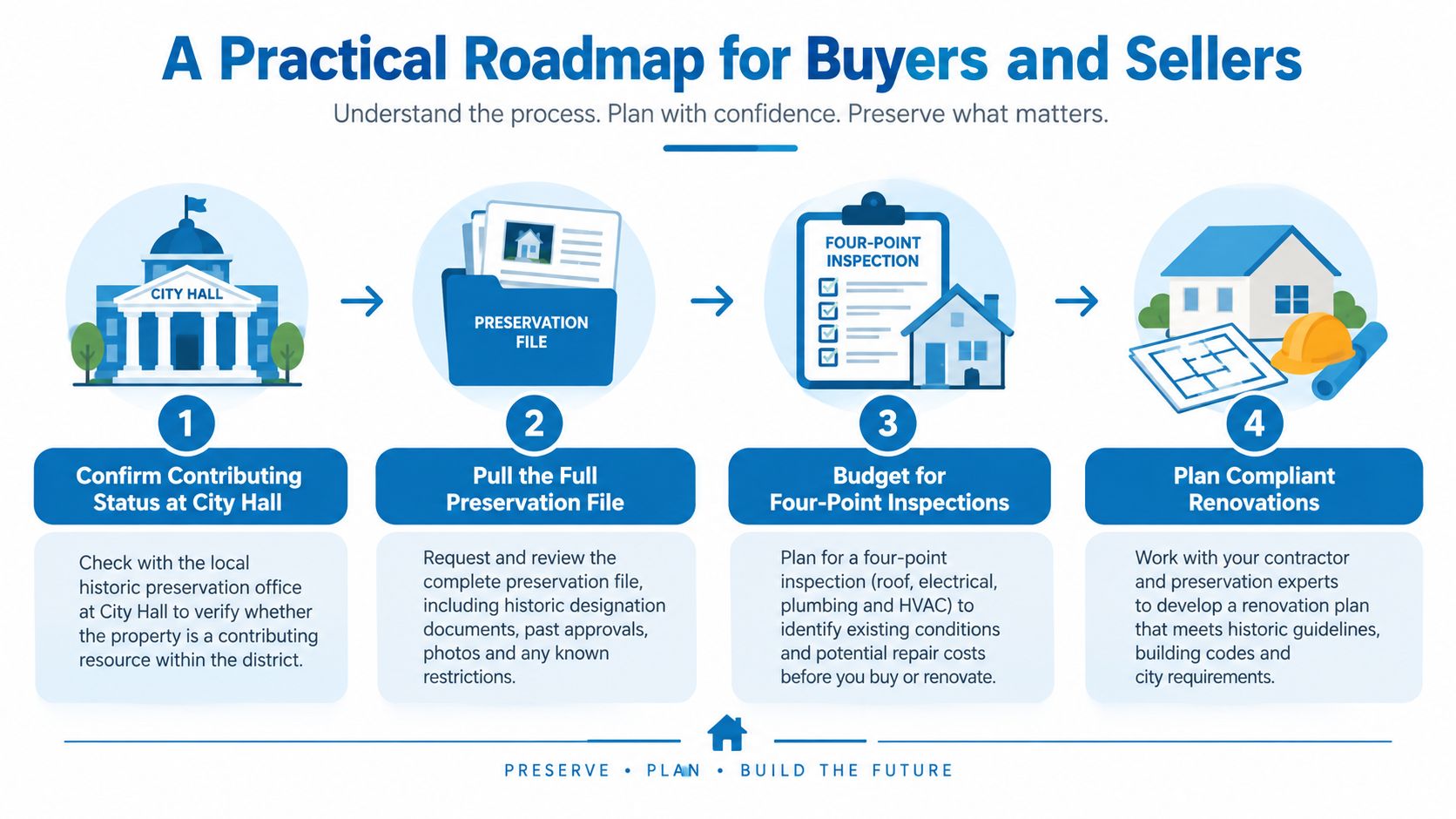
Historic transactions go better when the research happens in sequence. Buyers should begin with the city file, not the contractor's wish list. Sellers should begin preparing documentation before the property reaches the market.
For buyers
Confirm the designation. Ask City Hall whether the parcel sits in an HP district, a National Register district, both, or neither. Confirm whether the structure is contributing or non-contributing.
Pull the preservation history. Review prior approvals, partial-demolition records, alterations, site changes, and unresolved conditions. A home's visible appearance may not reveal the full permit history.
Inspect the expensive systems. Use an inspection plan that pays close attention to foundation movement, electrical systems, plumbing, roofing, moisture, termites, and structural connections. Older blocks can hide costly conditions behind attractive finishes.
Price the entire purchase. Build a net-cost worksheet that includes the purchase price, inspection findings, preservation applications, specialized materials, insurance, taxes, utilities, maintenance, mitigation, and a reserve for surprises. Ask the lender whether a renovation product such as the FHA 203(k) loan fits the property and proposed work, because historic restrictions and contractor requirements may affect financing.
For sellers
Start with a preservation-aware listing file. Gather surveys, prior Certificates of Appropriateness, permits, architectural plans, inspection reports, insurance information, and documentation for major improvements.
If you expect a buyer to ask about an addition, window replacement, elevation project, or site change, discuss the intended scope with preservation staff before making promises. You don't need to complete the buyer's renovation, but you should avoid marketing an improvement as feasible until the approval pathway is understood.
Disclose known unpermitted work. Concealing an alteration rarely helps a seller. It can create inspection objections, financing problems, renegotiation, and post-closing disputes.
Write contingencies that match the property
A standard inspection contingency may not address preservation feasibility. Buyers should consider document-review and approval contingencies when the purchase depends on a major exterior project. Financing language should account for insurance availability, appraisal concerns, repair requirements, and the possibility that the lender won't treat planned improvements as completed value.
Sellers should expect serious buyers to ask detailed questions. That's not excessive caution. It's how a buyer protects the budget and avoids discovering after closing that the desired renovation requires a different design, material, or approval process.
What Current Listings and Closings Actually Show
The historic segment needs its own pricing conversation. Broad St. Augustine real estate averages can hide the difference between a restored contributing property, a renovation-heavy cottage, a commercial-adjacent home, and a rare high-end residence.
Homes.com reported 34 houses for sale in the Saint Augustine Historic District, with asking prices from $379,900 to $3,333,000. The same source reported a $725,000 median sale price, a 14% year-over-year decline, an average of 119 days on market, 66 sales during the prior 12 months, and approximately 6.5 months of supply. Review the Homes.com Historic District market page before relying on any portal snapshot, because listing data can change.
A separate recent market analysis reported 19 city-district closings in June 2026, compared with 25 the prior year, while the median closed price moved from $617,500 to $450,000 and median days on market moved from 49 to 55. Those figures should be independently verified before publication or use in a pricing opinion, but they reinforce the central point: scarcity doesn't guarantee a quick sale or a uniform premium. See the city policy document containing the referenced market analysis.
Historic District vs St Augustine Market Snapshot
| Metric | Historic District | St Augustine Overall |
|---|---|---|
| Reported active houses | 34 | Not stated in the same verified snapshot |
| Asking-price range | $379,900 to $3,333,000 | Not stated in the same verified snapshot |
| Reported median sale price | $725,000 | Not stated in the same verified snapshot |
| Average days on market | 119 | Not stated in the same verified snapshot |
| Prior twelve-month sales | 66 | Not stated in the same verified snapshot |
| Reported supply | Approximately 6.5 months | Not stated in the same verified snapshot |
For sellers, the answer isn't to copy the highest active listing. Build a defensible price from comparable properties, then adjust for condition, contributing status, location, flood exposure, income potential, parking, outdoor space, and documented renovation history.
For buyers, stale listings deserve investigation rather than automatic dismissal. A long market time may reflect overpricing, insurance friction, an ambitious renovation, or a property that needs a buyer with a very specific vision. Fresh pricing can be meaningful, but only when the seller has also presented clear documentation and realistic condition information.
That discipline matters across Northeast Florida. Palm Coast home values, Flagler Estates homes, and broader Flagler County real estate each follow different buyer expectations. St. Augustine's historic core is too specialized for a citywide average to answer the pricing question.
Let's Talk About Your Historic Home Goals
When I meet someone interested in a historic property, I start with practical questions. Is the structure contributing? Which preservation district applies? What does the flood determination say? Has the property had water intrusion? What work do you want to complete, and what's your actual timeline?
For sellers, I can help organize a preservation-aware property review before the list price is set. That means looking at comparable sales, condition, prior approvals, visible exterior changes, insurance considerations, and the type of buyer most likely to appreciate the property without underestimating its obligations.
For buyers, I can build a targeted search and tour plan around the kind of historic ownership experience you want. Some clients want a walkable Old City setting and accept smaller lots and tighter renovation controls. Others want character with more flexibility, or they compare a historic purchase with new construction in Palm Coast, Flagler County, or surrounding St. Augustine communities.
I'm available for in-person walkthroughs from St. George Street to Aviles Street and throughout the surrounding historic neighborhoods. Pairing MLS data with city preservation files gives us a clearer view than either source provides alone.
My job is to be honest about trade-offs before you make an offer or choose a list price. Historic character can be irreplaceable, but it can also bring approval delays, specialized maintenance, insurance questions, and a smaller resale audience. You deserve to understand all of that before committing.
Marilynn Wolfe, LLC offers local pricing strategy, market insight, and hands-on guidance for buyers and sellers evaluating historic properties in St. Augustine, Palm Coast, and Flagler County. Visit Marilynn Wolfe, LLC to request a preservation-aware property review or begin a targeted search for a home that fits your goals, budget, and renovation plans.