
You're looking at homes for sale online, and a smaller Palm Coast house has a higher price per square foot than a larger home nearby. Does that mean the smaller property is overpriced, or that the larger one is a bargain? Neither conclusion is safe without checking what's behind the number.
Price per square foot is a starting question, not a pricing answer. For homeowners preparing to sell, it can help identify which properties deserve a closer look. But a defensible price for a Palm Coast or St. Augustine home requires more than multiplying its size by a headline market figure.
Why the Same Price Can Mean Different Things in Palm Coast
When you compare homes for sale price per square foot, you're comparing an entire property through a single measurement: interior living space. The asking price, however, includes much more than the rooms inside.
A buyer is also considering the lot, setting, condition, and features. That's why apparently similar homes can deserve different prices, even before you examine whether their reported square footage is accurate.
Start With the Property, Not the Ranking
My recommendation is simple: don't sort listings by price per square foot and assume you've ranked their value. Use the number to decide what to investigate.
The price-per-square-foot measurement guide identifies the limitations that matter here: the metric doesn't fully capture lot size, condition, layout, location, or amenities. Those aren't minor details to put aside after you've calculated a price. They're central to the buyer's decision.
- For a Palm Coast seller: Identify which properties a buyer would realistically consider instead of yours.
- For a St. Augustine buyer: Separate homes that fit your location and lifestyle requirements from properties that merely look inexpensive on a spreadsheet.
- For an absentee owner: Verify the property's present condition rather than relying on your memory of it.
- For a downsizer: Judge usable space and accessibility, not just the amount of space offered.
Keep Local Comparisons Local
Palm Coast real estate, St. Augustine real estate, and Flagler Estates homes shouldn't be placed in one undifferentiated pricing pool. Start with the subject property's neighborhood and property type, then expand the search only when you can explain why another sale is relevant.
The same discipline applies when comparing resale homes, new construction, and homes in age-restricted communities. Don't assume they compete directly because their advertised living areas are similar.
Practical rule: A useful comparable is a home your likely buyer would seriously consider, not just a home with a convenient price.
What Price Per Square Foot Actually Measures
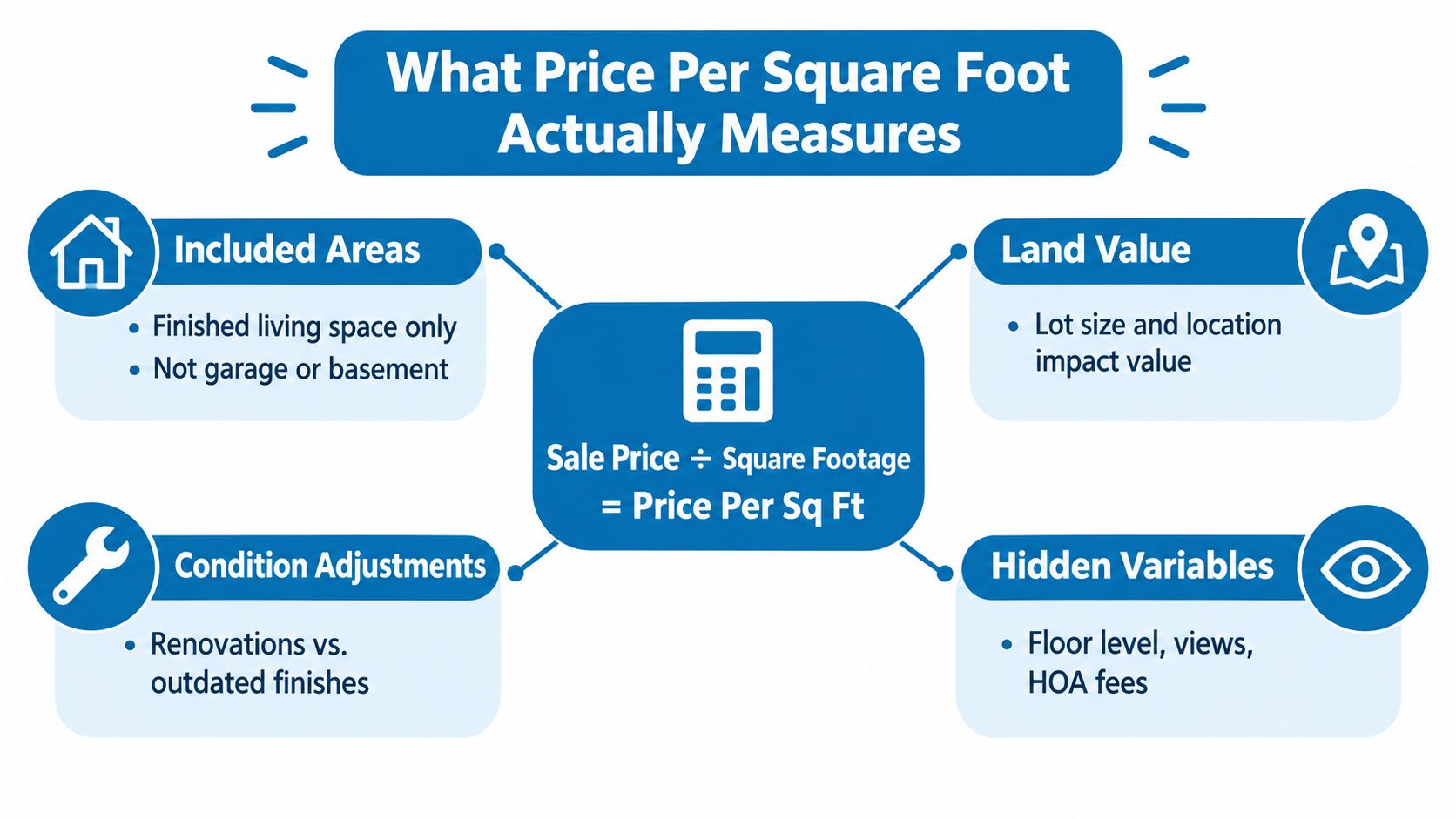
The calculation is straightforward: sale price divided by measured living area equals price per square foot. The harder work is choosing consistent inputs.
For an active listing, the numerator is the asking price. For a completed transaction, it's the closed sale price. Keep those calculations labeled separately, because seller expectations and buyer-paid prices answer different questions.
Verify the Living-Area Figure
Before accepting the denominator, compare the MLS entry, county property record, available builder plans, and any appraisal or measured floor plan. Don't automatically choose the largest figure or assume the newest listing entry is correct.
A measurement discrepancy alone can materially change the result: a 200-square-foot difference on a home reported as 1,800 square feet can move its apparent price from $250 to approximately $281 per square foot, as described in the measurement guide linked earlier. That example reflects a changed denominator, not an increase in what the property is worth.
The calculation graphic is a useful reminder to separate measured space from the other features buyers consider.
Resolve Disagreements Before Comparing
Gross living area and total under-roof area aren't interchangeable. A garage or screened lanai may contribute to a property's appeal without belonging in the living-area denominator.
- Ask for the measurement basis: Find out whether the figure came from public records, builder documents, or a professional measurement.
- Investigate additions: An enclosed patio or converted space needs closer review, including its documentation and treatment under the applicable measurement standard.
- Use matching definitions: Don't compare one home using total covered space with another using only qualifying finished living area.
There isn't a universal winner when records disagree. My recommendation is to have the discrepancy resolved through a qualified measurement and the applicable appraisal standard, then document the figure used in the pricing analysis.
Also, don't interpret the infographic's simplified area labels as rules for every property configuration. The actual measurement standard, not an illustration, determines what qualifies.
What Palm Coast and St. Augustine Numbers Look Like Today
Local market figures are useful for orientation. They're not permission to price every house at the citywide median.
The reporting period and sample matter just as much as the headline. A short-period median, a longer-period median, and an average asking price can all be accurate while describing different groups of properties.
Read the Local Reports Side by Side
| Market report | Reported figures | Best use |
|---|---|---|
| Palm Coast recent closed sales | $359,000 median sale price and $187 median sold price per square foot over the three months ending September 2026; total median price rose 2.5%, while median price per square foot fell 4.1% year over year, according to Redfin's Palm Coast housing market report. | Check recent citywide direction, including the difference between total prices and unit pricing. |
| Palm Coast broader closing sample | A six-month median of $190 per square foot across 1,580 closings with usable living-area measurements, with the middle half ranging from $169 to $216, according to Resideline's Palm Coast market analysis. | Understand the spread rather than treating the midpoint as a universal target. |
| St. Augustine listings and sales | $346 average asking price per square foot across 188 active listings, compared with a $409,000 median sold price and $261 median sold price per square foot across 295 sales recorded in 2026, according to the St. Augustine market report. | Distinguish current seller expectations from completed transactions. |
What These Figures Mean for Your Home
The Palm Coast reports don't contradict each other. They use different reporting windows and samples, so homeowners shouldn't force their medians into a single supposedly exact answer.
The contrasting Palm Coast trends are especially important. A higher overall median sale price doesn't automatically mean buyers paid more for each square foot; the mix of homes sold can change the result.
For St. Augustine, don't interpret the asking-versus-sold figures as a measured negotiation discount. They describe different samples and use different summary measures.
A citywide median tells you where the middle of a reported sample sits. It doesn't tell you where your property belongs.
For Palm Coast home values, I'd use these reports to calibrate expectations, then turn to the property's actual competitive set. In the St. Augustine housing market, I'd also keep active inventory separate from closed-sale evidence throughout the analysis.
How to Build a Local Comparable Set That Actually Compares
Build your comparable set around the subject property before calculating anything. If you start by collecting attractive numbers, you'll be tempted to justify them afterward.
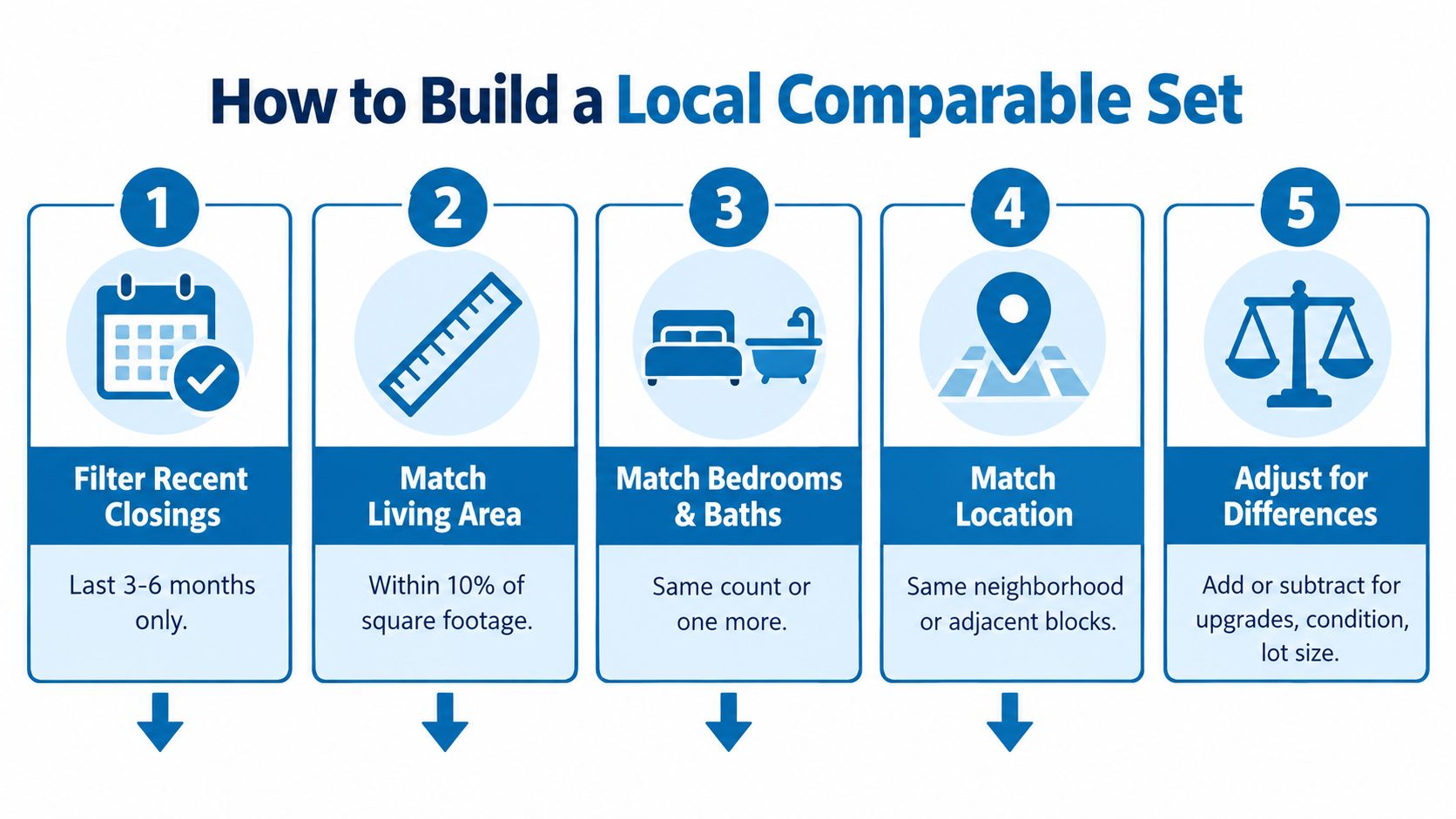
Use recent closed sales as the foundation. Review the MLS records and available property documentation closely enough to understand what sold, not just the headline price.
Select Properties Buyers Would Substitute
Begin in the same neighborhood or subdivision where possible. Match property type, living area, construction era, bedroom configuration, lot characteristics, garage capacity, and condition.
- Prioritize relevant closings: A nearby sale with similar features deserves more attention than a distant property that happens to match the square footage.
- Bracket the subject: Include relevant properties that help establish the lower and upper ends of its likely position.
- Check distinctive features: Waterfront or golf exposure, renovation quality, and outdoor amenities need deliberate consideration.
- Record missing information: If you can't verify a comparable's condition or living-area basis, flag that limitation instead of treating it as equally reliable.
This graphic provides a screening sequence, but its fixed filters shouldn't replace judgment about the local evidence.
Reconcile Rather Than Simply Average
Calculate each comparable's sold price per qualifying living-area unit. Then explain why its result should carry more or less weight for the subject property.
Don't assign a universal dollar adjustment to extra square footage or renovations. My recommendation is to look for evidence of what buyers paid for those differences in the relevant competitive market, rather than applying a convenient rule of thumb.
The FHFA House Price Index overview reinforces the distinction between absolute property pricing and broader appreciation: its historical coverage extends to the mid-1970s and includes all 50 states and more than 400 American cities. An index helps interpret market movement; it doesn't eliminate the need to compare similar properties.
For Flagler Estates homes, resist importing a Palm Coast subdivision sale merely to fill out the worksheet. A smaller, well-explained comparable set is more useful than a larger collection of properties that buyers wouldn't view as substitutes.
The Size Discount and Why Lower Is Not Always Better
The lowest price per square foot isn't automatically the best deal. It may describe a larger home spreading certain property components across more living area.
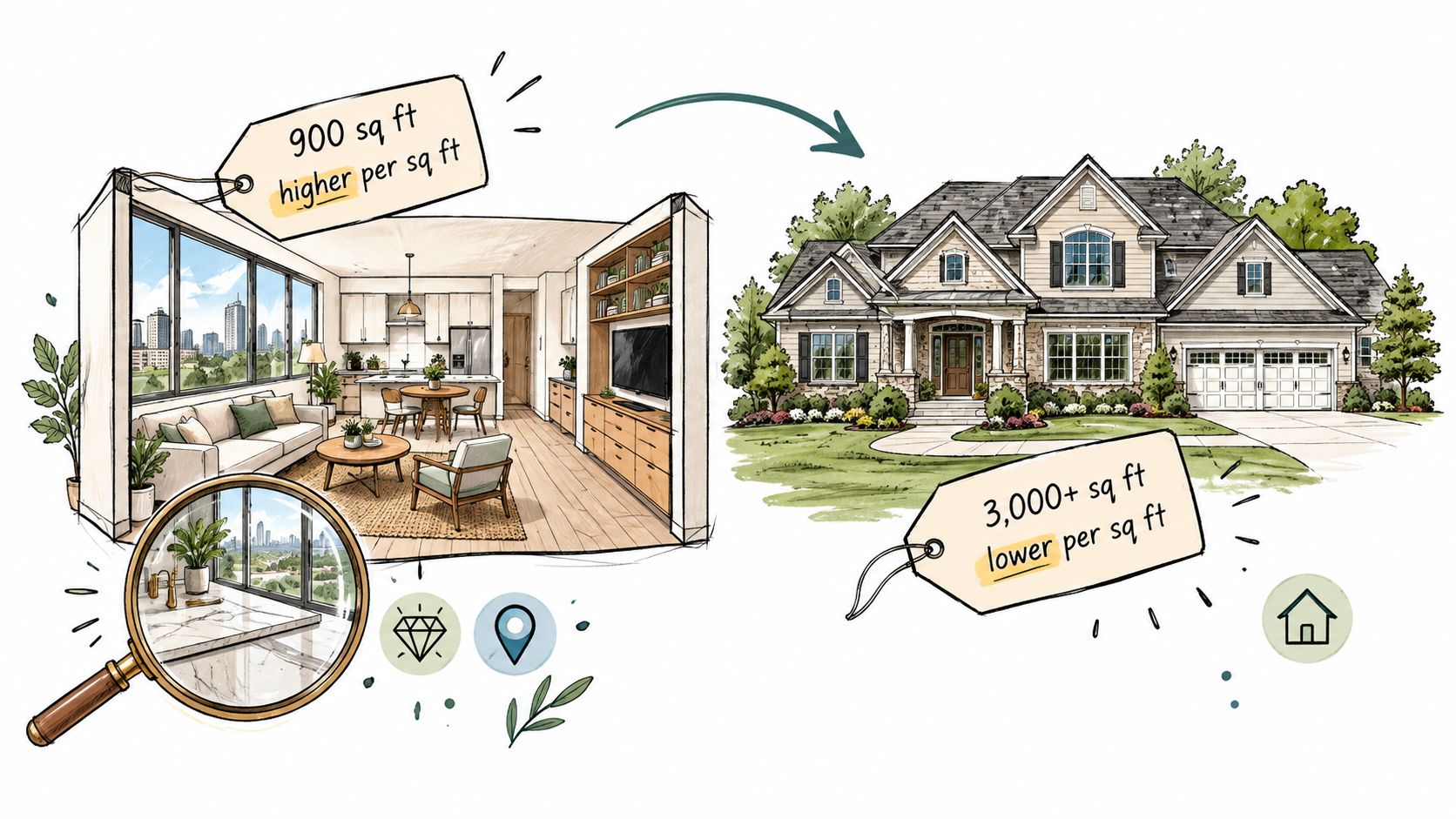
A comparison between a 900-square-foot condominium and a 2,500-square-foot single-family home illustrates the problem: land, kitchens, utilities, and other components don't scale evenly with interior size, as explained in the price-per-square-foot calculator guide. Neither property has to be mispriced for their unit prices to differ substantially.
The illustration highlights that comparison trap.
Judge the Purchase Beyond Interior Size
For buyers relocating to Northeast Florida, I'd rather see a careful ownership-cost comparison than a search for the lowest unit price. Review insurance information, flood exposure, HOA or CDD charges, expected maintenance, and the condition of major systems before calling a home a bargain.
| A higher figure may be reasonable when | A lower figure deserves scrutiny when |
|---|---|
| The home offers a better lot or a more useful layout. | The layout leaves substantial space difficult to use. |
| Construction and documented improvements reduce near-term repair concerns. | Deferred maintenance requires investigation. |
| The property better fits the buyer's daily needs. | The buyer is accepting location compromises solely for more space. |
Apply the Same Discipline to Downsizing
A downsizer shouldn't assume a smaller home is poor value because its unit price exceeds that of the larger home being sold. Evaluate the actual purchase price, recurring expenses, maintenance responsibilities, and suitability for the next stage of life.
For homeowners considering age-restricted communities, obtain the governing documents and fee information before comparing ownership costs. For new-construction buyers, distinguish the advertised offering from the specific home, lot, and options under consideration.
Buying advice: Pay for space and features you'll use. Don't let a low unit price persuade you to buy a property that doesn't fit.
Why Local Time Adjustments Beat National Benchmarks
An older comparable sale needs a date check before you use it to support today's listing price. Its recorded price reflects the conditions surrounding that transaction, not automatically the conditions your buyer faces now.
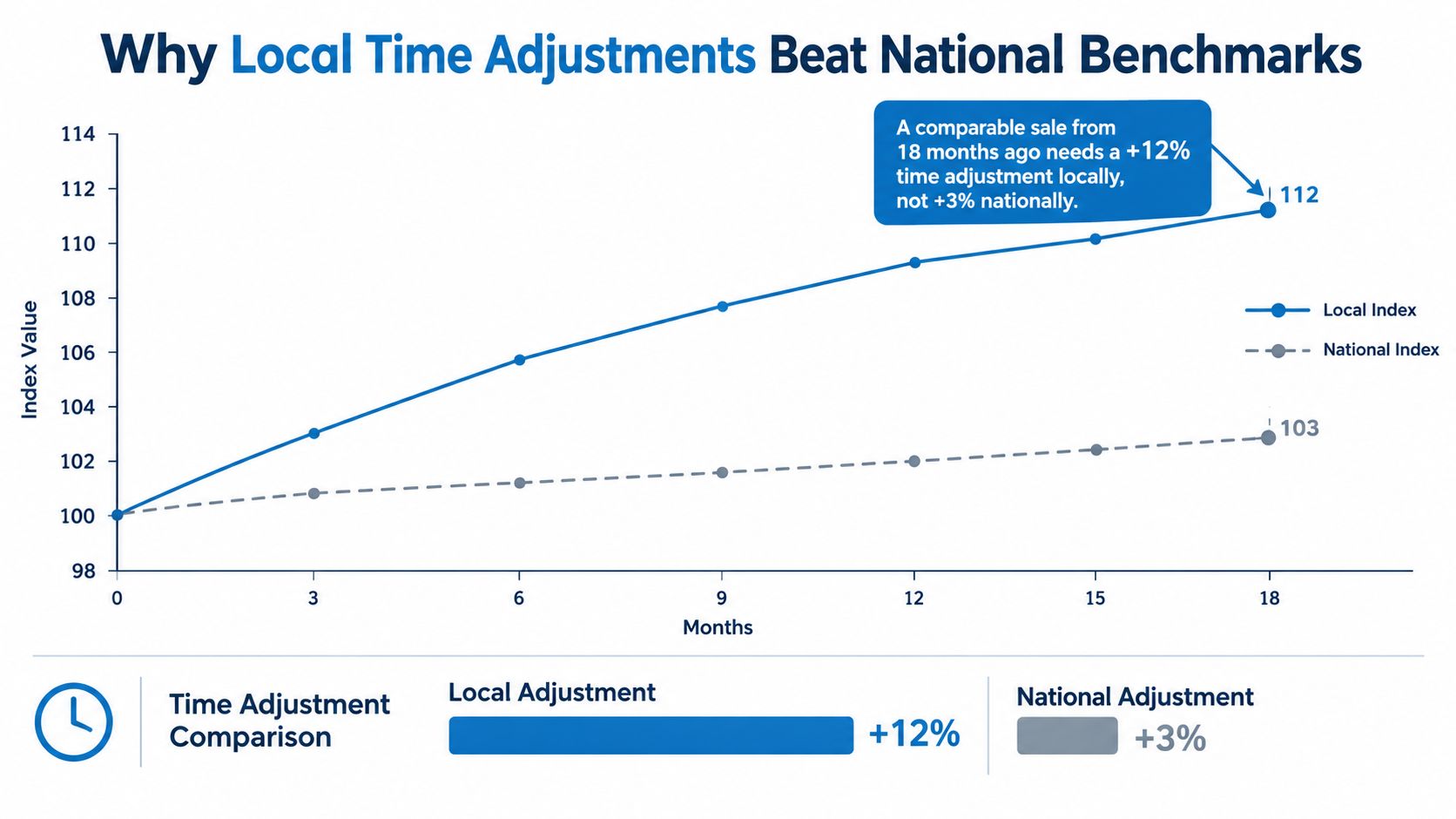
The 2025 second-quarter FHFA report showed national four-quarter appreciation of 2.9%, while Florida's four-quarter change was negative 1.39%, according to the FHFA quarterly House Price Index report. These are historical figures, not a claim about today's exact Palm Coast appreciation rate, but they demonstrate why national movement shouldn't be substituted for Florida evidence.
Choose Evidence That Matches the Place and Period
Use the most relevant available state or metropolitan index alongside neighborhood sales. Match the adjustment period to the comparable's timing, and don't apply a full reporting-period change to a sale covering a different interval.
The chart below is a conceptual illustration, not verified Palm Coast or St. Augustine market data. Its depicted local increase and adjustment shouldn't be used to price a Northeast Florida property.
A broad benchmark has other limits, too. The Census Bureau's new-construction reporting placed the 2023 national median at $154.70 per square foot and the South regional median at $146.64, as reported in its National Housing Month housing overview. Those figures provide historical new-construction context, not a current resale valuation for Flagler County.
Keep the Calculations Separate
Maintain distinct worksheet entries for the subject's proposed price per square foot, the comparable set's median, and the supported time adjustment. Each answers a different question, and combining them too early makes the reasoning harder to audit.
- Subject pricing: What unit price does the proposed listing amount imply?
- Comparable midpoint: Where does the selected closed-sale sample sit?
- Time adjustment: What evidence supports changing an older sale's price to reflect the relevant period?
For absentee owners and downsizers, this separation helps distinguish a property-specific concern from broader Palm Coast real estate market trends. Don't assume a softer indicated value means your home alone has become less desirable.
An additional video resource is available below.
A Practical Checklist for Sellers and Buyers in Flagler County
Before trusting a listing's price per square foot, ask for a written explanation of the inputs and comparisons. You don't need an elaborate report to spot weak reasoning, but you do need more than a number copied from a portal.
For anyone selling a home in Palm Coast, I recommend completing the evidence review before choosing the listing price. Preparing the property and preparing the pricing analysis should happen together.
Verify Before You Commit
- Confirm the area source: Request the measurement basis and resolve meaningful conflicts among the listing, public records, and available property documents.
- Label the price type: Keep asking-price calculations and closed-sale calculations in separate columns.
- Select enough relevant sales: There's no useful universal count. Seek a set that brackets the property and explains its position; if evidence is thin, identify the limitation.
- Document improvements: Gather available permits, renovation information, and major-system records rather than relying on broad descriptions such as updated.
- Review lot and condition differences: Make the reasons for each adjustment visible.
- Check transaction timing: Require support for any time adjustment and confirm that its geography and period fit.
- Review ownership obligations: Buyers should obtain insurance information, applicable community charges, and maintenance details before deciding that the price represents value.
Recognize the Warning Signs
Be cautious when someone recommends a price because nearby sellers are asking that amount, or because a national benchmark supports it. Be equally cautious when a comparison crosses neighborhoods or property types without explaining why buyers would consider both homes.
An unexplained living-area change is another warning sign. So is a pricing worksheet that gives every comparable identical weight despite obvious differences.
For sellers, keep documentation accessible and make the home's condition easy to evaluate. For buyers, investigate the questions that could affect ownership and resale before becoming attached to an apparently favorable unit price.
A defensible local price is one you can explain property by property. That's the standard I'd use throughout Flagler County real estate and surrounding Northeast Florida communities.
Marilynn Wolfe, LLC offers personalized pricing strategy, market insight, and selling guidance for Palm Coast, St. Augustine, Flagler County, and surrounding communities, with Marilynn serving as a Strategic Listing Agent with LPT Realty LLC. To understand what your home's price per square foot means in today's competitive set, visit Marilynn Wolfe, LLC, call 904-429-2829, or email marilynnwolfe.realtor@gmail.com for a personalized home-value discussion.