
You're about to list your Palm Coast home, so you check a few nearby listings, choose a price that feels comfortable, post on social media, and wait for the right buyer. That approach sounds simple, but it leaves important questions unanswered: Which homeowners are you trying to reach? What makes your property compelling? How will you know whether your pricing, promotion, or follow-up is working?
That's why learning how to write a marketing plan matters. A useful plan for Palm Coast real estate, St. Augustine real estate, or Flagler County real estate isn't a long list of platforms. It's a practical measurement system that connects local research, audience needs, pricing strategy, promotion, follow-up, and revenue.
Why Most Local Marketing Plans Fall Apart
A Palm Coast homeowner decides to sell after seeing a neighbor's listing receive attention online. She chooses an asking price based on a nearby property, assumes buyers will find the home through a few social posts, and starts promoting before deciding what success should look like.
The listing may attract views, but views don't explain whether the price is right. If inquiries come from buyers who aren't financially prepared, the owner may conclude that marketing failed when the actual issue was positioning. If the home receives little activity, there may be no record showing whether the problem came from price, presentation, search visibility, property details, or slow follow-up.
A written plan prevents those guesses. The U.S. Small Business Administration's business-planning guidance treats market research and competitive analysis as core planning components. That principle applies directly to a local real estate business, where Palm Coast, St. Augustine, Flagler Estates, and nearby communities can attract different buyers and produce different pricing conversations.
Practical rule: Don't promote a property until you can explain who it's for, why the price fits the market, and what action you want the prospect to take.
Local conditions also make preparation more valuable than improvisation. A seller considering Palm Coast home values needs property-specific research, not a broad statement that the Northeast Florida market is strong or weak. A homeowner near Flagler Estates may need a different comparison set from an owner near the coast, while a seller in St. Augustine may need messaging built around a different buyer search.
Your plan should answer five questions:
- Audience: Who is most likely to need this service?
- Positioning: Why should that audience trust the advice?
- Offer: What useful next step can you provide?
- Measurement: Which actions indicate real progress?
- Review: When will you change the plan?
Hope is not a marketing strategy. A written plan gives a seller and agent a shared way to make decisions before spending time and money.
Start With Local Market Research You Can Actually Use
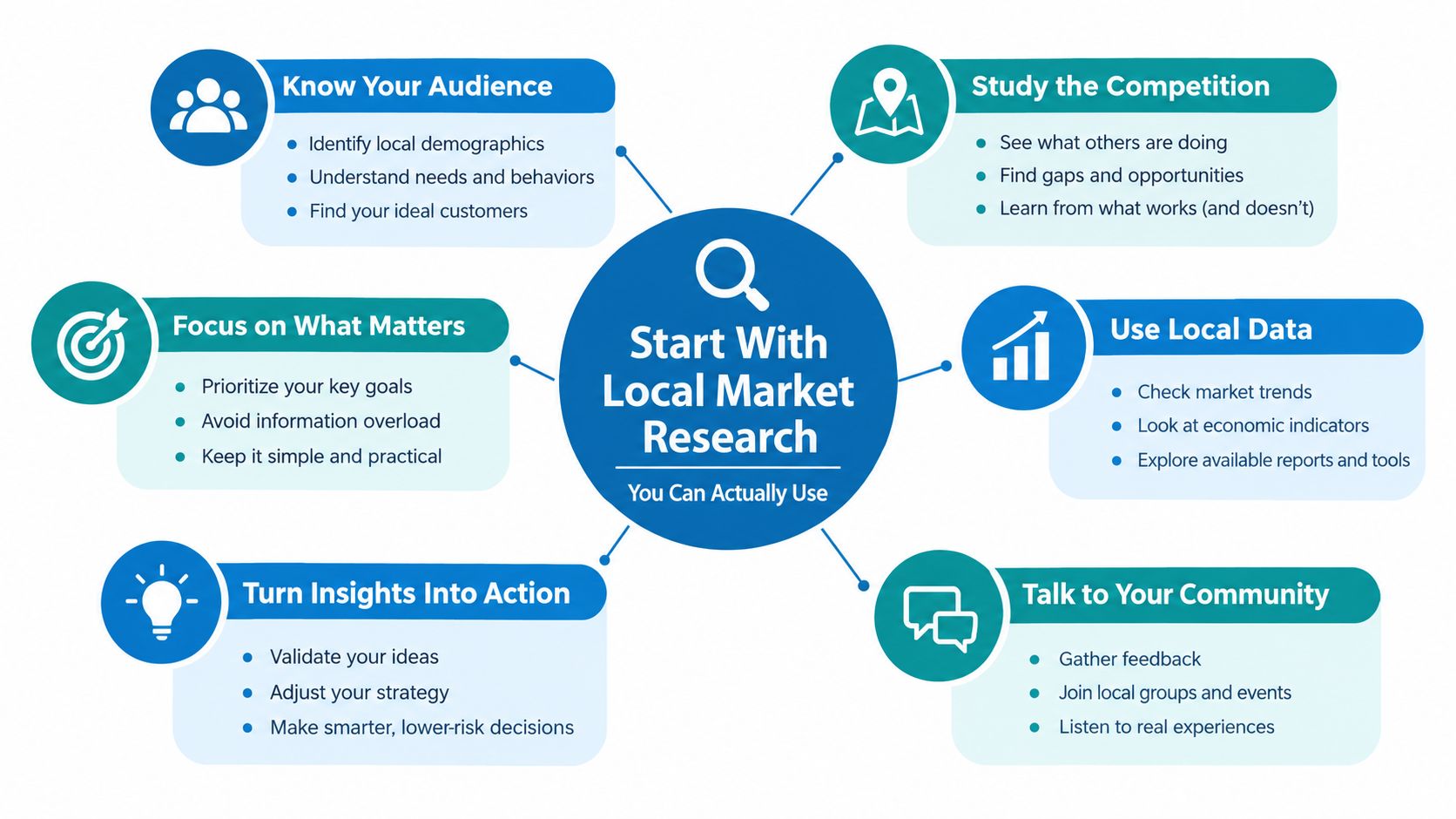
The SBA framework identifies six useful research dimensions: demand, market size, economic indicators, location, market saturation, and pricing. For a Northeast Florida real estate plan, each one should become a question you can investigate.
- Demand: Which Palm Coast, St. Augustine, and Flagler County homeowners may consider selling soon?
- Market size: How large is the owner-occupied audience?
- Economic indicators: What local employment and income conditions may affect buyer decisions?
- Location: Which neighborhoods, subdivisions, municipalities, and unincorporated areas matter?
- Saturation: Which agents and teams compete for the same homeowners?
- Pricing: What price ranges and fees do sellers and buyers encounter?
Palm Coast provides a useful baseline. The U.S. Census Bureau estimates that the city's population was 102,113 in 2023, compared with 89,258 in the 2020 Census, a 14.4% increase. The same profile reports that 80.1% of occupied housing units were owner-occupied during 2019 to 2023, with a median value of owner-occupied homes of $317,200. Those figures describe a city-level audience, not the value of any individual home. Condition, size, features, location, and comparable sales still determine a property's market position.
Turn research into local questions
Use direct research instead of relying only on instinct. The SBA lists surveys, questionnaires, focus groups, and in-depth interviews as practical methods. An agent could ask past clients why they started considering a move, interview neighbors about objections to selling, or survey relocation buyers about the information they needed before visiting Palm Coast or St. Augustine.
Housing data also needs consistent labels. Florida Realtors' market-report system provides monthly, quarterly, and annual statistics for different property types, with county and local reporting options. Use the correct geography and period when researching Flagler County real estate, Flagler Estates homes, or the St. Augustine housing market. A statewide FHFA house-price index through FRED can provide Florida-level context, but it's an index, not a dollar valuation for a specific property.
Segment Your Audience by Jobs to Be Done
A broad persona such as “local homeowner” isn't specific enough to guide a campaign. A better marketing plan identifies the job the person needs completed, the event that creates urgency, and the next action that moves the conversation forward.
| Segment | Trigger | Preferred Channel | Next Action |
|---|---|---|---|
| Homeowner considering a sale | Curiosity about current value or a change in plans | Local search and a home-value resource | Request a pricing conversation |
| Absentee property owner | Difficulty managing a local property from another area | Direct referral, email, or a local property guide | Schedule a remote consultation |
| Move-up seller | Need to sell before purchasing a different home | Search, referrals, and buyer-seller content | Discuss timing and purchase coordination |
| Downsizing or 55+ homeowner | Desire for a simpler home or different lifestyle | Personal introduction and educational content | Have a low-pressure planning conversation |
| Relocating buyer | Moving to Palm Coast, St. Augustine, or nearby communities | Neighborhood and relocation content | Arrange a relocation consultation |
| New-construction buyer | Interest in builder options, upgrades, or timelines | Community search and builder-focused guidance | Review communities and purchase steps |
The trigger matters because each group asks a different first question. An absentee owner may need confidence that communication and property logistics can happen locally. A downsizing homeowner may care more about timing, preparation, and a calm process than about aggressive promotion. A relocation buyer may need neighborhood context before discussing a particular house.
Record five details for every segment: trigger, location, urgency, objection, and next action. Add the preferred channel only after you understand the problem. This keeps the plan from becoming a collection of posts that sound identical.
The best message isn't the one that reaches everyone. It's the one that makes the right homeowner feel understood.
Use the map to create separate landing pages, email topics, neighborhood guides, and consultation offers. A page about selling a home in Palm Coast should not use the same language as a guide for someone comparing new construction near St. Augustine.
Set SMART Objectives You Can Actually Measure
“Grow visibility in Northeast Florida” sounds positive, but it doesn't tell anyone what to do next. It has no defined audience, owner, measurement, or deadline.
George T. Doran introduced the SMART framework in the November 1981 issue of Management Review, volume 70, issue 11, pages 35 to 36. The original criteria were Specific, Measurable, Assignable, Realistic, and Time-related. Modern marketing commonly adapts the wording to Specific, Measurable, Achievable, Relevant, and Time-bound, as documented in this record of Doran's SMART framework.
A stronger objective for a local real estate campaign is:
Generate 20 qualified seller consultations from Palm Coast and Flagler County homeowners during the next 90 days, with at least 60% receiving a documented pricing and preparation follow-up.
That objective identifies the audience, outcome, target, activity, and timeframe. It also gives the owner a review point. If consultations occur but follow-up documentation is missing, the issue may be operational rather than promotional.
Write one primary objective for each campaign. Possible outcomes include relocation-buyer consultations, listing presentations, referral introductions, website leads, or consultation-to-client conversion. Don't assign one campaign five competing goals. A seller campaign should primarily generate qualified seller conversations. Supporting metrics can show whether the campaign is moving people toward that result.
Review actual performance monthly against the target. Keep the objective if the audience and economics still make sense, revise the message if the wrong people respond, and change the channel only when the evidence supports that decision.
Build a Channel Portfolio, Not a Channel Checklist
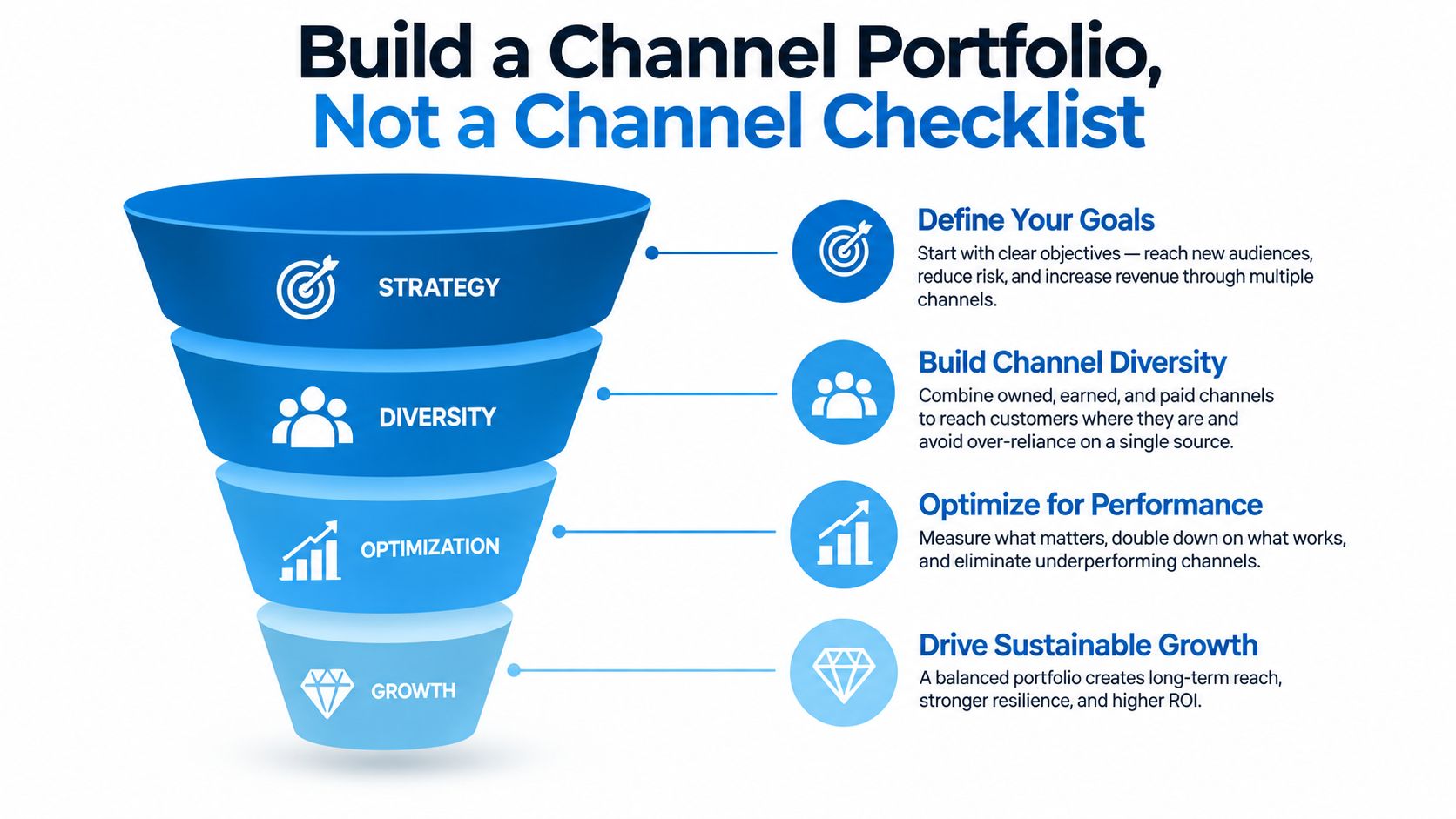
Most local businesses don't need to appear everywhere. They need a small system in which every channel has a defined role.
For a real estate marketing plan, I'd use four roles:
- High-intent discovery: Local search and a Google Business Profile help homeowners find information when they're already looking for Palm Coast home values, selling guidance, or St. Augustine real estate.
- Trust and education: Neighborhood pages, relocation guides, market explanations, and useful seller resources answer questions before a consultation.
- Owned follow-up: An email database gives the business a way to continue the conversation without relying entirely on a changing platform.
- Referral resilience: Past-client follow-up, review requests, relocation introductions, and professional partnerships create relationships that don't depend on one algorithm.
Referral activity deserves a central place. A 2025 survey reported by LocaliQ found that 65% of more than 730 small-business owners and marketers considered customer referrals their best acquisition source, rising to 75% among businesses with 10 or fewer employees. The same survey reported that 60% rated ROI as very important and 57% prioritized sales and revenue. These are survey benchmarks, not guarantees, but they support treating referrals as a measurable workstream rather than an occasional bonus.
Set a minimum cadence you can maintain. A useful local plan might prioritize one strong neighborhood resource, one seller or buyer email, and consistent referral follow-up over a flood of disconnected posts. Give each campaign an owner, budget, deadline, landing page, call to action, and tracking method.
Use a stop-loss rule. If a campaign produces clicks but no qualified conversations after its defined observation period, pause it, inspect the audience and offer, and reallocate effort only after comparing like-for-like results.
Measure Before You Spend, With a 30-Day Baseline Sprint
The first objective may be learning, not lead volume. If you don't know where inquiries originate, how quickly you respond, or where prospects stop moving, annual targets are guesses.
Run a 30-day measurement sprint before committing to a larger plan. Record:
- Inquiries: Count calls, forms, emails, direct messages, and consultation requests.
- Sources: Note Google search, a neighborhood guide, a referral, an open house, or a social post.
- Response time: Record how long it takes to make meaningful contact.
- Stages: Track inquiry, qualified lead, consultation, signed agreement, closing, and revenue.
- Audience: Label each contact as seller, absentee owner, downsizer, move-up seller, relocation buyer, or new-construction buyer.

Set attribution rules before results arrive
One prospect may read a neighborhood guide, search the business name, attend an open house, and then call after a referral. Decide how you'll credit that journey before the data becomes emotionally important. You might record both the first known source and the source that generated the consultation, rather than forcing every interaction into one label.
Track cost per lead and cost per qualified consultation, not just clicks or impressions. Return on marketing investment can be calculated as attributable gross commission contribution minus marketing cost, divided by marketing cost. The formula is useful only when source labels and revenue records are consistent.
A 2024 survey of 400 U.S. small-business owners reported successful marketing outcomes for 87% of businesses with a marketing plan, compared with 13% without one. The report characterizes that difference as 6.7 times, while also reporting that 60% of small businesses don't invest in search advertising and 61% don't invest in SEO. The result is a self-reported association, not proof that documentation alone causes success. It does support a disciplined approach: measure the local picture before copying what other businesses appear to be doing.
Your 90-Day Local Marketing Plan and Next Steps
Put the plan on one page:
- Research: Document demand, market size, economic conditions, locations, competitors, and pricing.
- Audience: Separate sellers, absentee owners, downsizers, move-up sellers, relocation buyers, and new-construction buyers.
- Objective: Give every campaign one primary outcome, an owner, a target, and a deadline.
- Portfolio: Assign roles to discovery, education, owned follow-up, and referrals.
- Measurement: Track sources, response time, qualified consultations, agreements, closings, and revenue.
Start with a manageable first quarter. During weeks one to two, establish the research file and baseline tracking. During weeks three to six, launch separate seller and buyer campaigns, such as a Palm Coast seller-value resource and a relocation guide for Palm Coast or St. Augustine. During weeks seven to twelve, review lead quality, consultation activity, response times, and full-funnel evidence. Reallocate effort only after comparing similar audiences and outcomes.
This process also improves the homeowner experience. Sellers receive clearer pricing conversations, absentee owners get a more practical remote process, downsizers can plan without pressure, and relocating buyers get information that reflects actual communities rather than generic Northeast Florida descriptions.
If you're trying to decide whether to sell, the marketing plan should begin with your situation, your property, and your timing. Local market insight is most useful when it helps you make a confident decision, whether that decision is to list now, prepare first, or wait.
Marilynn Wolfe, LLC offers local guidance for homeowners and buyers across Palm Coast, St. Augustine, Flagler County, and surrounding Northeast Florida communities. Reach out for a thoughtful home-value conversation, pricing strategy, and marketing plan built around your property and goals.