

Florida sellers typically pay roughly 7% to 10% of the sale price in closing costs, with the deed documentary stamp tax alone adding $0.70 per $100 of sale price. Several other charges, including title, closing, association, and credit items, are negotiated rather than fixed statewide.
If you're sitting at the kitchen table in Palm Coast with a preliminary net sheet, the first surprise usually isn't the sale price. It's the number of deductions underneath it. The contract may show an attractive figure, but the amount that reaches your bank account depends on taxes, payoff balances, title charges, prorations, credits, and brokerage compensation.
That's the practical answer to what closing costs do sellers pay in Florida. There isn't one flat fee. There's a stack of charges, some created by Florida law and others shaped by local custom, contract language, and the closing agent you choose.
For homeowners in Palm Coast, St. Augustine, Flagler County, Flagler Estates, and nearby communities, the right planning tool is a property-specific net sheet. A national percentage can start the conversation, but it can't tell you what your home will produce after closing.
A Quick Look at the Seller Side of a Florida Closing
A Palm Coast homeowner reviewing a preliminary seller net sheet might start with a simple calculation: expected sale price minus mortgage balance. That calculation is incomplete. The settlement statement may also show documentary stamp tax, title insurance, settlement charges, prorated property taxes, association-related fees, repair credits, and agreed brokerage compensation.
The seller side of a Florida closing is best understood line by line. The closing agent gathers the contract terms, payoff information, tax details, association figures, and title requirements, then turns them into the final accounting of the transaction.
Practical rule: Plan from the amount you expect to receive, not from the listing price printed at the top of the contract.
Palm Coast and St. Augustine have their own transaction customs, but they still operate within the same Florida framework for state charges. The allocation of title insurance, settlement fees, municipal lien searches, and certain other costs may differ based on local practice and negotiation. That distinction matters when you compare offers, especially if one buyer requests substantial credits or repair assistance.
The categories you'll see most often
A seller net sheet commonly brings together:
- State documentary stamp tax: The deed tax calculated from the consideration for the transfer.
- Title and closing charges: Owner's title insurance, settlement services, searches, recording, and related fees assigned by the contract.
- Property-tax prorations: The seller's share of the tax year through the closing date.
- Mortgage payoff: The amount required to release an existing loan at closing.
- Association charges: Estoppel information, outstanding dues, assessments, or other amounts that must be cleared.
- Credits and repairs: Contractual assistance for buyer costs or agreed repairs.
- Brokerage compensation: The amounts established in the seller's listing agreement and any negotiated buyer-side arrangement.
For an absentee owner, downsizing homeowner, or move-up seller, this accounting prevents a common mistake. Equity on paper isn't the same as cash in hand.
What Counts as a Seller Closing Cost in Florida
Seller closing costs are the expenses and adjustments deducted from the proceeds before the closing agent sends the remaining funds to you. Some are predictable. Others depend on the home, the contract, the county, the association, and the selected title company or attorney.
A useful way to organize the settlement statement is to separate statutory charges from customary or negotiable charges.
Start with the categories
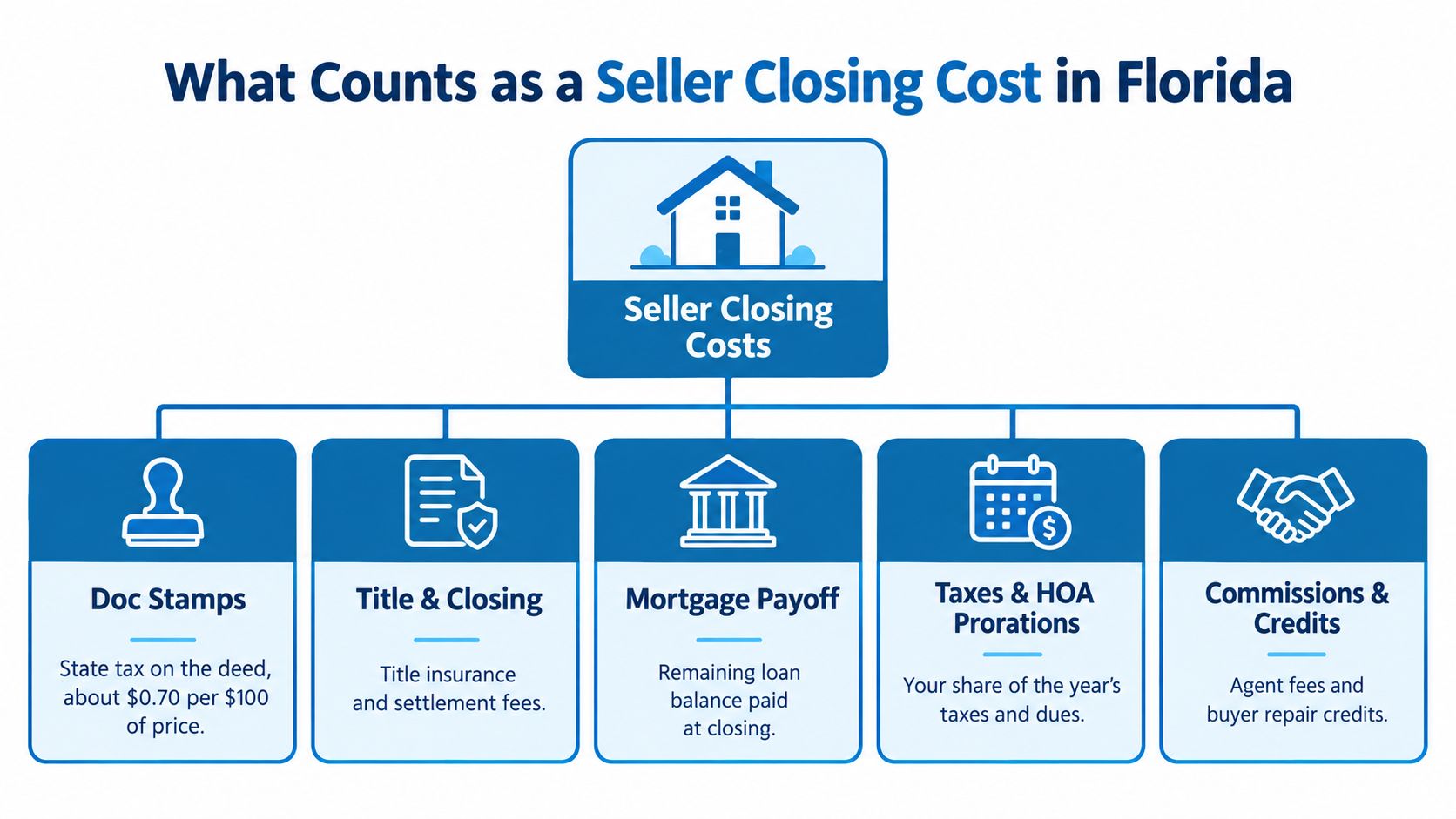
The major seller-side buckets are:
- Documentary stamp tax on the deed. Florida's Department of Revenue identifies a rate of $0.70 for every $100, or fractional portion, of consideration in every Florida county except Miami-Dade. The calculation is explained in the Florida Department of Revenue's documentary stamp tax guidance.
- Title and closing expenses. These may include owner's title insurance, settlement services, title searches, municipal lien searches, and recording or release charges, depending on the contract and local practice.
- Property-tax prorations. The closing statement allocates the seller's share of the annual taxes according to the closing date and contract method.
- Mortgage payoff. The loan balance and other payoff amounts are deducted so the lender's lien can be released.
- Association-related charges. Homeowners association or condominium amounts may include estoppel-related charges, dues, assessments, violations, or balances that need to be resolved.
- Credits and concessions. A seller may agree to help with repairs or buyer closing expenses as part of the negotiated contract.
- Brokerage compensation. The listing agreement and transaction negotiations establish the applicable compensation.
A rough planning expectation for Florida sellers is about 7% to 10% of the sale price, but that range should never replace a custom estimate. It can include brokerage compensation and negotiated concessions, not just traditional closing charges. The total changes with the property and contract.
The key question isn't whether a generic calculator gives you a percentage. Ask whether the estimate includes your payoff, tax proration, association documents, credits, title allocation, and negotiated compensation.
The Documentary Stamp Tax on the Deed
Florida's documentary stamp tax, commonly called Florida doc stamps, is usually the most predictable seller-paid closing expense. The Department of Revenue states that a deed transferring an interest in Florida real property is taxed at $0.70 for every $100, or fractional portion, of the total consideration paid or to be paid. The Florida statute identifies deeds and other instruments conveying real property as taxable documents.
For sellers in Palm Coast, St. Augustine, Flagler County, and most of Northeast Florida, the standard statewide rate applies because the exception is Miami-Dade. This isn't a local Palm Coast fee or a Flagler County fee. It's a state charge tied to the transfer documented by the deed.
The math is straightforward
Use the sale consideration, divide it by $100, then multiply by $0.70:
- A $300,000 sale produces $2,100 in documentary stamp tax.
- A $400,000 sale produces $2,800 in documentary stamp tax.
- A $600,000 sale produces $4,200 in documentary stamp tax.
The Department of Revenue's explanation of the rate and taxable consideration is available in its Florida documentary stamp tax reference.
What the tax is not based on
Doc stamps are not calculated from your profit. They aren't reduced because the buyer makes a small down payment, and they aren't reduced because you still owe a large mortgage. A remaining loan doesn't lower the taxable sale amount.
That distinction catches sellers off guard. If you bought a Palm Coast home years ago and still have a substantial payoff balance, the tax calculation still relates to the consideration for the transfer. The mortgage payoff is a separate deduction on the settlement statement.
Credits and unusual deal structures require closer review. Seller-paid buyer costs, non-cash consideration, and other contract terms may affect how the taxable consideration is evaluated. Don't rely on a price-only estimate when the transaction includes unusual terms. Ask the closing agent to confirm the calculation before you sign the final statement.
Title Insurance, Closing Fees, and Other Negotiated Charges
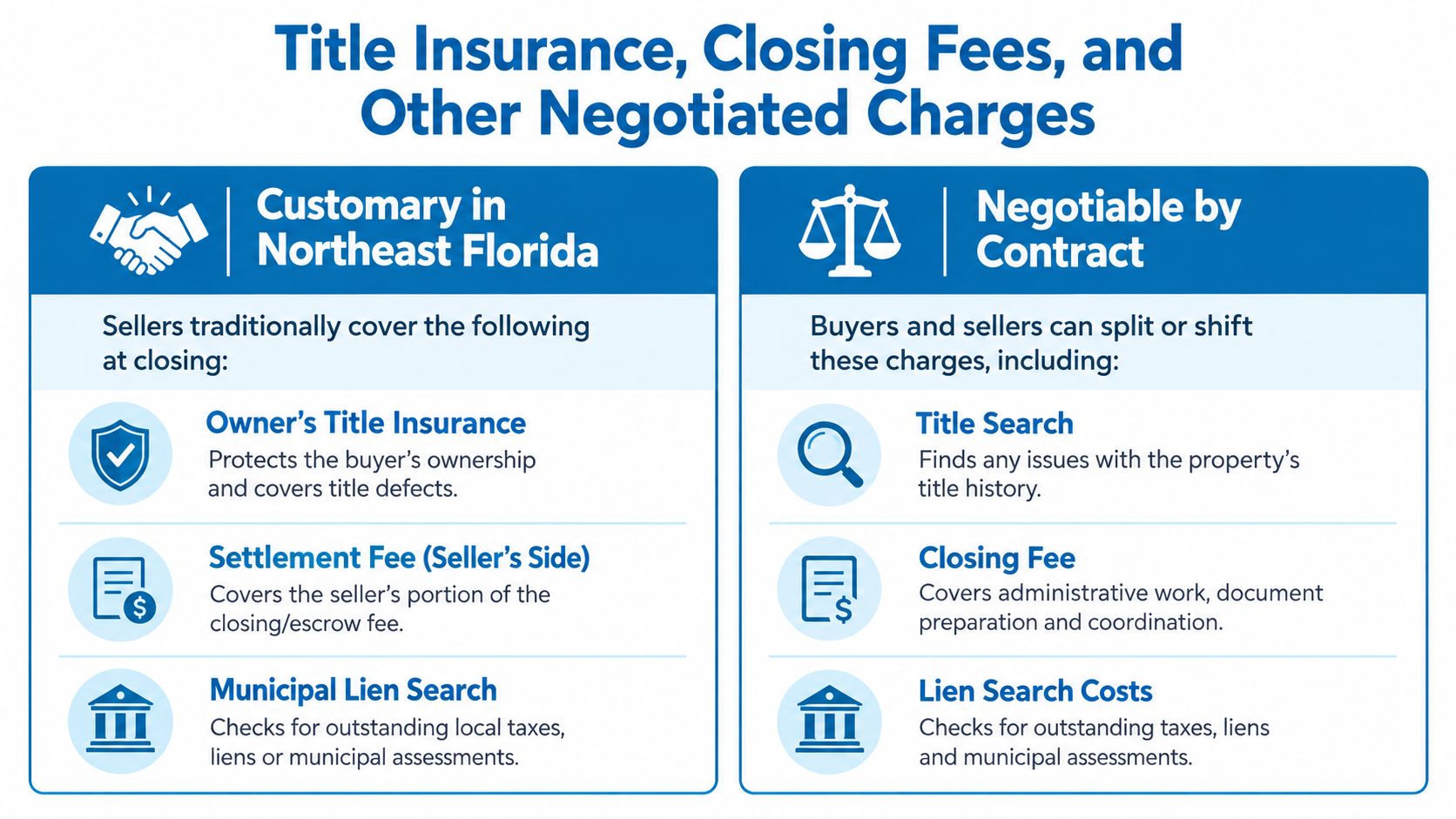
The cleanest way to understand Florida seller costs is to place doc stamps on one side of the page and local transaction charges on the other. The deed tax follows a statewide statutory rate in most counties. Title insurance, settlement fees, municipal lien searches, and related charges can depend on local custom and contract language.
In Northeast Florida, sellers may commonly pay an owner's title insurance premium and some settlement-related charges, but custom isn't the same thing as law. A buyer and seller can negotiate who pays, splits, or shifts certain expenses. The contract should control the outcome.
Customary does not mean mandatory
In Palm Coast and St. Augustine, a preliminary net sheet may show:
- Owner's title insurance: Coverage that protects the buyer's ownership interest against covered title problems, with payment responsibility often addressed through local custom and negotiation.
- Settlement or closing fee: The closing agent's charge for coordinating documents, funds, signatures, and disbursement.
- Title search or examination: Work to review the ownership history and identify title issues.
- Municipal lien search: Research into municipal charges or claims that may need resolution before transfer.
- Recording or release fees: Charges connected with recording documents or releasing an existing lien.
The precise allocation may differ between a Palm Coast property and a St. Augustine property, and it may also differ between two contracts in the same neighborhood. The selected closing agent's fee sheet matters too.
Ask for a separated estimate
Request a preliminary seller net sheet before listing or as soon as you have an offer. Ask the closing agent to identify which charges are statutory, which are customary, and which come directly from negotiated contract terms.
That separation gives you something useful to discuss. You can review whether a higher offer is being offset by large credits, whether the title allocation is clear, and whether the settlement charges match the actual transaction rather than a generic Florida estimate.
Prorations, Mortgage Payoff, and Repair Credits
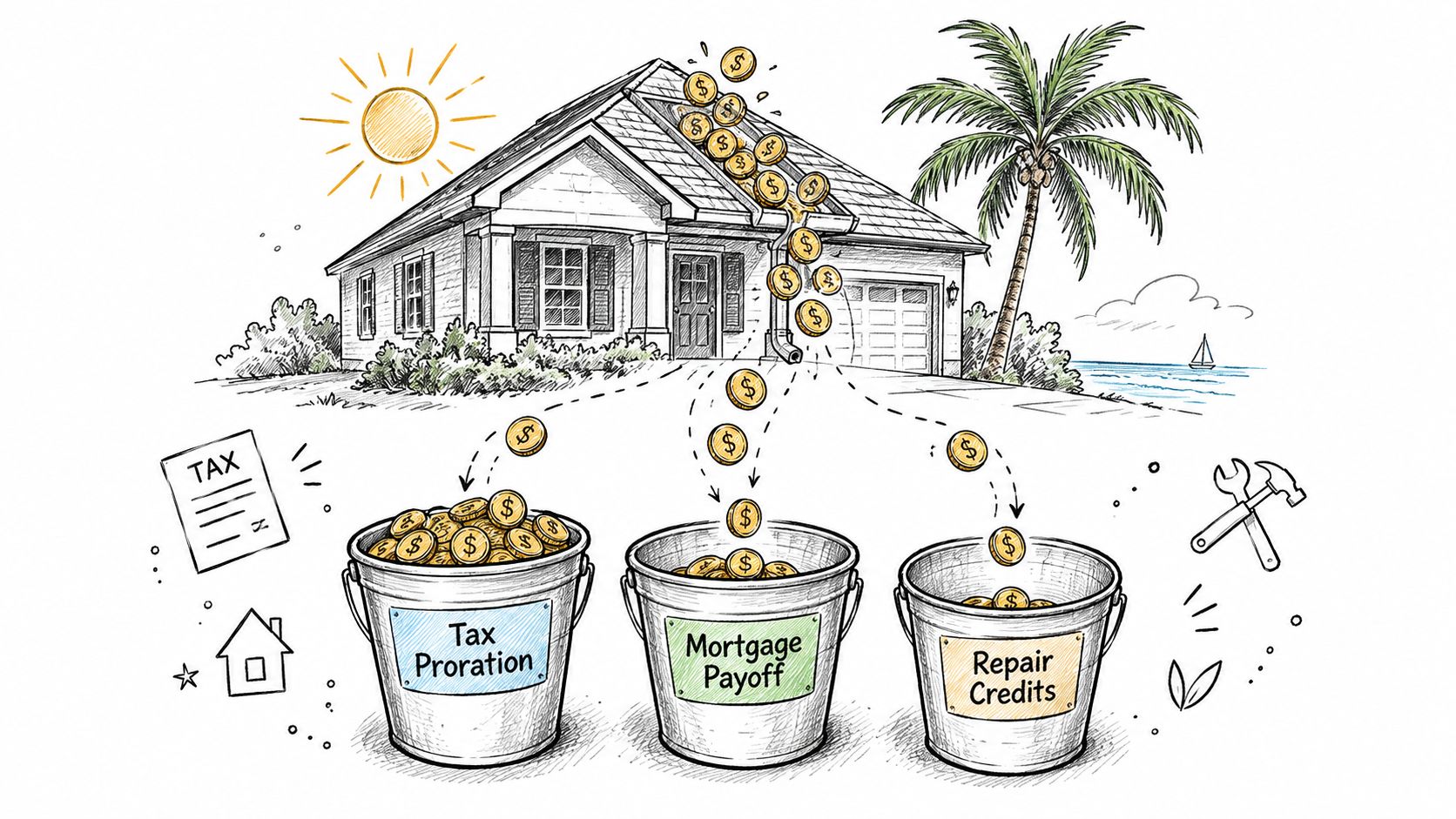
Some deductions are less visible during pricing conversations because they don't appear as a single obvious fee. They emerge from timing, ownership obligations, and contract negotiations. Property-tax prorations, loan payoffs, association balances, and repair credits can all reduce the amount wired to the seller.
Property taxes follow the closing date
Florida property taxes are generally paid in arrears. Because the final annual bill may not be available when the transaction closes, the settlement statement typically credits the buyer for the seller's share from January 1 through the day before closing, using the proration method established by the contract.
The actual adjustment depends on the assessed property, annual tax bill, closing date, and contract language. A seller preparing to list a Palm Coast or Flagler County home should request a current tax estimate and understand that the credit can reduce proceeds even when no new bill has arrived. A Florida seller net sheet reference describes this common contract-practice treatment.
The payoff removes one obligation, not all obligations
Your mortgage payoff is deducted from the proceeds so the lender's lien can be cleared. Paying off the loan doesn't eliminate doc stamps, brokerage compensation, title charges, taxes, association amounts, or buyer credits. It removes the loan balance from the calculation and leaves the rest of the seller obligations in place.
Association-related deductions deserve the same attention. An estoppel request may reveal unpaid dues, violations, or special assessments that must be addressed before transfer. The association's records and the contract determine how those items are handled.
For absentee owners: The settlement statement is your local financial snapshot. It can expose a tax credit, association balance, or negotiated repair obligation that you might miss while managing the sale from outside Northeast Florida.
Repair credits and buyer-cost contributions are also negotiated deductions. They can help keep a transaction together, but they reduce net proceeds. Before accepting an offer, compare the entire financial package, not only the contract price.
The Florida seller closing cost and net proceeds overview also identifies mortgage payoff, brokerage compensation, assigned title or closing charges, prorated taxes, buyer credits, association-related charges, and recording or release fees as common settlement deductions.
Here's a short video perspective on the relationship between sale price, deductions, and proceeds:
A Worked Example for a Palm Coast Home
A useful net sheet doesn't pretend every line is known before the contract. It identifies what can be calculated immediately, then leaves clearly marked spaces for the items that depend on the property, closing date, lender, association, and negotiated terms.
Consider a Palm Coast home with an expected sale price of $425,000. The deed documentary stamp tax is easy to calculate at the standard Northeast Florida rate:
$425,000 ÷ $100 × $0.70 = $2,975
The remaining lines require property-specific information. A preliminary worksheet might look like this:
| Seller-side item | Treatment in the estimate |
|---|---|
| Sale price | $425,000 |
| Documentary stamp tax | $2,975, calculated from the stated Florida rate |
| Owner's title insurance | Confirm with the closing agent and contract |
| Settlement fee | Confirm with the selected closing agent |
| Recording or release charges | Confirm documents and lien releases required |
| Property-tax proration | Calculate from the latest tax information and closing date |
| Mortgage payoff | Obtain a current payoff statement from the lender |
| Association estoppel or balance | Request association figures if applicable |
| Repair or buyer-cost credit | Use the exact amount negotiated in the contract |
| Brokerage compensation | Use the listing agreement and any separately negotiated arrangement |
This example intentionally leaves the variable charges open rather than inventing figures. A title premium isn't the same for every home, a tax credit changes with the closing date, and a mortgage payoff can't be estimated reliably from an old loan statement. The same applies to association charges and repair credits.
What the final calculation tells you
The net proceeds formula is:
Sale price minus documentary stamp tax, title and closing charges, prorated taxes, mortgage payoff, association amounts, credits, recording or release charges, and brokerage compensation.
For this Palm Coast example, the only fixed dollar figure available from the stated sale price is the $2,975 deed tax. The closing agent and listing agent should then fill in the remaining lines from actual documents and contract terms.
That is the important planning lesson. A higher price doesn't automatically create a higher net if it comes with large credits, repair obligations, payoff-related charges, or other deductions. A preliminary seller net sheet gives you a defensible estimate before you commit to a price or accept an offer.
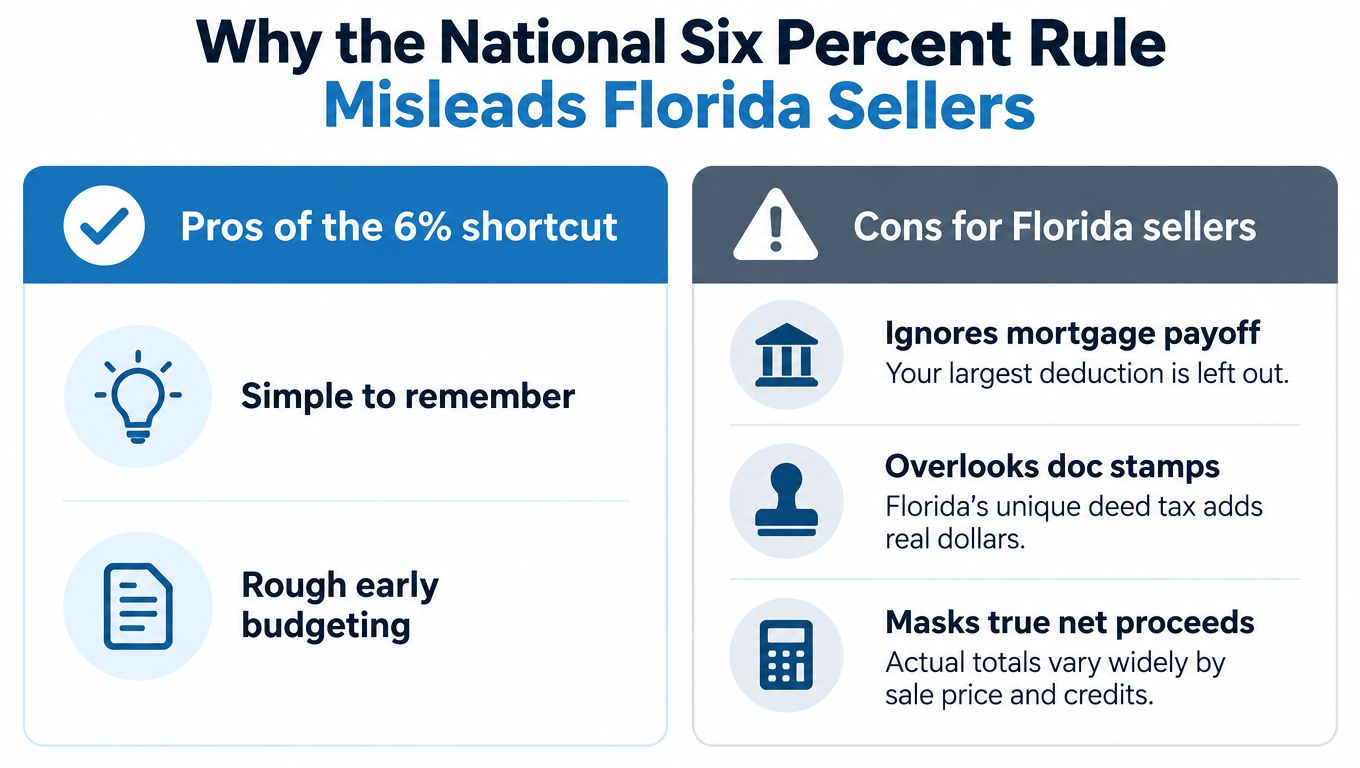
Why the National Six Percent Rule Misleads Florida Sellers
The familiar six percent shortcut is easy to remember, but it isn't a reliable Florida seller net sheet. It can blur together brokerage compensation and closing costs while leaving out charges that appear separately on the settlement statement.
For a Palm Coast or St. Augustine seller, the shortcut can overlook the deed documentary stamp tax, property-tax proration, association charges, title allocation, recording or release fees, and negotiated buyer credits. It also doesn't account for the fact that brokerage compensation is established through agreements and negotiations rather than one universal Florida rule.
Use the shortcut only as an early conversation
A rough percentage can help a homeowner understand that the sale price won't equal the wire transfer. It cannot tell you whether your contract assigns owner's title insurance to you, whether your Flagler County property has association obligations, or how much tax credit will apply on the closing date.
Build the estimate from documents instead:
- Contract terms: Confirm who pays title, closing, search, credit, and repair items.
- Current payoff: Use the lender's payoff statement rather than an old balance.
- Latest tax information: Give the closing agent a basis for calculating the proration.
- Association records: Identify dues, assessments, violations, and estoppel charges.
- Closing agent fee sheet: Review the actual charges for the transaction.
The national rule is a starting point at best. Your property-specific net sheet is the number that should guide pricing and offer comparisons.
Planning Your Own Net Sheet in Northeast Florida
Before listing a Palm Coast, St. Augustine, or Flagler Estates property, take three practical steps:
- Request a preliminary seller net sheet from a local closing agent and separate statutory charges from negotiable ones.
- Gather your current property-tax bill and association documents, including any information about dues, assessments, violations, or balances.
- Review the contract allocation for title, closing, credits, repairs, prorations, and brokerage compensation with your listing agent.
Florida's documentary stamp tax is predictable. The remaining deductions depend on the home, contract, lender, association, closing date, and closing agent. That's why a custom estimate beats a national rule of thumb for anyone selling in the Northeast Florida real estate market.
Marilynn Wolfe, LLC helps Palm Coast, St. Augustine, Flagler County, and surrounding Northeast Florida homeowners evaluate pricing, prepare for negotiation, and understand the net proceeds behind an offer. Visit Marilynn Wolfe, LLC to request local guidance and a personalized home value and seller net sheet, or contact Marilynn Wolfe at 904-429-2829 or marilynnwolfe.realtor@gmail.com.