

If you've accepted an offer on your home in Palm Coast or St. Augustine and your next thought is, "What will I walk away with at closing?", you're asking the right question. Most homeowners focus on the sale price first, then get surprised when the settlement statement shows a list of deductions they hadn't fully modeled.
That happens all the time in Palm Coast real estate, St. Augustine real estate, and across Flagler County real estate. A seller sees a strong number on paper, but closing day is where the math shows up. Loan payoff, commissions, taxes, deed charges, prorations, credits, and lien issues all affect what lands in your account.
The good news is that seller costs at closing aren't random. They're a collection of specific line items, some set by contract, some tied to Florida rules, and some driven by your property and negotiation strategy. If you understand them early, you can plan your next move with much more confidence, whether you're downsizing, relocating, selling an inherited home, or buying again in Northeast Florida.
What Sellers Really Want to Know Before Closing Day
A homeowner in Flagler County accepts an offer and feels relief for about a day. Then the practical questions start. How much is the mortgage payoff? Who pays for what? Why is the number on the settlement statement lower than the contract price?
That's the moment when seller costs at closing stop feeling abstract.
The number most sellers care about
Most sellers don't want a list of fees. They want net proceeds, the amount left after everything is paid. That's especially true for move-up sellers watching their down payment for the next purchase, absentee owners trying to settle an estate or rental sale cleanly, and 55+ homeowners planning a transition into a simpler lifestyle.
A closing statement doesn't show one “closing cost” fee. It usually shows multiple deductions. The seller's side commonly includes existing loan payoff, the seller's share of property taxes, broker commissions, deed preparation charges, cancellation of existing liens, and state revenue stamps, as described in the North Carolina Real Estate Commission closing overview. That's why your equity estimate and your actual proceeds are rarely the same number.
Practical rule: The sale price tells you what the property sold for. The settlement statement tells you what you kept.
Why local sellers get caught off guard
In my experience, homeowners preparing for selling a home in Palm Coast often spend far more time thinking about paint colors, showing schedules, and whether their pricing strategy matches current Palm Coast real estate market trends than they do reviewing closing charges. That's understandable. The listing phase feels urgent. The deductions feel far away.
They're not far away. They're already built into the deal the moment you go under contract.
A seller who understands the likely categories early can make better choices before problems become expensive. That includes how to price, whether to offer repairs, whether a concession makes more sense than a reduction, and how to schedule the closing date if timing matters for taxes, HOA dues, or a simultaneous move.
The Major Line Items Every Seller Should Expect
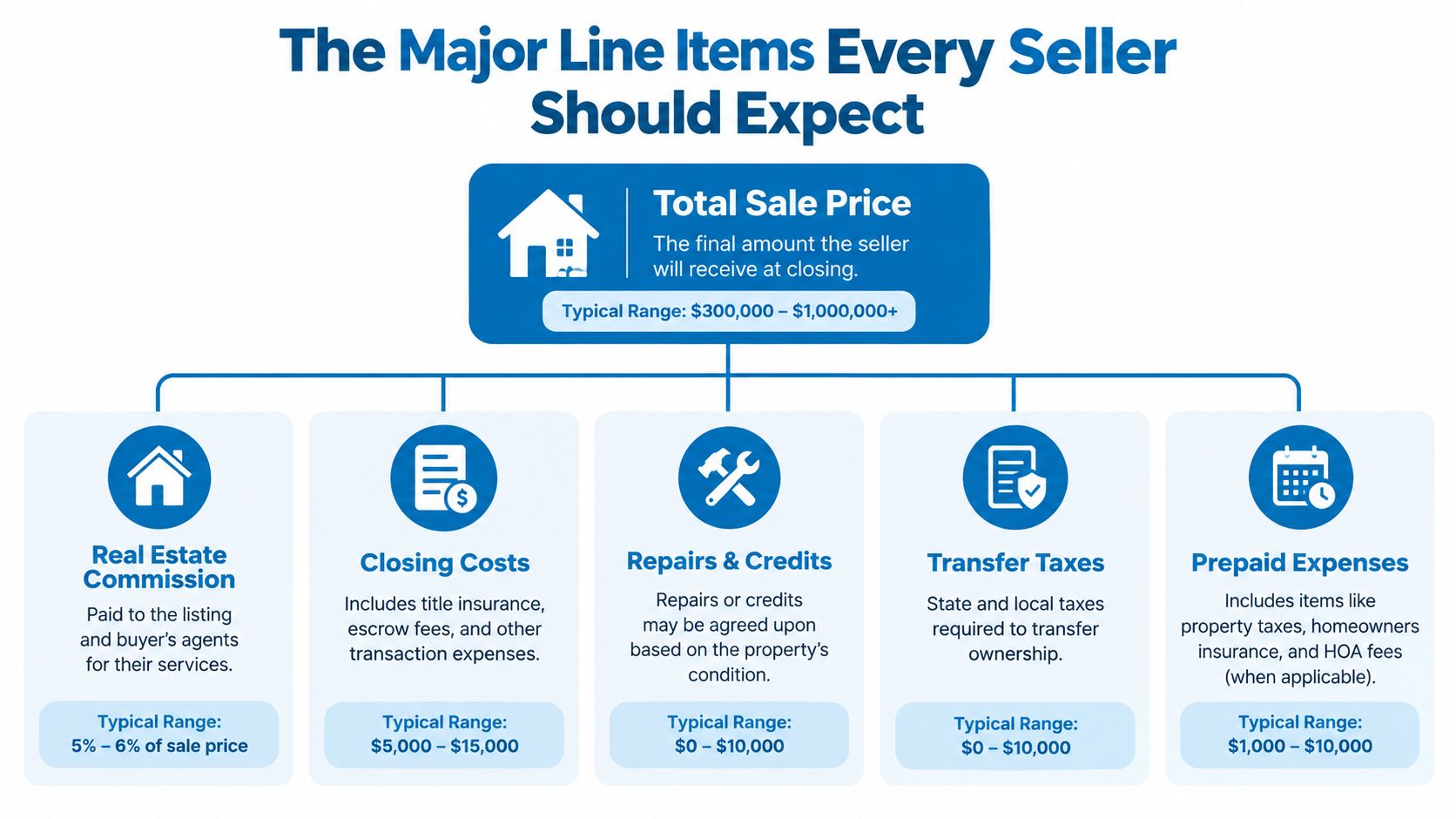
The first draft settlement statement lands in your inbox, and it reads like a spreadsheet written in a foreign language. It isn't. Every deduction falls into a category you can recognize, and once you can name the category, you can judge whether the number is fair.
The charges that usually matter most
Four items drive most of the gap between your sale price and your actual proceeds:
- Broker compensation: Often the largest seller-side cost, set by the listing agreement and the contract structure. This is the line worth negotiating hardest, and the next section covers how that conversation has changed.
- Mortgage payoff: Your lender payoff is not the balance on your last statement. It includes accrued interest and other amounts due through the payoff date, so request the payoff figure early rather than estimating it.
- Florida documentary stamp tax on the deed: $0.70 per $100 of consideration in Flagler County, roughly $2,100 on a $300,000 sale. This is a state tax on the transfer itself, and it is not negotiable.
- Prorations and credits: These adjust the math based on closing date, property taxes, dues, and negotiated terms. They can move money in either direction depending on when you close.
Below those, expect deed preparation charges, recording fees, and costs tied to clearing title, including old liens or other recorded obligations that must be resolved before clear title can transfer.
What each line is really paying for
Some charges pay for services, such as preparing documents and handling closing administration. Others pay off existing obligations, like your mortgage or liens. Others are government charges, including the documentary stamp tax and recording fees. And some are contract adjustments between buyer and seller.
That distinction matters because flexibility varies by category. You can negotiate compensation and concessions. You can sometimes shift a proration by moving the closing date. You cannot negotiate the state's stamp tax, and arguing over a small document prep fee rarely pays for the phone call.
Sellers usually save the most money by focusing on the handful of charges that are negotiable or avoidable, not by arguing over the smallest administrative line.
For homeowners selling in St. Augustine housing market conditions or anywhere in Flagler County, this preparation pays off in the final week. When you already know what each category means, the settlement statement stops looking like a surprise invoice and starts looking like a checklist you can work through line by line.
Understanding Commissions After the NAR Settlement
A Palm Coast homeowner called me last spring, already braced to pay a fixed 6% because "that's just what it costs." She had priced her move around a number nobody was required to charge her. That conversation is now the norm, and sellers who walk into it with an outdated script leave money on the table.
What the old structure looked like
Historically, real estate commissions often ran about 5% to 6% of the home's purchase price, per the Florida Revenue reference document. On a $350,000 sale, that works out to $17,500 at 5% or $21,000 at 6%. On a $400,000 sale, even a one-percentage-point difference equals $4,000, a meaningful amount for any seller making a move.
Why sellers need a real negotiation now
The compensation structure began changing after a 2024 federal jury verdict involving the National Association of Realtors and several large brokerages, followed by a settlement requiring changes to how compensation and seller concessions could be communicated and negotiated.
Commissions still exist. What changed is that a historical range is no longer an automatic charge, and treating it that way costs you.
In practice, the amount depends on the listing agreement, the services being provided, any buyer-broker arrangement, any seller concessions, and local conditions in places like Palm Coast, St. Augustine, and nearby communities. A home that needs aggressive marketing, pricing discipline, and negotiation support may justify a different structure than a straightforward sale with unusually strong demand. I've seen the same property support two very different fee structures depending on the marketing plan attached to them.
A smart commission conversation isn't just "What percent is it?" It's "What work is being done, what exposure will the property get, and how does that structure affect my net?"
That's the level of detail sellers deserve before they sign.
Florida Documentary Stamp Tax for Sellers in Flagler County
Among all seller costs at closing, Florida documentary stamp tax on the deed is one of the easiest to estimate in advance. It's also one of the most overlooked by homeowners who try to project net proceeds from memory. If you're selling in Palm Coast or anywhere in Flagler County, this is a number you can pin down before you ever list.
How the tax works in most Florida counties
The Florida Department of Revenue documentary stamp tax rules state that transfers of real-property interests are taxed at $0.70 for each $100, or portion of $100, of total consideration in every Florida county except Miami-Dade. In practical terms, that equals 0.70% of the transaction value.
For sellers in Palm Coast, Flagler County, and surrounding Northeast Florida communities, that creates a predictable baseline expense.
| Sale Price | Estimated Deed Stamp Tax |
|---|---|
| $300,000 | $2,100 |
| $400,000 | $2,800 |
Those examples follow the same per-$100 math, so you can run the figure for any price point yourself.
What sellers often miss
This tax is based on total consideration, not on your net proceeds and not on what's left after your mortgage is paid. So if you have a large loan payoff, moving expenses, repair credits, or other deductions, the deed stamps are still calculated from the sale price consideration. A seller with a big payoff balance still pays stamps on the full sale amount, and that surprises people who budgeted from their expected net.
Florida law makes all parties to the taxable document legally liable, but the contract decides who pays. In customary Florida residential transactions, the seller generally pays the deed stamps, per the state's documentary stamp rules.
That's why I like sellers to treat deed stamps as a fixed planning number early. In Flagler County real estate, it's one of the clearest examples of a Florida-specific closing cost that should be confirmed in the contract, then carried into your net sheet from the start.
Prorations and Prepaid Items at Closing
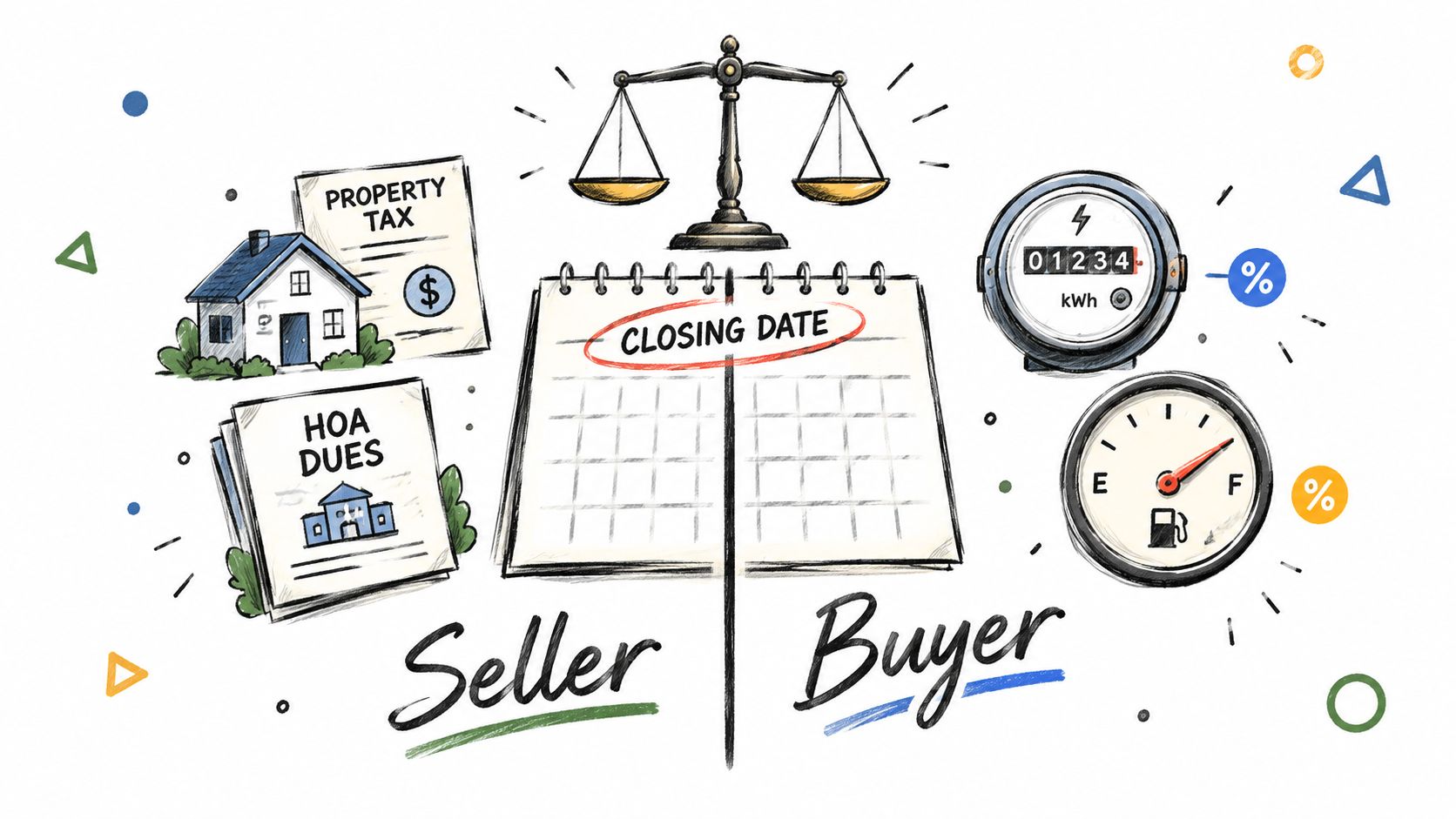
Prorations are the quiet line items that confuse sellers because they don't feel like fees. They're really time-based adjustments between buyer and seller based on who owned the property when.
What gets prorated
The most common prorations involve property taxes and community charges such as HOA dues or, in some neighborhoods, CDD-related amounts. Depending on the property, there can also be adjustments for items such as utilities or fuel if those accounts are handled through closing rather than separately.
If a seller closes partway through a billing period, each side pays for their share of time. That's the basic idea.
Why the closing date matters
If you close on the 15th of the month, the settlement statement may allocate the earlier part of that period to the seller and the remaining part to the buyer. The exact math depends on the item being prorated and how the closing agent prepares the statement, but the principle is simple. You pay for the period you owned or used the property.
That matters in communities throughout Palm Coast, St. Augustine, and areas with newer development patterns, including places where buyers may also be comparing Flagler Estates homes or other properties with additional community-related costs.
Check the proration dates, not just the dollar amounts. A small date error can create an unnecessary charge.
When I review a statement, I look first at whether the ownership period is correct. Sellers can catch mistakes here more easily than they think, especially if they already know the billing cycle for taxes, dues, or any special community charge.
Concessions, Repair Credits, and Price Reductions
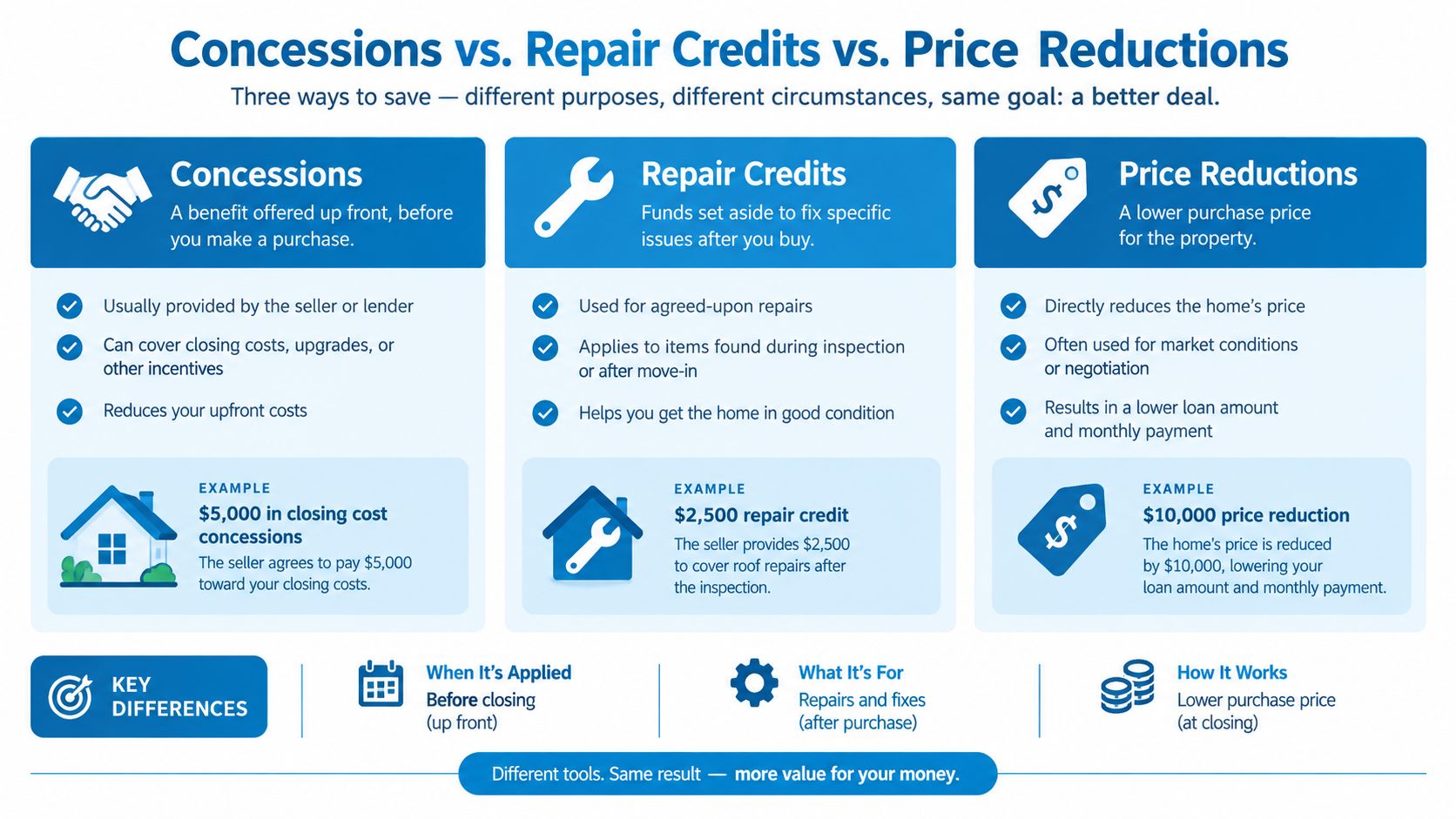
Sellers often treat concessions as a side issue. They're not. They're one of the biggest strategic choices in a deal because they change both your proceeds and the buyer's ability to close.
The numbers you may see in the market
Coverage referenced by Homes.com on closing costs and concessions notes that 24% of sellers offered concessions in 2024, down from 33% in 2023, while another recent estimate placed concessions at roughly 44% of U.S. sales in Q1 2025. Those figures don't match because the definitions and datasets differ, and that's exactly why broad headlines can mislead sellers.
A concession can cover buyer closing costs, prepaid expenses, repairs, or an interest-rate buydown. But the value to the buyer isn't always equal to the cost to the seller. Loan limits, appraisal issues, buyer cash position, and the wording of the contract all affect whether the concession works the way people expect.
Which option usually works better
A seller in the Palm Coast real estate market might be deciding between four moves:
- A price reduction if the home is overpriced relative to buyer response.
- A repair credit when the issue is specific and the buyer wants flexibility.
- A closing-cost concession if buyer cash is the obstacle.
- A rate buydown contribution if lowering payment helps the buyer more than lowering price.
What doesn't work is choosing one by habit. The better question is which option gives the strongest net while keeping the deal together. In some cases, a lower price creates appraisal complications. In others, a repair credit is cleaner. Sometimes helping with closing costs solves the problem faster than changing the list price.
That's why I prefer to compare these options on the seller's actual estimated net, not on guesswork.
Reading the Settlement Statement Before You Sign
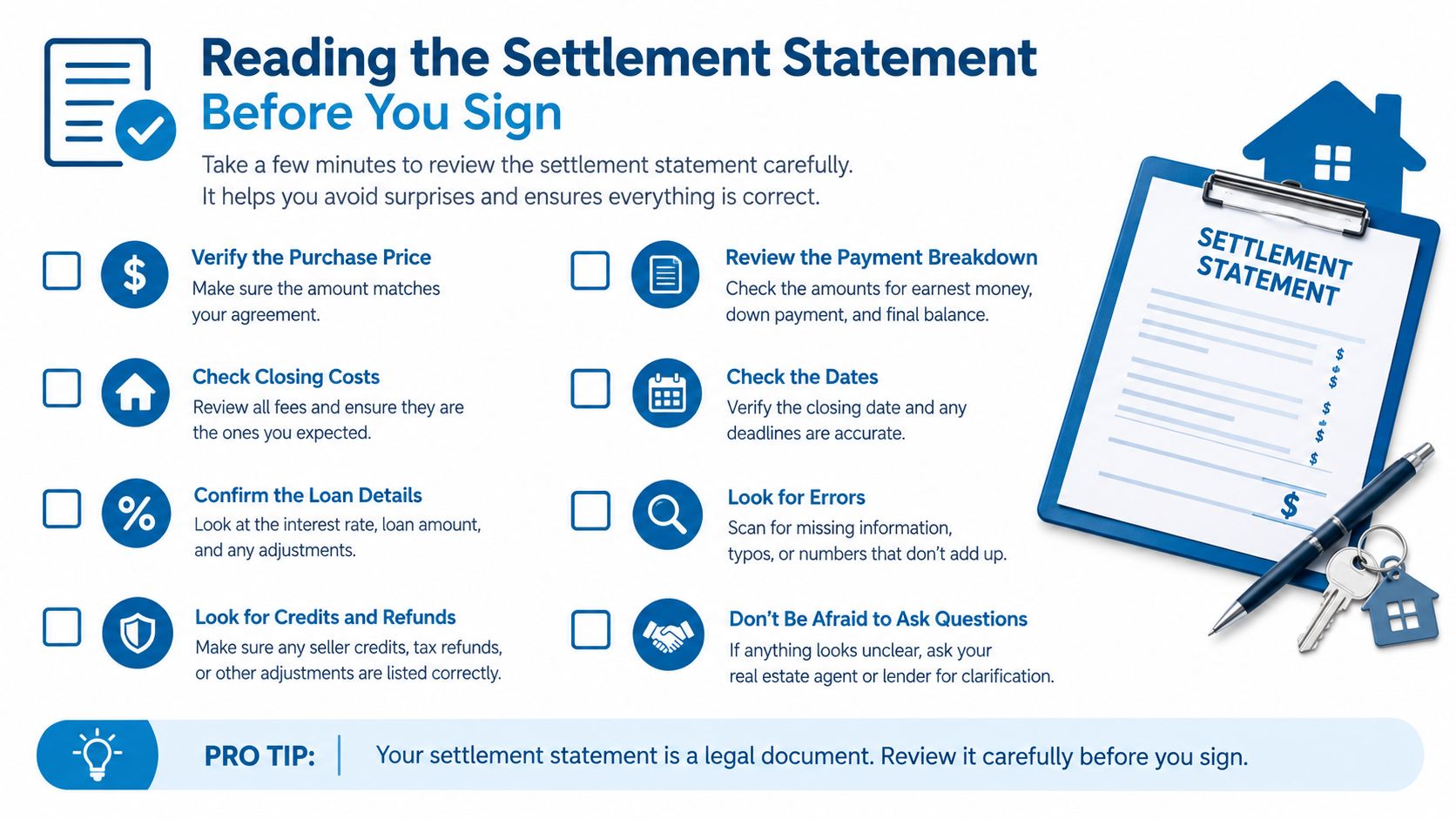
The final review is where sellers either protect their proceeds or leave money on the table. By closing week, the habit that matters is simple. Compare the preliminary version and the final version line by line, and ask about anything that moved.
What deserves your attention first
For federally insured mortgage transactions, settlement information is disclosed through standardized Closing Disclosure forms. The seller's disclosure summarizes funds received and expenses paid by the seller, and it identifies items such as recording fees, loan payoffs, title-related charges, taxes, and other transaction costs. As noted earlier, the CFPB publishes a sample seller disclosure that shows how these line items are laid out, and it's worth keeping that format in mind when your own statement arrives.
The items sellers should verify
Use this checklist before signing:
- Mortgage payoff: Confirm it matches the lender's official payoff, not just your monthly statement balance.
- Recording charges: Confirm the deed recording fee matches the county's published rate, and check that no mortgage recording charge for the buyer's loan was shifted to your side of the statement.
- Broker compensation and credits: Make sure the negotiated terms are reflected accurately, including any agreed buyer-broker compensation.
- Tax prorations and title items: Check dates and descriptions against the contract.
- Liens or payoff issues: Unpaid judgments, contractor claims, or other recorded obligations can reduce proceeds or delay closing.
If a number changed from the earlier estimate, ask why before you sign. Most closing issues are easier to fix before funds are disbursed.
That one review can prevent avoidable surprises.
Practical Tips to Lower Your Out-of-Pocket Closing Costs
The best way to manage seller costs at closing is to start before the sign goes in the yard. Once a property is under contract, your options narrow. Before that, you have an advantage.
Where sellers can be proactive
The first place to start is commission structure. Don't treat it like a standard package you're supposed to accept without discussion. Ask how the service model works, how the property will be marketed, how buyer-broker compensation is being handled in the current environment, and what that means for your likely net in the current St. Augustine housing market or Palm Coast home values conversation.
The next move is your closing date. Sellers often choose a date based only on convenience, but timing can affect prorations and your moving plan. If the date creates unnecessary overlap with taxes, dues, or your next housing payment, that should be part of the discussion early.
Small decisions that protect your net
I also encourage sellers to deal with known issues before they become emergency negotiations.
- Handle obvious repairs early: A buyer who discovers a problem late often asks for a broad credit. A seller who addresses the issue ahead of time usually keeps more control.
- Review title and payoff items sooner: If there's an old lien, judgment, or payoff discrepancy, solving it before the final week reduces closing risk.
- Model credits against reductions: Don't assume a lower price is always the cleanest answer. Sometimes a targeted concession keeps the contract stronger.
- Read the preliminary settlement statement in advance: Incorrect prorations, unexpected charges, or missing contract terms are easiest to catch here.
For absentee owners, inherited-property sellers, and homeowners balancing a sale with a purchase, this preparation matters even more. You're not just trying to close. You're trying to close cleanly, on time, and with the least disruption to your next step.
Sellers who do best in Northeast Florida usually make decisions from a net sheet, not from a headline sale price.
That's especially true across Palm Coast real estate, St. Augustine real estate, and nearby communities where buyer expectations, neighborhood condition, and pricing strategy all shape negotiations differently. A seller in a 55+ community may care most about timing and certainty. A move-up seller may care most about preserving cash for the next purchase. An out-of-area owner may value simplicity above all else.
Different goals call for different choices, but the principle stays the same. If you know the likely charges before you list, you'll make stronger decisions all the way through closing.
If you'd like to understand what your home might realistically net in today's market, it helps to look at your property, your timing, and your likely contract structure together. That's how you turn a rough estimate into a useful plan.
Marilynn Wolfe, LLC offers personalized home value guidance, seller net-proceeds planning, and local market insight for homeowners in Palm Coast, St. Augustine, Flagler County, and surrounding Northeast Florida communities. If you want a clear look at what you may pay at closing and what you could realistically walk away with, visit Marilynn Wolfe, LLC or reach out directly at 904-429-2829 or marilynnwolfe.realtor@gmail.com.