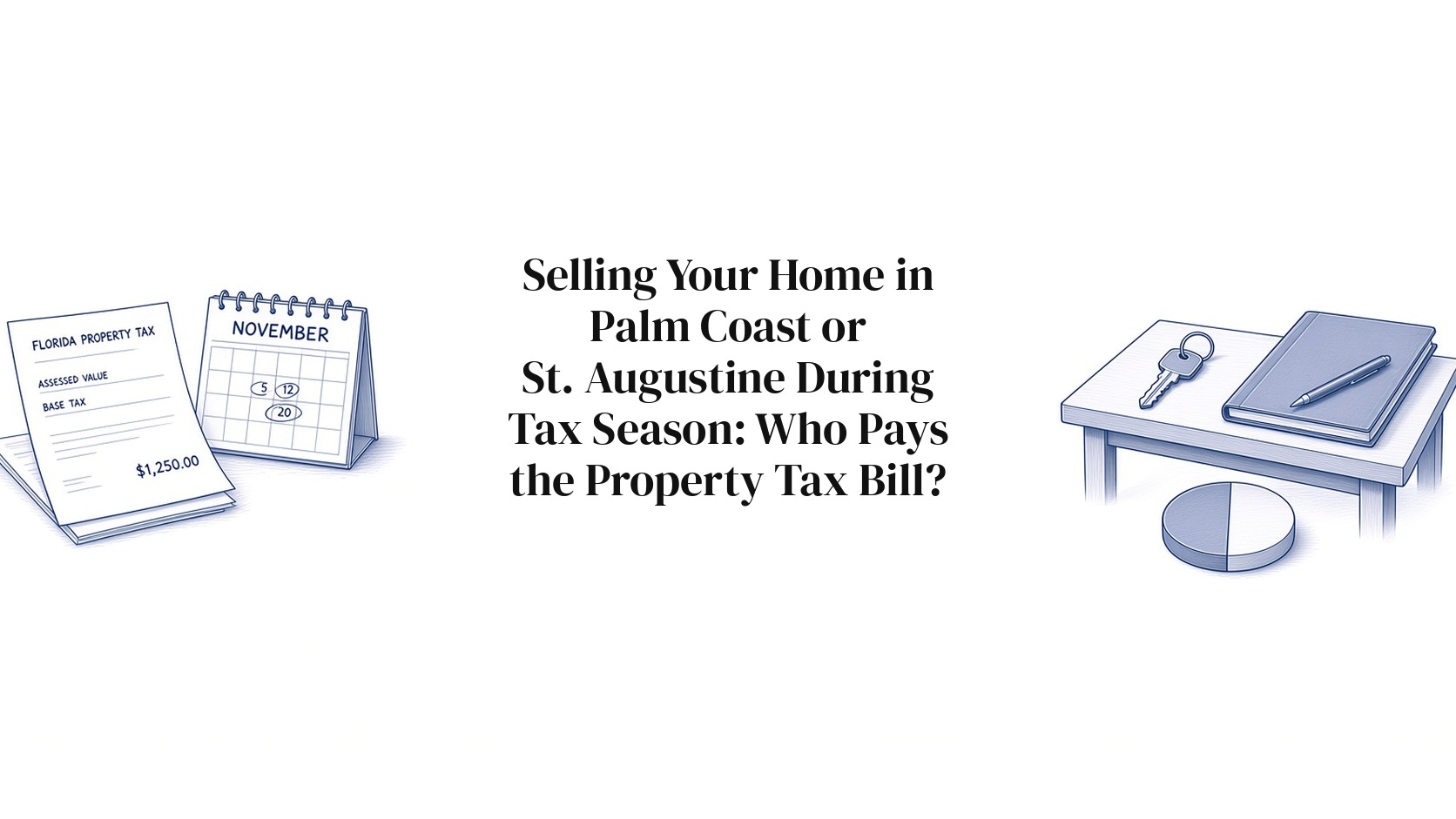
When you sell a home in Flagler or St. Johns County, you pay property taxes only for the part of the year you owned it. Florida property tax bills cover the whole calendar year, January 1 through December 31, and they’re mailed around November 1. So at closing, the taxes are usually split, or “prorated,” by day. You get charged for your days, the buyer gets a credit for them, and whoever owns the home when the bill is due pays the bill. If you’re selling right now, in the middle of tax season, there are a few extra things worth knowing.
I’m Marilynn Wolfe with LPT Realty, LLC. I help sellers in Palm Coast, Flagler Beach, St. Augustine and nearby St. Johns County. Here’s the plain version of how property taxes work when you sell.
How Florida property tax bills work
A few basics make the rest of this easier to follow.
- Bills come once a year. The Flagler County Tax Collector mails real estate tax bills on October 31. The St. Johns County Tax Collector mails them on or around November 1.
- You pay at the end of the year, not ahead of time. The bill you get in November covers January 1 through December 31 of that same year.
- Paying early earns a discount. Florida law sets the discount: 4% if you pay in November, 3% in December, 2% in January and 1% in February. There’s no discount in March.
- The bill is due by March 31. Unpaid taxes become delinquent on April 1, and in Flagler County a 3% penalty is added at that point.
- Escrow changes who writes the check. If your mortgage payment includes taxes, your lender usually requests the bill and pays it. In St. Johns County, the copy you get will say it has been forwarded to your escrow agent.
Who pays property taxes when you sell?
Both of you, each for your own share of the year.
Florida’s standard Realtor and Florida Bar purchase contracts (the “AS IS” and standard residential contracts most local sales use) prorate taxes as of the day before closing. The seller is responsible from January 1 up to the day before closing. The buyer is responsible from closing day through December 31.
Because the bill doesn’t come until November, most of the year it hasn’t been paid yet when you close. So the closing agent doesn’t send any money to the Tax Collector for you. Instead, your share shows up as a charge to you and a credit to the buyer on the closing statement. The buyer then pays the full bill when it arrives. The St. Johns County Tax Collector explains it the same way: a new owner is responsible for the full bill, and the credit on the closing statement goes to the buyer, not to the Tax Collector.
Property taxes are one piece of what closing costs sellers pay in Florida. I also walk through seller costs at closing.
Why the proration uses the discounted number
This part surprises a lot of sellers. The standard contracts say the proration allows for the “maximum allowable discount,” plus any homestead or other exemptions. The biggest discount is the 4% you get for paying in November.
So the math usually starts with the bill minus 4%, not the full amount. The title company or closing agent does the actual calculation, and you’ll see it on your closing statement before you sign.
What if this year’s bill isn’t out yet?
If you close before the new bill exists, which covers most of the year, the contract tells the closing agent what to use instead:
- The current year’s assessment with last year’s tax rate, if the new assessment is out.
- Otherwise, last year’s tax bill.
Because that’s an estimate, the standard contracts let either side ask to readjust it once the real bill comes out. That’s one reason I like my sellers to understand the tax line before closing day.
Selling in November or December: the extra wrinkle
If you’re closing right now, the current year’s bill is already out. A couple of things can happen:
- You’ve already paid it. If you paid the whole year in November, the buyer typically owes you back for their days, and that shows up as a credit to you on the closing statement.
- It’s still unpaid. Your closing agent will tell you how they’re handling it. Have them walk you through it on your closing statement so you know exactly what’s being paid and by whom.
- Your lender pays it from escrow. When your mortgage is paid off at closing, any money left in your escrow account goes back to you under the standard contract. That refund usually comes from your lender after the payoff, so it may not show on the closing statement.
If you’re out of state, this is all handled with your closing agent by phone, email and mail. You don’t need to be here.
A heads-up to pass along: the buyer’s bill may be different from yours
If you’ve had a homestead exemption for years, your tax bill may be a lot lower than a new owner’s will be. Under Florida law, a homestead’s assessed value can only go up by a capped amount each year (the “Save Our Homes” cap). After a sale, the assessment resets to market value as of January 1 of the next year.
That matters to you as a seller because buyers sometimes look at your tax bill and assume theirs will match. It usually won’t. I don’t quote anyone’s future tax bill. Instead, I point buyers to the county property appraiser’s tools and their own lender. That keeps everyone’s expectations real and protects your deal from surprises later on.
If you’re buying your next home in Florida, ask your property appraiser’s office about homestead portability. The new homestead exemption application is due March 1 of the year after you buy.
A simple checklist for sellers this tax season
- Find your bill. Look it up on the Flagler County Tax Collector or St. Johns County Tax Collector website using your address or parcel number.
- Check whether it’s paid. Know whether you paid it, your lender paid it, or it’s still open.
- Decide on the discount. If you’re paying it yourself and closing later in the year, paying in November still gets you the 4% discount. Talk with your closing agent about timing before you pay.
- Watch for your escrow refund after your mortgage is paid off.
- Read the tax line on your closing statement before closing day, and ask questions.
Every situation is a little different
Taxes on an inherited home, a rental, a property in a trust, or a home with a special assessment can work differently. This post is general information, not tax or legal advice. For your own situation, talk with your closing agent, your county Tax Collector or Property Appraiser, a CPA, or a real estate attorney.
Thinking about selling?
If you’re thinking about selling in Palm Coast, Flagler Beach, St. Augustine or nearby St. Johns County, I’ll walk you through what you’d likely net, taxes included, before you ever list. Call or text me at (904) 429-2829.
FAQ
Who pays property taxes when you sell a house in Florida?
Both the seller and the buyer pay their share. Taxes are usually prorated as of the day before closing. The seller is charged from January 1 up to the day before closing, and the buyer gets a credit for that amount. The buyer then pays the full bill when it comes out in November.
When are property tax bills mailed in Flagler and St. Johns County?
The Flagler County Tax Collector mails bills on October 31. The St. Johns County Tax Collector mails them on or around November 1. Both bills cover January 1 through December 31 of that year.
What is the property tax discount for paying early in Florida?
State law sets it at 4% in November, 3% in December, 2% in January and 1% in February. There’s no discount in March. Taxes are due by March 31 and become delinquent April 1.
Why is my tax proration less than my actual tax bill?
Standard Florida contracts prorate taxes allowing for the maximum early-payment discount, which is 4%, plus any exemptions. So the math is based on the discounted amount.
Will the buyer’s property taxes be the same as mine?
Often not. If you have a homestead exemption, the Save Our Homes cap may have kept your assessment lower. Under Florida law, the assessment resets to market value on January 1 after a sale, so the buyer’s bill can be higher.
Photo credits: Palm Coast photo: “Palm Coast Sunset” by Andyrkellergmail, Wikimedia Commons, CC BY-SA 4.0. Castillo de San Marcos photo: National Park Service (public domain).
Marilynn Wolfe, REALTOR® | Strategic Listing Agent | LPT Realty, LLC | (904) 429-2829 | Equal Housing Opportunity